110V vs 220V Welders: Which Power Input Do You Need?
Choose a 120V (110V) welder if you mainly weld sheet metal and mild steel up to 3/16 inch, as Miller lists for the Millermatic 142. Choose a 240V or dual-voltage welder if you want more thickness capacity, since Miller lists the Millermatic 211 PRO for up to 3/16 inch on 120V and up to 3/8 inch on 240V. Always check the manual for the circuit your machine requires.
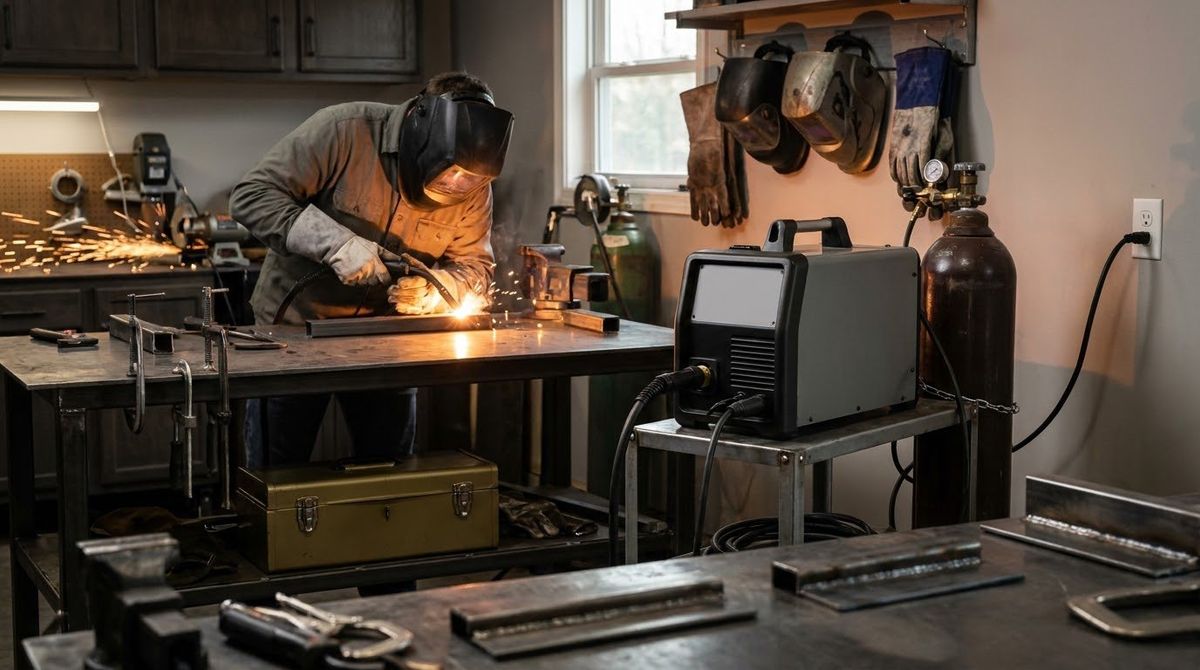
From the guide: Best Welding Machines: A Buyer's Guide for MIG, TIG, Stick, and Multi-Process
Input voltage is a major constraint on how thick a piece of metal your machine can fuse in one pass, as explained in our welding machines buyer’s guide. In North America, “110V” usually refers to standard household power around 120V, while “220V” usually refers to 230V to 240V shop power.
Choosing between them comes down to the electrical circuits you have available today, the thickness of metal you plan to weld, and how long your weld beads will be. Here is how 120V, 240V, and dual-voltage welders compare using published manufacturer specifications and electrical safety rules.
How 120V (110V) Welders Perform
A dedicated 120V welder, such as the Miller Millermatic 142, draws power from a standard single-phase circuit. That convenience makes 120V machines popular for garages, driveway repairs, and portable maintenance.
If you are weighing machines by output, the duty cycle calculator shows how a rated duty cycle changes at other amperages, and our duty cycle explainer covers how to read the rating plate.
Output and Thickness Limits
Miller lists the Millermatic 142 for a 30 to 140 A output range, rated 100 A at 19 V at 60% duty cycle (80 A at 18 V at 100% duty cycle), welding mild steel from 24 gauge to 3/16 inch in a single pass. Miller lists the Millermatic 211 PRO at 110 A at 120V, and ESAB lists a 130 A, 20% duty cycle rating on 120V for the Rebel EMP 215ic. These published figures show that rated output on 120V is limited compared with the same machines on 240V.
ESAB’s Rebel EMP 215ic also lists a stick range of 6 to 130 A and a DC TIG range of 5 to 130 A on 120V, compared with 16 to 180 A for stick and 5 to 200 A for TIG on 230V.
Check the Circuit Before You Plug In
Many homeowners assume any wall outlet will run a 120V welder, then trip the breaker mid-bead. Input current varies by model. ESAB, for example, lists a 28.6 A maximum primary current and 18 A effective primary current at 120V for the Rebel EMP 215ic. Always read the circuit and breaker requirements in your machine’s manual, and have a qualified electrician check or install the circuit if you are unsure.
How 240V Welders Perform
Stepping up to 230V/240V single-phase power lets the same machine deliver more output. Manufacturer ratings show the difference.
Real-World Output Gains
Look at how published ratings change from 120V to 230V/240V:
- Miller Millermatic 211 PRO: Rated 110 A at 19.5 V at 60% duty cycle on 120V and 160 A at 22 V at 60% duty cycle on 240V. Miller says it can weld up to 3/16-inch material at 120V and up to 3/8-inch material at 240V.
- ESAB Rebel EMP 215ic: MIG setting range of 15 to 130 A on 120V and 15 to 235 A on 230V, with 235 A rated at 15% duty cycle on 230V. ESAB lists a maximum plate thickness of 3/8 inch.
If you are shopping for a machine that scales with your shop, see our best MIG welders for beginners and best TIG welders comparisons.
Dual-Voltage (120V / 240V) Welders
Many modern inverter welders accept either input voltage. Miller lists the Millermatic 211 PRO, Multimatic 215 and Thunderbolt 160 for both 120V and 240V input, with the Thunderbolt 160 using a multi-voltage plug. You get two machines in one:
- At a friend’s house or jobsite: Run on 120V to tack body panels, repair a gate hinge, or weld thin brackets, within the machine’s lower 120V output.
- In your home shop: Run on 240V for the higher rated output and the thicker plate capacity the manufacturer lists.
Dual-voltage machines usually require a different plug or adapter for each voltage, so check the manual to see how your machine is configured and which plug it needs.
Running a 120V or 240V Welder on a Generator
If you plan to weld away from shop power, such as repairing a tractor implement or fence gate in the field, confirm generator compatibility in your welder’s owner’s manual before plugging in. Miller says its 9,500-watt Bobcat 265 engine-driven welder-generator provides enough power for full output from most Millermatic or Multimatic welders, while the Millermatic 255 and Multimatic 255 require a 12,000-watt engine-driven welder to provide full output. ESAB lists a recommended generator of 8.2 kVA / 8.0 kW for the Rebel EMP 215ic. Always follow the generator and welder manuals for required output and power quality.
Plugs, Breakers and Electrical Code (YMYL)
Wiring a 240V welder outlet is not a casual DIY task. The National Electrical Code and local codes govern welder branch circuits, and the manufacturer’s manual specifies the plug, circuit and overcurrent protection for your machine. Hire a licensed electrician for any new circuit.
Plug Types Vary by Machine
ESAB lists a NEMA 6-50P supply plug for the Rebel EMP 215ic at 230V and supplies an adapter from NEMA 6-50R to NEMA 5-15P for 120V use. Other machines use different plugs and cord sets, so do not assume your welder uses a particular receptacle. Never modify a welder’s plug or force it into a mismatched outlet, including a dryer outlet, unless the manual and a licensed electrician confirm it is permitted.
Read the Specification Plate
Compare the rated input current on the specification plate or in the manual with your circuit. ESAB publishes both Imax (maximum) and Ieff (effective) primary current for the Rebel EMP 215ic, which shows that the current a welder draws depends on the output and duty cycle you use. Use the manual’s guidance to select wire size and breaker rating rather than rules of thumb.
Electrical and Welding Safety Checklist (YMYL)
Before connecting any 120V or 240V welder, follow OSHA 29 CFR 1910.252 and the manufacturer’s electrical warnings:
- Qualified electrical work: Have all 240V receptacles, breakers, and subpanels installed by a licensed electrician in compliance with the National Electrical Code and local codes.
- Disconnect before servicing: Disconnect input power before opening a welder’s case or changing power cord connections, as your manual instructs.
- Inspect cords and ground clamps: Never operate a welder with frayed insulation, missing ground prongs, or loose work clamps.
- Avoid wet environments: Keep floors dry, wear dry gloves and insulating footwear, and never weld while standing in water.
- Standard PPE and ventilation: Pair a proper electrical setup with a welding helmet fitted with the filter lens OSHA specifies for your process, flame-resistant clothing, adequate ventilation, and combustibles relocated at least 35 feet from the work site where practicable (OSHA 1910.252(a)). OSHA 1926.350 requires gas cylinders to be secured upright.
Disclaimer: Electrical installation information is educational only and does not replace the National Electrical Code, local building codes, your welder’s owner’s manual, or a licensed electrician.
Next Steps
Ready to match your shop power to a machine or process? Check our welding safety and PPE guide and use the amps-by-thickness reference and run your numbers through our welder duty cycle and amperage calculators.
| Specification | 120V Dedicated (Millermatic 142) | Dual-Voltage (Millermatic 211 PRO) | Dual-Voltage (ESAB Rebel EMP 215ic) |
|---|---|---|---|
| Input Voltage | 110/115/120 V | 120/240 V | 120/230 VAC |
| Rated Output | 100 A at 19 V, 60% | 110 A (120 V) / 160 A (240 V), 60% | 130 A at 20.5 V, 20% (120 V) / 235 A at 26 V, 15% (230 V) |
| Output Range | 30-140 A | 30-230 A | MIG 15-130 A (120 V) / 15-235 A (230 V) |
| Mild Steel Capacity | 24 ga. to 3/16 in. | 24 ga. to 3/8 in. (3/16 in. on 120V per Miller guide) | Up to 3/8 in. plate |
| Input Current | See manual | See manual | Imax 28.6 A (120 V) / 30 A (230 V) |
A dual-voltage machine gives the most thickness capacity per machine if you can supply 240V, while a dedicated 120V machine is enough for 3/16-inch steel and thinner. In either case, follow the manual's circuit requirements and have a qualified electrician install any new receptacle.
Questions we get
Can a 110V welder run on a 15-amp household outlet?
Check your machine's manual for the required circuit. Input current varies by model, and ESAB, for example, lists a 28.6 A maximum primary current for the Rebel EMP 215ic at 120 V, which exceeds a 15 A or 20 A circuit rating at full output. A supplied 5-15P adapter exists for that machine, but available output may be limited, so follow the manufacturer's instructions.
How thick can a 110V welder weld?
Miller lists the 120V Millermatic 142 for mild steel from 24 gauge to 3/16 inch in a single pass, and says the Millermatic 211 PRO can weld up to 3/16 inch at 120V and up to 3/8 inch at 240V. Check the published thickness capacity for your model and input voltage, and use multiple passes with joint preparation for thicker material.
What plug does a 220V welder use?
It depends on the machine, so check the manual. ESAB lists a NEMA 6-50P supply plug for the Rebel EMP 215ic at 230 V, and ships a power cable adapter from NEMA 6-50R to NEMA 5-15P for 120 V. Never alter a welder's plug yourself; have a qualified electrician install a receptacle that matches the plug and the manual.
Can I use an extension cord with a 110V or 220V welder?
Follow your welder's owner's manual. Undersized or overly long extension cords can overheat and reduce available voltage at the machine, so many manuals specify limits or prohibit extension cords. If the manual allows one, use only the wire gauge and maximum length it specifies, and inspect the cord for damage before every use.
Are dual-voltage welders as good as dedicated 220V welders?
They share the same listed capability on 240V input, but not on 120V. Miller lists the Millermatic 211 PRO at 110 A on 120 V and 160 A on 240 V, so output rises with voltage. Compare the rated output, duty cycle and thickness capacity the manufacturer lists at the voltage you will actually use.
Can I plug a 220V welder into a dryer outlet?
Do not adapt a welder to a dryer outlet without confirming it is permitted. Your welder's manual specifies the required plug, circuit and overcurrent protection, and a dryer circuit may not match them. Have a licensed electrician install a receptacle and breaker that meet the National Electrical Code, local codes and the manufacturer's instructions.
Where we got this
- Miller Electric Millermatic 142 Product Page (millerwelds.com)
- Miller Electric Millermatic 211 PRO Product Page (millerwelds.com)
- ESAB Rebel EMP 215ic Fact Sheet (assets.esab.com)
- Miller Electric: Buying Your First Welder — A Practical Guide for Do-It-Yourselfers (millerwelds.com)
- OSHA 29 CFR 1910.252 — Welding, Cutting, and Brazing General Requirements (osha.gov)
- OSHA 29 CFR 1926.350 — Gas welding and cutting (cylinder handling) (osha.gov)
Keep reading
- Best Welding Machines: A Buyer's Guide for MIG, TIG, Stick, and Multi-Process
Compare MIG, TIG, stick, and multi-process welding machines by duty cycle, 110V vs 220V input power, amperage range, and shop use.
- Best MIG Welders for Beginners
Compare MIG welders for beginners on input voltage, duty cycle, amperage range, and thickness capacity using manufacturer specs.
- Best TIG Welders: What to Look For and Top Picks
Compare the best AC/DC TIG welders on amperage range, high-frequency start, pulse control, duty cycle, and input voltage using manufacturer specs.
- Welder Duty Cycle Explained: Weld and Rest Minutes
Duty cycle is the share of 10 minutes a welder can run at rated output. Learn the formula, read a rating plate and find your weld and rest minutes.