Best Welding Machines: A Buyer's Guide for MIG, TIG, Stick, and Multi-Process
The best welding machine for your shop depends on the metals you weld, your available 120V or 240V electrical service, and how long you run continuous beads. Beginners and general fabricators usually start with a MIG or multi-process inverter welder, precision aluminum and stainless fabricators choose an AC/DC TIG machine, and outdoor repair welders rely on stick units.
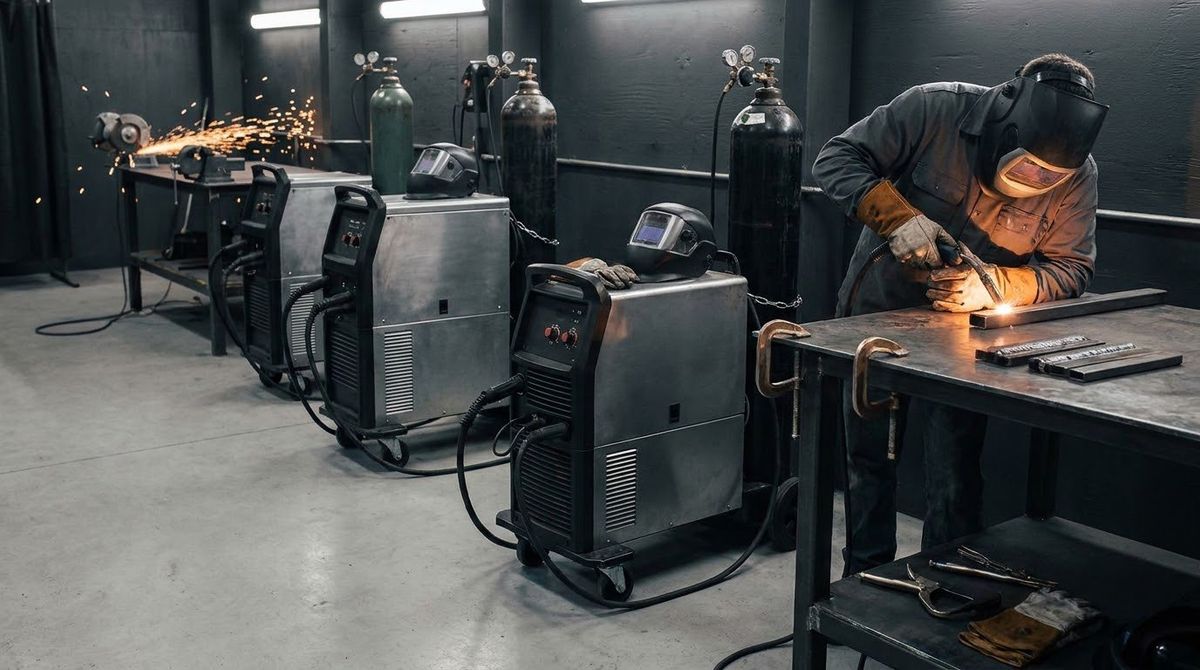
Buying a welding machine starts with matching the power source to the metal you plan to join, the electrical service in your shop, and how many minutes of continuous arc time your projects demand. Welding machines are commonly grouped into four categories—MIG, TIG, stick, and multi-process—each with a different balance of ease of use, portability, and finish quality.
This guide explains the specifications that matter, so you can compare machines against the manufacturer’s own spec sheets. Before comparing specifications, make sure your workspace meets baseline welding safety and PPE requirements, including proper ventilation, arc-flash protection, and circuit grounding.
How Welding Machines Work: Constant Voltage vs. Constant Current
Every arc welding machine regulates electricity differently depending on the process it supports. Understanding the difference between constant voltage (CV) and constant current (CC) power sources explains why a basic MIG welder cannot run stick electrodes effectively and why a dedicated stick welder needs a different feeder setup for wire.
- Constant Voltage (CV) machines hold arc voltage steady while automatically varying amperage as the wire feeds into the puddle. MIG (GMAW) and flux-core (FCAW) machines use CV output so that small changes in your hand distance do not extinguish the arc.
- Constant Current (CC) machines hold amperage steady while allowing voltage to fluctuate slightly as you move the electrode closer to or farther from the workpiece. Stick (SMAW) and TIG (GTAW) machines use CC output for stable penetration and precise heat control.
- Multi-process inverter machines switch electronically between CV and CC output curves inside one chassis, giving a single unit the ability to feed wire and run stick or TIG electrodes.
If you are still deciding which arc method fits your work, explore our types of welding processes guide or run your project specs through the welding process picker.
MIG Welders: Best for Beginners and General Fabrication
Gas Metal Arc Welding (GMAW), commonly called MIG welding, is the fastest and most approachable process for new welders, automotive restorers, and general steel fabricators. A motorized drive system pushes a continuous solid wire electrode through a handheld gun while shielding gas flows around the molten puddle to block atmospheric contamination.
Why Beginners and Home Shops Choose MIG
Because the wire feeds automatically at a preset speed, you only need to control gun angle, travel speed, and stickout distance. Modern entry-level MIG machines from major manufacturers include preset parameter charts or digital auto-set controls that pair wire diameter and material thickness to starting voltage and wire feed speed.
Most light-to-medium MIG machines also support polarity reversal so you can run self-shielded flux-core wire without a gas cylinder. That dual capability lets you weld clean sheet metal indoors with shielding gas and switch to flux-core wire for breezy outdoor gate or trailer repairs. See our beginner-friendly MIG welder comparison for a deeper breakdown of wire-feed features, and review our learning MIG from scratch tutorial to learn proper gun technique.
Key MIG Machine Specs to Check
- Wire spool capacity: Compact machines accept small spools while larger shop units accept bigger spools that usually lower your cost per pound of wire; check the spool sizes listed in the machine’s manual.
- Drive roll quality: Look for cast-aluminum or heavy-duty drive assemblies rather than flex-prone plastic housings, especially if you plan to run flux-core or aluminum wire.
- Spool gun readiness: Welding aluminum with a standard push-style MIG gun often causes bird-nesting because soft aluminum wire kinks inside long liners. Machines wired for a plug-and-play spool gun feed aluminum reliably from the gun itself.
- Gas solenoid and regulator: Confirm whether the machine ships with a built-in gas solenoid valve and flowmeter regulator or requires a conversion kit.
TIG Welders: Best for Precision, Stainless Steel, and Aluminum
Gas Tungsten Arc Welding (GTAW), or TIG welding, uses a non-consumable tungsten electrode to establish an arc while you feed filler rod manually with your other hand and modulate amperage with a foot pedal or fingertip control. It produces the cleanest, most controllable welds with zero spatter, making it the standard for thin sheet metal, exhaust tubing, sanitary stainless, and aerospace or motorsport fabrication.
DC TIG vs. AC/DC TIG Machines
Not all TIG machines weld the same metals. Choosing between a DC-only machine and an AC/DC machine is the single biggest decision in this category:
- DC TIG welders operate on Direct Current Electrode Negative (DCEN). They excel on carbon steel, chromoly, stainless steel, copper, and titanium, but they cannot break up the high-melting-point oxide layer on aluminum.
- AC/DC TIG welders alternate current polarity rapidly during AC mode, using the positive half-cycle to clean aluminum oxide and the negative half-cycle to penetrate the base metal. If aluminum fabrication is on your project list, an AC/DC machine is mandatory.
TIG Features That Matter on the Shop Floor
When comparing the best TIG welders, pay close attention to arc-starting methods and pulse controls:
- High-frequency (HF) start vs. lift-arc start: Entry-level multi-process machines usually offer lift-arc DC TIG, where you touch the tungsten lightly to the workpiece and lift to strike the arc. Dedicated TIG machines add non-contact high-frequency start, which prevents tungsten contamination and pairs with a foot pedal.
- Post-flow and pre-flow gas timers: Shielding gas must protect the hot tungsten electrode and weld puddle after the arc stops. Adjustable post-flow timers prevent tungsten oxidation and brittle weld craters.
- Pulse capability: Pulse TIG alternates between peak welding current and background cooling current, reducing heat input and warping on thin stainless steel or tight edge joints.
For technique and filler-rod pairing, read our TIG basics and MIG and TIG side by side.
Stick Welders: Best for Heavy Steel, Rust, and Outdoor Work
Shielded Metal Arc Welding (SMAW), or stick welding, uses a flux-coated consumable rod held in an electrode stinger. As the arc melts the core wire, the flux coating vaporizes to form a shielding gas cloud and a protective slag crust over the cooling weld bead.
Because stick welding needs no external gas bottle, wind will not blow away your shielding protection. It remains the workhorse process for farm equipment repair, structural steel erection, pipeline work, and thick plate fabrication where mill scale, paint, or light rust cannot be ground completely bright.
What to Look For in a Stick Machine
- Open-circuit voltage (OCV) and arc force: Higher open-circuit voltage makes striking stubborn electrodes easier. Adjustable arc force (or “dig”) boosts amperage momentarily when the arc shortens so the rod does not stick to the puddle.
- AC vs. DC stick output: Basic AC buzz-box transformers are inexpensive and reliable for general farm repair using AC-compatible rods like E6011 or E6013. DC stick inverters produce a smoother arc, less spatter, and better compatibility with low-hydrogen E7018 structural electrodes.
- Hot start: A brief amperage surge at arc initiation helps light the rod cleanly without leaving cold start defects.
Learn rod selection and arc control in our stick welding guide and welding rods and electrodes guide.
Multi-Process Welders: One Machine for Mixed Shop Work
Multi-process inverter welders combine MIG, flux-core, DC stick, and DC TIG capabilities in a single portable enclosure. Instead of buying and storing three separate power sources, you swap the lead connections, select the process on the front panel, and weld.
Advantages and Trade-Offs of Multi-Process Units
- Space and budget efficiency: For a home garage, maintenance shop, or mobile repair rig, one dual-voltage multi-process machine costs less and occupies far less floor space than three standalone units.
- Process compromises: Most mid-priced multi-process machines use lift-arc DC TIG rather than high-frequency AC/DC TIG. That makes them strong for steel and stainless TIG work, while aluminum still requires adding a MIG spool gun or stepping up to an AC/DC multi-process unit.
- Accessory readiness: Check what comes in the box. Some multi-process packages include the MIG gun and stick stinger but sell the TIG torch, foot pedal, and gas regulator separately.
110V vs. 220V Input Power: Matching Your Shop Electrical Service
Electrical input power dictates how thick a metal a welder can penetrate in a single pass and how hard you can push it before tripping a breaker. Manufacturers rate small machines for 120V (often called 110V or 115V) household outlets, heavy machines for 240V (220V or 230V) dedicated circuits, and versatile inverters as dual-voltage units that automatically adapt to either plug.
What 120V Circuits Can and Cannot Do
A standard 120V, 15-amp or 20-amp household circuit limits total input watts. On 120V power, machines are limited to thinner material than on 240V. Miller, for example, rates its Millermatic 211 PRO for up to 3/16-inch steel on 120V versus 3/8-inch on 240V, so check the rated thickness for the specific model. That is enough for automotive sheet metal, exhaust tubing, and light brackets. Running a 120V welder on an undersized or long extension cord causes voltage drop, erratic arc starts, and nuisance breaker trips.
Why 240V Power Unlocks Structural Thickness and Duty Cycle
Connecting a dual-voltage or dedicated 240V machine to a 240V circuit lets the power source draw the same power at half the current, which allows higher maximum weld output. Use the breaker and receptacle size in the machine’s manual, and have a licensed electrician install any new circuit. That extra headroom allows thicker material to be welded and supports higher duty cycles.
Compare outlet requirements, breaker sizing, and voltage-drop considerations in our 110V vs. 220V welders guide.
Understanding Duty Cycle and Amperage Range
Two nameplate numbers determine whether a welding machine fits your workload: amperage range (its minimum and maximum output) and duty cycle (how long it can sustain that output).
How Duty Cycle Works
Duty cycle is standardized on a 10-minute cycle. A machine rated at 20% duty cycle at 150 amps can weld continuously for 2 minutes out of every 10 minutes at 150 amps, and must rest with its cooling fan running for the remaining 8 minutes. If you exceed that limit, the internal thermal overload sensor shuts down output until temperatures drop.
Crucially, duty cycle rises as you turn the amperage down. A machine rated at 20% at 150 amps will have a higher duty cycle at lower amperage; the spec sheet lists the rating at several output levels. Read welder duty cycle explained for weld and rest minutes, and use our welder duty cycle calculator to estimate allowable arc-on minutes at your actual working amperage, and check starting parameters with the welding amperage calculator.
Why the Minimum Amperage Floor Matters
Buyers often fixate on maximum amperage while ignoring the minimum floor. If you restore auto body panels or weld thin-gauge tubing, a machine with a high minimum output can burn holes through thin metal. Compare the minimum amperage on the spec sheets of the machines you are considering when thin-gauge work is part of your plan.
Inverter vs. Transformer Welding Machines
Inside the cabinet, welding power sources fall into two electrical architectures:
- Transformer-rectifier machines step down line voltage using large, heavy copper or aluminum coils. They are durable, tolerate dusty shop floors, and have fewer circuit boards to repair, though they weigh significantly more and draw higher idle power.
- Inverter machines rectify AC line power to DC, switch it at high frequency through solid-state semiconductors, and step it down through a compact transformer. They weigh a fraction of transformer units, deliver smoother arc characteristics, support dual-voltage sensing, and consume less electricity—making them the standard choice for modern home, mobile, and multi-process welders.
Essential Accessories and Consumables to Budget For
The sticker price of a welding machine rarely covers everything needed to strike your first arc safely. Before finalizing your budget, plan for:
- Auto-darkening welding helmet and PPE: Never weld without an ANSI-compliant helmet rated for your process and amperage, flame-resistant clothing, and leather welding gloves. See our best welding helmets guide.
- Shielding gas cylinder: Solid-wire MIG and all TIG welding require compressed shielding gas (such as 75% Argon / 25% CO2 for steel MIG or 100% Argon for TIG). Factor in cylinder purchase or lease costs and safe upright securing per welding safety guidelines.
- Filler metals and wear parts: Stock matching contact tips, nozzles, drive rolls, tungsten electrodes, and wire or stick rods from our welding supplies and consumables guide.
- Dedicated circuit or adapter: Verify your shop receptacle matches the machine’s plug configuration (such as NEMA 5-15/5-20 for 120V or NEMA 6-50 for 240V) and consult a licensed electrician before adding new shop circuits.
Electrical and Shop Safety When Buying and Installing a Welder
Under OSHA 29 CFR 1910.254, the frame or case of a welding machine (except engine-driven machines) must be grounded, cables with damaged insulation or exposed conductors must be replaced, and a machine that has become wet must be thoroughly dried and tested before use. ANSI Z49.1 and the manufacturer’s manual add installation and operating requirements. Never remove the grounding prong on a power cord, never operate a welder in standing water or rain, and inspect electrode holders, work clamps, and power cables for cracked insulation before every session. Keep flammable materials clear of the spark zone and ensure adequate ventilation—especially when welding galvanized, stainless, or coated metals. Review full hazard controls in our welding fume safety and ventilation and welding fire safety and hot work guides.
Buying by Shop Scenario: Which Machine Fits You?
Even with specifications in front of you, narrowing down the right category is easier when you match the machine to your real-world shop setup:
- Home garage and DIY repairs (120V or dual-voltage): A dual-voltage 120V/240V MIG or multi-process inverter lets you start welding on a standard 120V garage outlet right away, then unlock higher amperage and duty cycle later if you install a 240V receptacle. Focus on wire-feed smoothness, a low minimum amperage floor for sheet metal, and clear parameter charts.
- Automotive restoration and exhaust work: Auto body panels demand low-amperage control so you do not blow holes through 18- to 22-gauge sheet metal. A short-circuit MIG machine running .023” or .024” solid wire—or a TIG welder with a foot pedal for stainless exhausts and aluminum intercoolers—gives you the cleanest results with minimal warpage.
- Farm, ranch, and mobile field repair: Heavy equipment breaks outdoors, often coated in grease, paint, or rust. A portable DC stick inverter or self-shielded flux-core machine ignores wind and tolerates imperfect metal prep without hauling fragile shielding-gas cylinders across a field.
- Dedicated fabrication or motorsport shop (240V): When you weld all day on structural frames, aluminum brackets, or sanitary stainless tubing, prioritize 240V input power, a duty cycle that matches your working amperage, high-frequency AC/DC TIG capability, and cast-metal wire drive assemblies built for 8-inch or 12-inch spools.
Next Steps: Pick Your Machine Category
- Choose a MIG or flux-core unit if you want the fastest learning curve for mild steel repairs, brackets, and automotive work—start with our top-rated beginner MIG machines.
- Choose a TIG machine if your priority is clean, spatter-free welds on thin stainless steel or aluminum—see our TIG welder reviews guide.
- Check your shop outlets first using our 110V vs. 220V welders breakdown so your new machine plugs in safely on day one.
| Machine Type | Primary Processes | Best Material Fit | Learning Curve | Outdoor Tolerance |
|---|---|---|---|---|
| MIG Welder (CV) | GMAW, FCAW | Mild steel, stainless, aluminum (with spool gun) | Low — easiest wire-feed start | Poor with gas; good with self-shielded flux-core |
| TIG Welder (CC) | GTAW, often DC Stick | Thin steel, stainless steel, aluminum (AC/DC units) | High — two-hand filler and pedal control | Poor — shielding gas blows away easily |
| Stick Welder (CC) | SMAW | Thick structural steel, rusty or painted iron | Moderate — arc striking and slag control | Excellent — no external shielding gas required |
| Multi-Process Welder | MIG, Flux-Core, DC Stick, DC TIG | Mixed shop repairs, steel and stainless | Low to moderate depending on process | Good when switched to Stick or flux-core |
Choose a 120V/240V MIG or multi-process inverter for general garage fabrication, an AC/DC TIG welder for thin precision aluminum and stainless work, and a dedicated stick machine for heavy outdoor repair.
All Welding Machines guides
- 110V vs 220V Welders: Which Power Input Do You Need?
Compare 110V (120V) and 220V (240V) welders on thickness capacity, duty cycle, circuit breakers, NEMA 6-50 plugs, and dual-voltage options.
- Best MIG Welders for Beginners
Compare MIG welders for beginners on input voltage, duty cycle, amperage range, and thickness capacity using manufacturer specs.
- Best TIG Welders: What to Look For and Top Picks
Compare the best AC/DC TIG welders on amperage range, high-frequency start, pulse control, duty cycle, and input voltage using manufacturer specs.
- Welder Duty Cycle Explained: Weld and Rest Minutes
Duty cycle is the share of 10 minutes a welder can run at rated output. Learn the formula, read a rating plate and find your weld and rest minutes.
Questions we get
What is the best type of welding machine for a beginner?
A wire-feed MIG welder is the easiest machine for most beginners to learn because the machine feeds filler wire automatically while you focus on travel speed and gun angle. Many entry-level MIG units also run self-shielded flux-core wire, letting you weld outdoors without a shielding gas cylinder.
What does duty cycle mean on a welding machine?
Duty cycle is the percentage of a 10-minute interval that a welder can run continuously at a specified amperage before needing to cool down. For example, a 20 percent duty cycle at 150 amps means two minutes of arc-on time followed by eight minutes of cooling.
Do I need a 110V or 220V welding machine for a home garage?
A 120V (commonly called 110V) welder works well for thin sheet metal and light repairs on standard household outlets. If you plan to weld thicker steel plate or run longer beads without tripping breakers, a 240V (220V) or dual-voltage machine provides higher output and better duty cycle.
Can a multi-process welder TIG weld aluminum?
Most compact multi-process welders only provide DC TIG output, which welds carbon steel and stainless steel but cannot properly clean the oxide layer on aluminum. To TIG weld aluminum, you need an AC/DC TIG machine or a MIG welder equipped with an aluminum spool gun.
Are inverter welding machines better than transformer machines?
Inverter welders convert incoming AC power electronically, making them much lighter, more portable, and more energy-efficient than heavy copper-wound transformer machines. They also support dual-voltage input and smoother arc control. Transformer welders remain rugged for stationary shop work, while inverters dominate modern home, mobile, and multi-process setups.
What safety standards apply when setting up a welding machine?
Follow the manufacturer's manual, OSHA 29 CFR 1910.254 (which requires welding machine frames to be grounded), and ANSI Z49.1. Always verify circuit breaker ratings, inspect cables for damaged insulation, keep the work clamp close to the weld zone, and wear proper eye and fume protection.
Where we got this
- Buying Your First Welder: A Practical, Informative Guide for Do-It-Yourselfers — MillerWelds (millerwelds.com)
- Understanding Common Welding Terms — A Guide for Beginners — MillerWelds (millerwelds.com)
- OSHA 29 CFR 1910.254 — Arc Welding and Cutting (osha.gov)
- American Welding Society — Free Welding Resources & Safety Guides (ANSI Z49.1) (aws.org)
- ESAB University — Welding & Cutting Technical Content (esab.com)
Keep reading
- 110V vs 220V Welders: Which Power Input Do You Need?
Compare 110V (120V) and 220V (240V) welders on thickness capacity, duty cycle, circuit breakers, NEMA 6-50 plugs, and dual-voltage options.
- Best MIG Welders for Beginners
Compare MIG welders for beginners on input voltage, duty cycle, amperage range, and thickness capacity using manufacturer specs.
- Best TIG Welders: What to Look For and Top Picks
Compare the best AC/DC TIG welders on amperage range, high-frequency start, pulse control, duty cycle, and input voltage using manufacturer specs.
- Welder Duty Cycle Explained: Weld and Rest Minutes
Duty cycle is the share of 10 minutes a welder can run at rated output. Learn the formula, read a rating plate and find your weld and rest minutes.