Welding Safety and PPE: Fumes, Arc Flash, Shock, Fire and Gas Cylinders
Safe welding requires controlling five core hazards—toxic fumes, ultraviolet/infrared arc radiation, electric shock, fire and hot slag, and high-pressure gas cylinders—using engineering controls and ANSI-rated PPE. Follow OSHA 29 CFR 1910 Subpart Q, ANSI Z49.1, and NFPA 51B: ventilate plumes away from your breathing zone, wear a properly shaded helmet and flame-resistant gear, keep dry insulation against shock, clear combustibles 35 feet, and chain cylinders upright.
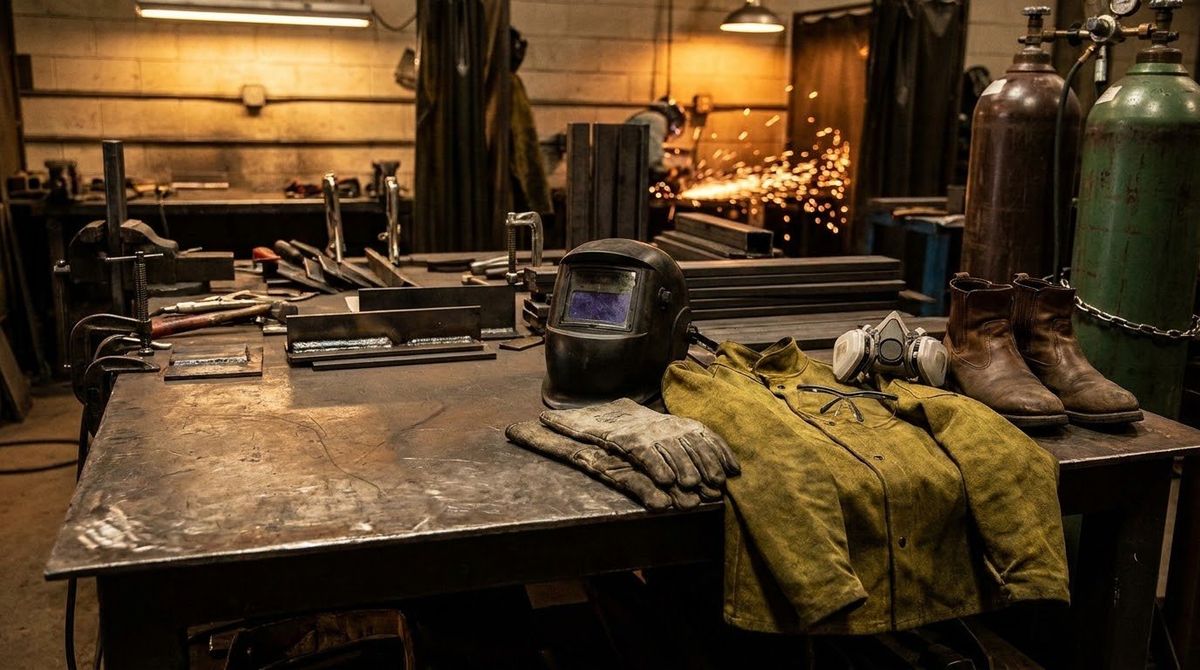
Safety Disclaimer: This guide provides educational safety information based on OSHA 29 CFR 1910 Subpart Q, ANSI Z49.1, and NFPA 51B. It is not a substitute for your equipment owner’s manual, workplace safety rules, or hands-on instruction from a qualified safety professional.
Welding concentrates extreme heat, blinding ultraviolet radiation, electrical current, airborne metal fumes, and high-pressure gases into a small workspace. Every incident is preventable when you treat hazard control as part of your setup routine rather than an afterthought.
Federal workplace rules in OSHA 29 CFR 1910 Subpart Q (sections 1910.252–1910.254) and the American Welding Society’s consensus standard ANSI Z49.1 (Safety in Welding, Cutting, and Allied Processes) organize welding safety around five primary hazards: fumes and gases, arc radiation, electric shock, fire and hot work, and compressed-gas cylinders.
1. Welding Personal Protective Equipment (PPE) Checklist
PPE is your last line of defense after engineering controls like ventilation and fire barriers are in place. Never strike an arc—even for a quick tack weld—without full protection:
- Welding helmet with proper filter shade: Must comply with ANSI Z87.1 and block ultraviolet (UV) and infrared (IR) rays. Auto-darkening helmets react in fractions of a millisecond, while passive fixed-shade helmets use a dark glass filter. Compare features in our helmet recommendations guide.
- Safety glasses with side shields: Always wear clear or lightly tinted ANSI Z87.1 impact-rated safety glasses under your welding hood to protect your eyes from flying slag, wire ends, and grinding sparks when the hood is raised.
- Flame-resistant (FR) clothing: Wear heavy cotton, wool, or FR-treated jackets and leather aprons/sleeves. Never wear synthetic fabrics (polyester, nylon, or fleece), which melt onto skin when hit by sparks. Keep shirt collars buttoned, pockets buttoned or flap-covered, and pant legs uncuffed over boots so slag cannot pool inside.
- Dry leather welding gloves: Use thick, insulated gauntlet gloves for Stick and MIG, and thinner, dexterous leather gloves for TIG. Replace gloves immediately if they become wet, oil-soaked, or torn.
- High-top leather boots and hearing protection: Steel-toe or composite-toe leather boots protect against falling plate and hot spatter; earplugs or earmuffs guard against grinder noise and overhead spatter entering the ear canal.
2. Welding Fumes, Gases, and Ventilation
Arc welding vaporizes base metals, filler wires, flux coatings, and surface residues into a rising plume of microscopic particles and toxic gases. According to OSHA 29 CFR 1910.252(c) and NIOSH occupational health guidance, chronic inhalation of welding fumes can damage the lungs, kidneys, and central nervous system.
High-Risk Metals and Coatings
- Manganese: Present in most carbon-steel filler wires and electrodes; overexposure can cause manganism, a disabling neurological condition with Parkinson’s-like symptoms.
- Stainless steel and high-chrome alloys: Release hexavalent chromium, a known carcinogen requiring strict exposure monitoring and specialized ventilation.
- Galvanized (zinc-coated) steel: Produces zinc oxide fumes that cause metal fume fever—a flu-like illness with chills and fever. Remove coatings from the weld zone where practical and use source-capture ventilation.
- Lead, cadmium, beryllium, and chlorinated solvents: Welding on painted/plated metals or near degreasing solvents (which can decompose into toxic gases under UV arc light) can cause severe acute poisoning. Clean parts thoroughly and keep solvents completely away from welding arcs.
How to Control Fume Exposure
Follow the NIOSH Hierarchy of Controls:
- Position your head out of the plume: Never lean directly over the weld puddle; work from the side so natural drafts carry fumes away from your helmet.
- Use Local Exhaust Ventilation (LEV): Portable fume extractors, downdraft tables, or fume-extraction MIG guns capture contaminants right at the arc before they reach your breathing zone.
- Maintain general air circulation: Avoid welding in unventilated garages, basements, or confined spaces. Confined spaces require continuous mechanical ventilation, air monitoring, and an outside attendant under OSHA 1910.252(c)(4).
- Wear a properly fitted respirator: When engineering controls cannot keep exposures below occupational limits, use a NIOSH-approved particulate/fume respirator (for example a particulate respirator or a powered air-purifying respirator, selected for the contaminants present) within a formal respiratory program.
Read our full breakdown in welding fume safety and ventilation.
3. Arc Eye (Welder’s Flash) and Radiation Protection
Welding arcs emit intense ultraviolet (UV), visible light, and infrared (IR) radiation. Even a brief accidental flash from across a shop—or reflected off a bright wall—can burn the cornea, causing photokeratitis (“arc eye”), which feels like sand in the eyes hours after exposure.
Filter Shade Selection and Bystander Shielding
- Match shade to process and amperage: OSHA 1910.252(b) lists shade 4 to 8 for gas welding (4 or 5 light, 5 or 6 medium, 6 or 8 heavy), shade 3 or 4 for torch brazing, and shade 10 to 14 for shielded metal-arc welding depending on electrode size (shade 10 for up to 5/32-inch electrodes, 12 for 3/16 to 1/4 inch, 14 for 5/16 and 3/8 inch). Gas-shielded arc welding is listed at shade 11 (nonferrous) and 12 (ferrous) for the same smaller electrode sizes. Larger electrodes and higher current call for a darker shade; confirm against the helmet manufacturer’s chart.
- Protect exposed skin: UV radiation causes severe sunburn-like burns on bare necks, wrists, and forearms within minutes. Cover every inch of skin.
- Shield bystanders: Install flame-resistant welding curtains or screens around your work bay so coworkers and family members never catch stray arc flashes.
4. Electric Shock Prevention
Every arc welding machine carries enough electrical potential to cause fatal shock—especially the open-circuit voltage present when the machine is switched on and waiting to strike an arc. Under OSHA 29 CFR 1910.254, safe electrical practice relies on dry insulation and intact equipment:
- Keep yourself dry and insulated: Never weld while standing in water, on wet concrete, or in sweat-soaked clothing. Wear dry leather gloves and stand on dry rubber mats or wooden duckboards when working on grounded metal structures.
- Inspect leads before every session: Replace electrode cables, work-return leads, and stingers immediately if the copper strands are exposed or the insulation is cracked. Never wrap welding cables around your body.
- Connect the work clamp close to the weld: Attach the work clamp (ground clamp) directly to the workpiece as close to the weld area as practical so current does not travel through building framing, bearings, or electrical conduits.
- Never touch the electrode and work simultaneously: Do not touch a live Stick electrode, TIG tungsten, or MIG wire with bare skin or wet gloves while the machine is energized.
- Verify machine grounding and power: Plug 120V/240V welders only into properly grounded circuits rated for the machine’s draw. See our 110V vs. 220V welders guide for power-supply basics.
5. Fire Prevention and Hot Work Safety
Welding sparks and molten slag can travel well across a shop floor—and drop through floor cracks or wall openings—igniting wood, cardboard, sawdust, rags, or fuel vapors long after you shut off the machine. OSHA 29 CFR 1910.252(a) sets the federal hot-work rules, and NFPA 51B and your employer’s hot-work permit may add stricter requirements:
- Clear the 35-foot zone: OSHA 1910.252(a)(2) directs that combustible material be moved at least 35 feet from the point of operation where practicable, so move flammable liquids, aerosols, paper, wood, and dry debris away from the work area.
- Guard immovable hazards: When you cannot move combustibles or floor openings, cover them tightly with flame-resistant welding blankets, sheet metal guards, or wet fire-retardant mats. If you cannot relocate or guard combustibles, do not weld.
- Never weld on closed drums or fuel tanks: Containers that held flammable liquids or unknown residues can explode violently when heated unless they have been professionally cleaned, purged, and tested per AWS/OSHA procedures.
- Keep extinguishers within reach and post a fire watch: Have a charged ABC or CO2 fire extinguisher immediately accessible. OSHA requires a fire watch when appreciable combustible material is closer than 35 feet to the point of operation, and the watch must continue for at least a half hour after welding or cutting ends.
Learn how to set up a compliant hot-work area in our welding fire safety and hot work guide.
6. Compressed-Gas Cylinder Handling and Storage
MIG, TIG, and oxy-fuel processes rely on heavy steel cylinders pressurized up to 2,000+ psi. If a cylinder tips over and shears its valve off, the escaping gas can turn the cylinder into a dangerous projectile. OSHA 29 CFR 1910.253 (general industry) and 1926.350 (construction) set the cylinder rules below:
- Secure cylinders upright at all times: OSHA’s construction standard 1926.350(a)(9) requires compressed gas cylinders to be secured in an upright position at all times (brief exceptions while being hoisted or carried). Fasten each cylinder to a welding cart, wall bracket, or rack with a chain or strap, and follow the cylinder supplier’s guidance on placement.
- Keep valve caps on when not in use: OSHA 1910.253(b)(2)(iv) requires valve protection caps to be in place, hand-tight, except when the cylinder is in use or connected for use. Never lift a cylinder by its cap. Do not roll or drag cylinders on their sides.
- Separate oxygen from fuel gases in storage: Stored oxygen cylinders must be kept at least 20 feet away from fuel-gas cylinders (such as acetylene or propane) or separated by a noncombustible barrier at least 5 feet high with a fire-resistance rating of at least one-half hour (1910.253(b)(4)(iii)).
- Keep oil and grease away from oxygen: Keep oil and grease away from oxygen cylinders, and do not handle them with oily hands or gloves (OSHA 1910.253(b)(5)(i)). Never apply oil, grease, or pipe dope to oxygen regulators, valves, or fittings.
- Store acetylene valve end up: OSHA 1910.253(b)(3)(ii) requires acetylene cylinders to be stored valve end up. Keeping them upright also keeps the acetone solvent in the cylinder out of the valve and regulator.
For gas selection and regulator setup, see our shielding gas for MIG and TIG guide.
7. Confined Spaces, Coated Metals, and Special Hazards
Standard open-shop precautions are not enough when welding inside enclosed spaces or on coated, unknown, or pressurized materials. OSHA 29 CFR 1910.252(c)(4) and ANSI Z49.1 impose strict additional rules:
- Confined spaces (tanks, boilers, crawlspaces, ship compartments): Shielding gases such as argon and carbon dioxide are heavier than air and can displace oxygen in low spots such as tanks and pits. Never weld in a confined space without continuous mechanical ventilation, atmospheric testing for oxygen and toxic/flammable gases, a lifeline/harness where required, and a trained outside attendant. Keep gas cylinders and welding power sources outside the confined space.
- Never use oxygen to ventilate or cool down: Pure oxygen makes clothing, hair, and grease ignite explosively. Never blow dust off your clothes with oxygen or feed oxygen into a confined space to “freshen the air.”
- Lead, cadmium, and zinc coatings: Welding or torch-cutting structural steel painted with old lead-based primer, cadmium-plated hardware, or galvanized zinc parts generates acute toxic fumes. OSHA 1910.252(c) requires local exhaust ventilation or airline respirators for lead- or cadmium-bearing metals indoors or in confined spaces, and NIOSH-approved respirators outdoors for lead; follow your employer’s exposure program.
- Degreasing solvents: Chlorinated hydrocarbon solvents (such as brake cleaners containing tetrachloroethylene) can decompose into toxic gases when exposed to UV light from a welding arc. OSHA’s construction rule (1926.353) keeps chlorinated solvents at least 200 feet from the exposed arc unless shielded. Keep all solvent cans and wet cleaned parts out of the welding bay, and let parts dry completely before striking an arc.
8. Shop Layout, Bystander Protection, and Emergency Readiness
A safe welding bay protects everyone around you, not just the person holding the torch:
- Welding screens and curtains: Surround open work tables with tinted flame-resistant welding curtains so coworkers, family members, or passersby never catch direct or reflected UV arc flash.
- Cable and hose routing: Keep welding leads and gas hoses neatly coiled or routed overhead/along walls so they do not create trip hazards, get crushed by shop carts, or sit in puddles of water or cutting coolant.
- First-aid and emergency plan: Keep a stocked shop first-aid kit, eyewash station, and charged ABC/CO2 fire extinguisher near the exit—never tucked behind the welding table where a fire could block access. Post emergency numbers clearly, especially if working alone.
- Post-weld inspection: Hot metal looks identical to cold metal within seconds of losing its red glow. Mark hot workpieces with soapstone (“HOT”), cool parts safely without quenching high-carbon steel unexpectedly, and keep watching for smoldering for at least 30 minutes after welding ends before locking up the shop.
OSHA Quick Reference: What the Regulation Text Actually Says
The summaries above come from the regulation text itself. These are the points readers most often get wrong, checked against the current OSHA pages for 29 CFR 1910 Subpart Q:
- Ventilation (1910.252(c)): For general mechanical ventilation, the rule sets a minimum rate of 2,000 cubic feet per minute per welder, unless local exhaust ventilation or approved airline respirators are used. In confined spaces, welding must be adequately ventilated to prevent the accumulation of toxic materials or oxygen deficiency, and where that cannot be done, NIOSH-approved airline respirators or hose masks are required.
- Machine grounding (1910.254(c)): The frame or case of the welding machine, except engine-driven machines, must be grounded, and the grounding is to be checked, with special attention to portable machines.
- Open-circuit voltage (1910.254(b)): For manual arc welding, the limits are 80 volts for AC machines and 100 volts for DC machines, which is why a machine that is switched on but not welding can still deliver a shock under the wrong conditions.
- Electrode holders (1910.254(d)): When not in use, electrode holders must be placed so they cannot make electrical contact with people, and the work lead must be firmly attached to the work.
- Wet and damaged equipment (1910.254(d)): Machines that have become wet must be thoroughly dried and tested before being used again, and cables with damaged insulation or exposed bare conductors must be replaced.
- Containers (1910.252(a)): No welding, cutting, or other hot work may be performed on used drums, barrels, tanks, or other containers until they have been thoroughly cleaned, and hollow spaces must be vented before heating or cutting.
- Oxygen storage (1910.253(b)): Oxygen cylinders in storage must be separated from fuel-gas cylinders and combustible materials, especially oil and grease, by at least 20 feet or by a noncombustible barrier at least 5 feet high with a fire-resistance rating of at least one-half hour.
OSHA’s general industry rules apply to most shops, while construction sites fall under 29 CFR 1926 Subpart J, which has parallel rules on cylinders (1926.350) and ventilation (1926.353). State plans can be stricter, and your employer’s written program, your equipment manual, and ANSI Z49.1 may add further requirements. When any of these conflict, follow the stricter one, and stop work and ask a qualified safety professional if you are unsure whether a hazard is controlled. A hobby garage is not exempt from the physics: the same fume, fire, shock, and cylinder hazards exist there, even when no inspector will ever visit.
Pre-Weld 60-Second Safety Walkaround
Before flipping the power switch on any welding machine—whether you are running a MIG welder, TIG welder, Stick machine, or Flux-Core feeder—run through this five-point check:
- Air: Is local exhaust or cross-ventilation running to pull fumes away from your face?
- Fire: Are combustibles cleared 35 feet away, floor cracks covered, and an extinguisher within reach?
- Electrical: Are your gloves dry, cables intact, and the work clamp firmly attached to bare metal on the workpiece?
- Gas: Are cylinders secured upright with leak-free regulator connections?
- PPE: Are your safety glasses, shaded helmet, FR jacket, and leather gloves on?
All Welding Safety guides
- Best Welding Helmets: Auto-Darkening, Lens Shade and Fit
Compare auto-darkening and passive welding helmets by ANSI Z87.1 rating, lens shade range, optical clarity, and headgear fit for MIG, TIG, and stick.
- Welding Fire Safety and Hot Work Precautions
Follow OSHA 1910.252 and NFPA 51B hot work rules, the 35-foot combustible clearance rule, fire watch duties, and shop fire extinguisher selection.
- Welding Fume Safety and Ventilation: What OSHA and NIOSH Say
Learn OSHA 1910.252 ventilation rules, NIOSH fume hazards like hexavalent chromium and manganese, and how to choose LEV, respirators, and PAPRs.
Questions we get
What PPE is required for arc welding?
Minimum PPE for arc welding includes a welding helmet with an ANSI Z87.1-compliant filter lens shaded for your process and amperage, safety glasses with side shields underneath, flame-resistant (FR) long-sleeve jacket or leathers, dry leather welding gloves, high-top leather boots, and hearing protection when grinding or chipping slag.
What is arc eye (welder's flash) and how do you prevent it?
Arc eye, or photokeratitis, is a painful burn of the cornea caused by intense ultraviolet (UV) radiation from a welding arc. Prevent it by wearing a properly shaded welding helmet, keeping safety glasses on underneath, and installing welding curtains to shield bystanders from direct or reflected arc light.
How far must combustibles be kept from welding operations?
Under OSHA 29 CFR 1910.252(a)(2), combustible material should be moved at least 35 feet from the point of welding or cutting where practicable. If it cannot be moved, it must be shielded with flameproof guards or covers, and a fire watch is required when appreciable combustibles are within 35 feet, continuing for at least a half hour after the work ends. NFPA 51B and your employer's hot-work permit may set longer watch times.
Why are welding fumes dangerous and how should they be controlled?
Welding fumes contain fine metal oxides and gases—including manganese, hexavalent chromium (from stainless steel), zinc (from galvanized steel), and carbon monoxide—that can cause respiratory illness and neurological damage. Control exposure by using local exhaust ventilation (source capture), positioning your head out of the plume, and wearing an appropriate respirator when ventilation is insufficient.
How should compressed welding gas cylinders be stored safely?
Store compressed gas cylinders upright, secured with chains or straps so they cannot tip, with valve protection caps installed whenever regulators are removed. Keep cylinders away from heat or sparks, and separate stored oxygen cylinders from fuel gases like acetylene by at least 20 feet or a 5-foot noncombustible barrier rated for 30 minutes.
Can you get electrocuted by a welding machine?
Yes. Even though welding arc voltages appear relatively low, the open-circuit voltage of an arc welder can deliver a fatal electric shock, especially in wet or sweaty conditions. Prevent shock by wearing dry leather gloves, using dry insulating mats when standing on metal or damp floors, inspecting cable insulation, and never touching bare electrode holders or live metal parts.
Where we got this
- OSHA — Welding, Cutting, and Brazing Overview (osha.gov)
- OSHA 29 CFR 1910.252 — General Requirements (Fire Prevention, PPE, Ventilation) (osha.gov)
- OSHA 29 CFR 1910.253 — Oxygen-Fuel Gas Welding and Cutting (Cylinders) (osha.gov)
- OSHA 29 CFR 1910.254 — Arc Welding and Cutting (Electrical Safety) (osha.gov)
- OSHA 29 CFR 1926.350 — Gas Welding and Cutting (Construction) (osha.gov)
- OSHA 29 CFR 1926.353 — Ventilation and Protection in Welding, Cutting, and Heating (osha.gov)
- American Welding Society — Free Welding Resources & ANSI Z49.1 (aws.org)
- NFPA 51B — Standard for Fire Prevention During Welding, Cutting, and Other Hot Work (nfpa.org)
Keep reading
- Best Welding Helmets: Auto-Darkening, Lens Shade and Fit
Compare auto-darkening and passive welding helmets by ANSI Z87.1 rating, lens shade range, optical clarity, and headgear fit for MIG, TIG, and stick.
- Welding Fire Safety and Hot Work Precautions
Follow OSHA 1910.252 and NFPA 51B hot work rules, the 35-foot combustible clearance rule, fire watch duties, and shop fire extinguisher selection.
- Welding Fume Safety and Ventilation: What OSHA and NIOSH Say
Learn OSHA 1910.252 ventilation rules, NIOSH fume hazards like hexavalent chromium and manganese, and how to choose LEV, respirators, and PAPRs.