Best MIG Welders for Beginners
Dual-voltage 120V/240V MIG welders give beginners the most room to grow. Miller lists the Millermatic 211 PRO for 24-gauge to 3/8-inch mild steel, and ESAB lists the Rebel EMP 215ic for plate up to 3/8 inch. A dedicated 120V machine such as the Millermatic 142 welds 24-gauge to 3/16-inch mild steel and suits garage hobbyists.
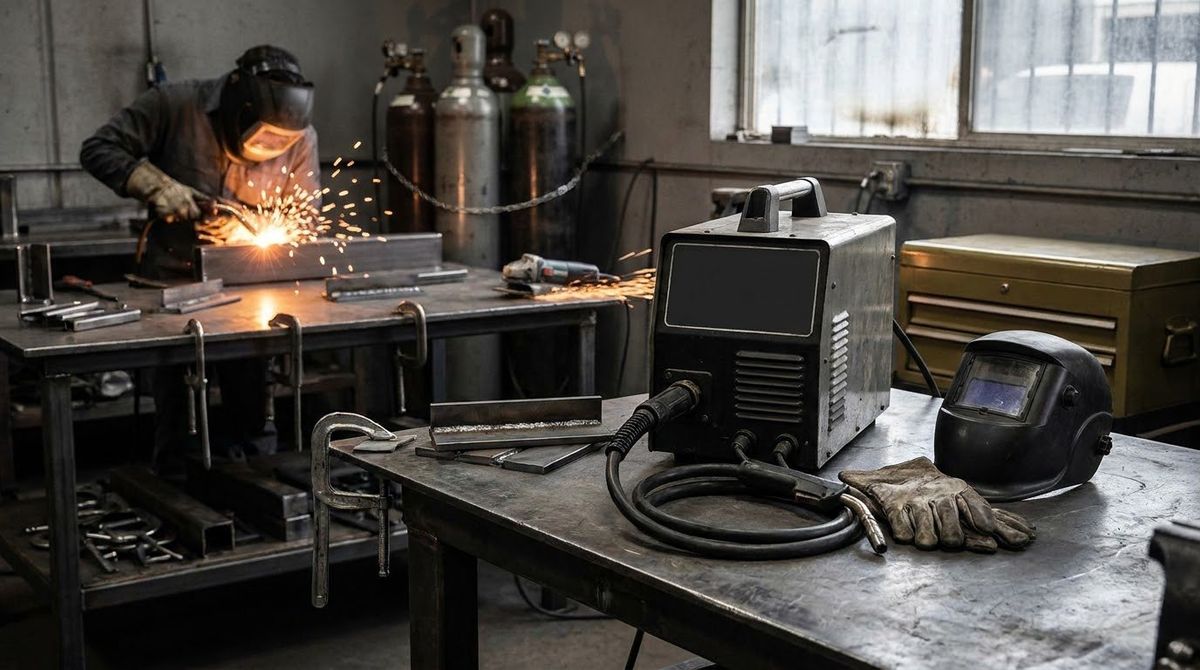
From the guide: Best Welding Machines: A Buyer's Guide for MIG, TIG, Stick, and Multi-Process
Choosing your first wire-feed machine starts with matching input power and maximum material thickness to the work you actually plan to build, as outlined in our welding machines buyer’s guide. Gas Metal Arc Welding (GMAW), commonly called MIG welding, is widely recommended by manufacturers such as Miller Electric as the easiest arc process to learn because the machine feeds filler wire continuously while you control travel speed and gun angle.
This guide synthesizes published manufacturer specifications and safety standards—rather than paid rankings or unverified user reviews—so you can compare 120V and dual-voltage MIG welders objectively. Whether you are repairing farm equipment, fabricating shop brackets, or learning MIG welding for beginners, the right machine balances output capacity, duty cycle, and wire-drive reliability.
What Makes a MIG Welder Good for Beginners?
A beginner-friendly MIG welder combines a forgiving arc, clear setup controls, and a metal wire-drive assembly that feeds 0.023-inch to 0.035-inch wire without bird-nesting. Instead of chasing the highest advertised peak amperage, focus on four published specifications that govern real-world usability.
To compare how long each machine can weld at a given output, the duty cycle calculator converts a rated duty cycle to other amperages; welder duty cycle explained shows how to read the rating.
Input Voltage and Circuit Requirements
Most entry-level MIG welders fall into two electrical categories: dedicated 120V (often called 110V) machines and dual-voltage 120V/240V machines. Published input current differs by model: ESAB lists a 28.6 A maximum primary current at 120V for the Rebel EMP 215ic, so always read the manual’s circuit and breaker requirements before plugging in. Rated output on 120V is limited (Miller lists 100 A for the Millermatic 142 and 110 A for the 211 PRO), which is why single-pass thickness on 120V-only machines tops out around 3/16 inch.
Dual-voltage machines, such as the Miller Millermatic 211 PRO or ESAB Rebel EMP 215ic, accept 120V for light work and 230V/240V for heavier plate. If you are deciding between shop circuits, review our breakdown of 110V vs 220V welders before wiring an outlet, and have a qualified electrician install any new receptacle.
Amperage Range and Duty Cycle
Duty cycle expresses how many minutes out of a 10-minute window a welder can operate at a given amperage without overheating. For example, a 20% duty cycle means 2 minutes of continuous arc time followed by 8 minutes of cooling. Compare each machine’s rated output and duty cycle from the manufacturer’s specification rather than the peak amperage in advertising: the ESAB Rebel EMP 215ic, for instance, lists 235 A at 15% on 230V but 130 A at 20% on 120V.
Wire-Drive System and Spool-Gun Support
Confirm the drive rolls support the wire sizes you plan to use (ESAB lists 0.023 to 0.035 inch for mild steel on the Rebel EMP 215ic). If you plan to weld aluminum later, check the manufacturer’s manual for the gun, liner or spool gun and the shielding gas it requires.
Synergic or Auto-Set Controls
Many modern inverter welders include parameter-assist features—such as Miller’s Auto-Set or ESAB’s sMIG—that automatically pair wire feed speed and arc voltage when you dial in wire diameter and metal thickness. These modes shorten the learning curve while still allowing full manual override as you gain experience.
Beginner MIG Welders by Use Case
The models below are drawn from current manufacturer product pages and spec sheets. Specs change between model revisions, so confirm against the manufacturer page before buying.
Dual-Voltage Option: Miller Millermatic 211 PRO
Miller lists the Millermatic 211 PRO for 120/240 V input with a 30 to 230 A output range.
- Rated output (120V): 110 A at 19.5 VDC, 60% duty cycle
- Rated output (240V): 160 A at 22 VDC, 60% duty cycle
- Mild steel capacity: 24-gauge to 3/8 inch
- Aluminum capacity: 18-gauge to 3/8 inch
Miller’s buyer’s guide similarly describes this class of machine as welding up to 3/16 inch on 120V and up to 3/8 inch on 240V. Miller’s Auto-Set feature configures voltage and wire speed based on wire size and material thickness.
Dedicated 120V Option: Miller Millermatic 142
Miller lists the Millermatic 142 as a 120V MIG welder (110/115/120 V input).
- Output range: 30 to 140 A
- Rated output: 100 A at 19 V, 60% duty cycle (80 A at 18 V, 100% duty cycle)
- Mild steel capacity: 24-gauge to 3/16 inch
- Aluminum capacity: 18-gauge to 14-gauge
Because it is a 120V machine, you cannot raise its output later by installing a 240V outlet. It suits auto body, exhaust and light-bracket work.
Multi-Process Option: ESAB Rebel EMP 215ic
Beginners who want MIG capability today plus stick and DC Lift TIG for later often consider multi-process machines. ESAB lists the Rebel EMP 215ic for 120/230 VAC single-phase input with MIG/MAG, flux-cored, stick (including cellulosic electrodes) and DC Lift TIG.
- MIG output: 15 to 130 A at 120V (130 A at 20% duty cycle); 15 to 235 A at 230V (235 A at 15% duty cycle)
- Stick output: up to 130 A at 120V and 180 A at 230V
- Maximum plate thickness: 3/8 inch
- Supply plug: NEMA 6-50P for 230V, with a supplied adapter to a NEMA 5-15P for 120V
Its sMIG feature adapts arc characteristics to the operator’s technique, per ESAB. The machine is DC only, so it does not provide AC TIG for aluminum; for that capability, review our best TIG welders guide.
MIG vs Flux-Core on a Beginner Machine
Every modern MIG welder can also run flux-core welding (FCAW) by swapping the drive roll to a knurled profile and setting polarity according to the machine’s manual or data plate. Self-shielded flux-cored wire (FCAW-S) requires no external shielding gas cylinder, which lowers your initial startup cost and lets you weld outdoors where wind would blow away MIG shielding gas.
However, Miller notes that flux-cored welding requires slag chipping while MIG does not. Beginners who weld indoors on clean steel generally achieve cleaner beads faster with gas-shielded MIG, while keeping a spool of flux-core wire on hand for windy outdoor repairs.
Essential Accessories and Consumables to Budget For
A welder’s box rarely includes everything needed to strike your first arc safely. Plan your budget around these essentials from our welding supplies and consumables guide:
- Shielding gas cylinder and regulator: A 75/25 argon-CO2 cylinder (typically 40 to 80 cu. ft. for hobbyists) plus a flowmeter regulator set to the rate in your machine manual (Miller suggests starting near 20 CFH).
- Filler wire: A 2-lb or 10-lb spool of ER70S-6 solid wire in 0.023-inch (sheet metal) or 0.030-inch (general fabrication).
- Contact tips and nozzles: Keep spare contact tips matched to your exact wire diameter and extra gas nozzles.
- Welding cart and cylinder restraint: A cart or wall bracket that keeps the gas cylinder secured upright (OSHA 1926.350(a)(9)).
- PPE and clamp accessories: Auto-darkening helmet, MIG welding gloves, flame-resistant jacket, safety glasses, and a 4-1/2-inch angle grinder for metal prep.
Welding Safety Rules for Beginners (YMYL)
Arc welding introduces serious hazards that must be controlled before you pull the trigger. Follow OSHA 29 CFR 1910.252 and ANSI Z49.1 (Safety in Welding, Cutting, and Allied Processes):
- Fumes and ventilation: NIOSH notes that welding fumes are composed of metals and most contain a small percentage of manganese, with long-term high exposure linked to neurological effects. Use local exhaust or mechanical ventilation. OSHA 1910.252(c) requires local exhaust or airline respirators for indoor work on lead-bearing or cadmium-coated metals, so do not weld coated or painted steel without removing the coating and using appropriate respiratory protection.
- Arc eye and UV radiation: The MIG arc emits intense ultraviolet and infrared radiation that can burn corneas (“arc eye”) and exposed skin in seconds. Always wear a welding helmet fitted with the filter lens shade that OSHA 1910.252(b)(2) and your helmet’s chart specify for the process, safety glasses with side shields underneath, and flame-resistant leather or heavy cotton clothing covering all skin.
- Electric shock: Inspect power cords, ground clamps, and gun liners for damage before every session. Never weld in damp conditions or while standing on wet concrete, and keep your body insulated from both the workpiece and live electrode circuit.
- Fire and hot work: Relocate combustibles at least 35 feet from the work site where practicable, otherwise shield them with fire-resistant covers, keep a fire extinguisher within reach, and maintain a fire watch for at least a half hour after welding per OSHA 1910.252(a).
- Compressed gas cylinders: OSHA 1926.350 requires compressed gas cylinders to be secured upright, valve protection caps in place when moving them, and the cylinder valve closed when work is finished. Keep cylinders away from sparks and electrical circuits.
Disclaimer: This guide is for educational purposes and does not replace your welder’s owner’s manual, local electrical codes, or formal safety training.
Next Steps
Ready to match your machine to the right process and shop power? Explore our welding safety and PPE guide and try our free welding tools and calculators to dial in starting amperage and duty cycle limits.
| Model | Input Power | Output Range | Rated Output / Duty Cycle | Mild Steel Capacity |
|---|---|---|---|---|
| Miller Millermatic 142 | 110/115/120 V | 30-140 A | 100 A at 19 V, 60% (80 A at 18 V, 100%) | 24 ga. to 3/16 in. |
| Miller Millermatic 211 PRO | 120/240 V | 30-230 A | 110 A at 19.5 V (120 V) / 160 A at 22 V (240 V), both 60% | 24 ga. to 3/8 in. |
| ESAB Rebel EMP 215ic | 120/230 VAC, 1-phase | MIG 15-235 A (230 V), 15-130 A (120 V) | 235 A at 26 V, 15% (230 V) / 130 A at 20.5 V, 20% (120 V) | Up to 3/8 in. plate |
If you want room to grow into 240V shop power, a dual-voltage machine such as the Millermatic 211 PRO or the Rebel EMP 215ic gives more thickness capacity. Choose a dedicated 120V unit such as the Millermatic 142 only if you weld 3/16-inch steel or thinner and have no plans to add a 240V receptacle.
Questions we get
What size MIG welder is best for a beginner?
It depends on the thickness you weld. Miller lists the 120V Millermatic 142 for 24-gauge to 3/16-inch mild steel, while dual-voltage machines such as the Millermatic 211 PRO and ESAB Rebel EMP 215ic are listed for up to 3/8-inch material. Match the machine's published thickness capacity and input requirements to your projects and your circuit.
Should a beginner buy a 110V or 220V MIG welder?
A dual-voltage 120V/240V welder gives beginners the most flexibility. You can run it on 120V for auto body and light fabrication, then move to 240V later for thicker steel and higher rated output. Check the manual for the required circuit and breaker size, because input current varies by model, and have an electrician install any new receptacle.
What is the easiest MIG welder feature for beginners to learn with?
Synergic or auto-set controls simplify setup by matching wire feed speed and voltage to your selected metal thickness and wire diameter. Features such as Miller Auto-Set or ESAB sMIG reduce dial guesswork while still letting you fine-tune parameters manually as your skills improve. Confirm which controls your specific model offers on the manufacturer's product page.
Can a beginner MIG welder weld aluminum?
Some can. Miller lists aluminum capacity for the Millermatic 142 (18 to 14 gauge) and the 211 PRO (18 gauge to 3/8 inch), and ESAB lists aluminum wire sizes for the Rebel EMP 215ic. Aluminum generally needs argon shielding gas and soft-wire feeding hardware, so check the manufacturer's manual for the required gun, liner and drive rolls before buying.
What shielding gas does a beginner MIG welder need?
Miller recommends a higher-argon blend such as 75% argon and 25% carbon dioxide for MIG on sheet metal. Set the flowmeter to the rate in your machine manual; Miller suggests starting light-duty work near 20 cubic feet per hour (CFH), while Lincoln's Power MIG 256 manual lists typically 25 to 35 CFH. Self-shielded flux-cored wire needs no external gas cylinder.
How much duty cycle does a hobbyist MIG welder need?
Duty cycle is the percentage of a 10-minute period a welder can run at a given output without overheating, so a 20% rating means 2 minutes of welding and 8 minutes of cooling. Compare the rated output and duty cycle listed in each manufacturer's specifications, and keep your welding amperage at or below the rated point for long beads.
Where we got this
- Miller Electric Millermatic 142 Product Page (millerwelds.com)
- Miller Electric Millermatic 211 PRO Product Page (millerwelds.com)
- ESAB Rebel EMP 215ic Fact Sheet (assets.esab.com)
- Miller Electric: Buying Your First Welder — A Practical Guide for Do-It-Yourselfers (millerwelds.com)
- Miller Electric: Successfully Welding Sheet Metal with MIG and TIG (millerwelds.com)
- Miller Electric: MIG Welding Tips and Techniques for Beginners (millerwelds.com)
- Lincoln Electric Power MIG 256 Operator Manual (manualslib.com)
- OSHA 29 CFR 1910.252 — Welding, Cutting, and Brazing General Requirements (osha.gov)
- OSHA 29 CFR 1926.350 — Gas welding and cutting (cylinder handling) (osha.gov)
- AWS Z49.1:2021 Safety in Welding, Cutting, and Allied Processes (pubs.aws.org)
- CDC / NIOSH Welding Fumes and Manganese (cdc.gov)
Keep reading
- Best Welding Machines: A Buyer's Guide for MIG, TIG, Stick, and Multi-Process
Compare MIG, TIG, stick, and multi-process welding machines by duty cycle, 110V vs 220V input power, amperage range, and shop use.
- 110V vs 220V Welders: Which Power Input Do You Need?
Compare 110V (120V) and 220V (240V) welders on thickness capacity, duty cycle, circuit breakers, NEMA 6-50 plugs, and dual-voltage options.
- Best TIG Welders: What to Look For and Top Picks
Compare the best AC/DC TIG welders on amperage range, high-frequency start, pulse control, duty cycle, and input voltage using manufacturer specs.
- Welder Duty Cycle Explained: Weld and Rest Minutes
Duty cycle is the share of 10 minutes a welder can run at rated output. Learn the formula, read a rating plate and find your weld and rest minutes.