Welding Fire Safety and Hot Work Precautions
Welding fire safety means relocating combustibles at least 35 feet from the work where practicable, guarding any that cannot be moved, and posting a trained fire watch with extinguishing equipment when combustibles are within 35 feet or otherwise exposed. OSHA 29 CFR 1910.252 requires that watch for at least 30 minutes after work ends, and NFPA 51B sets a longer baseline.
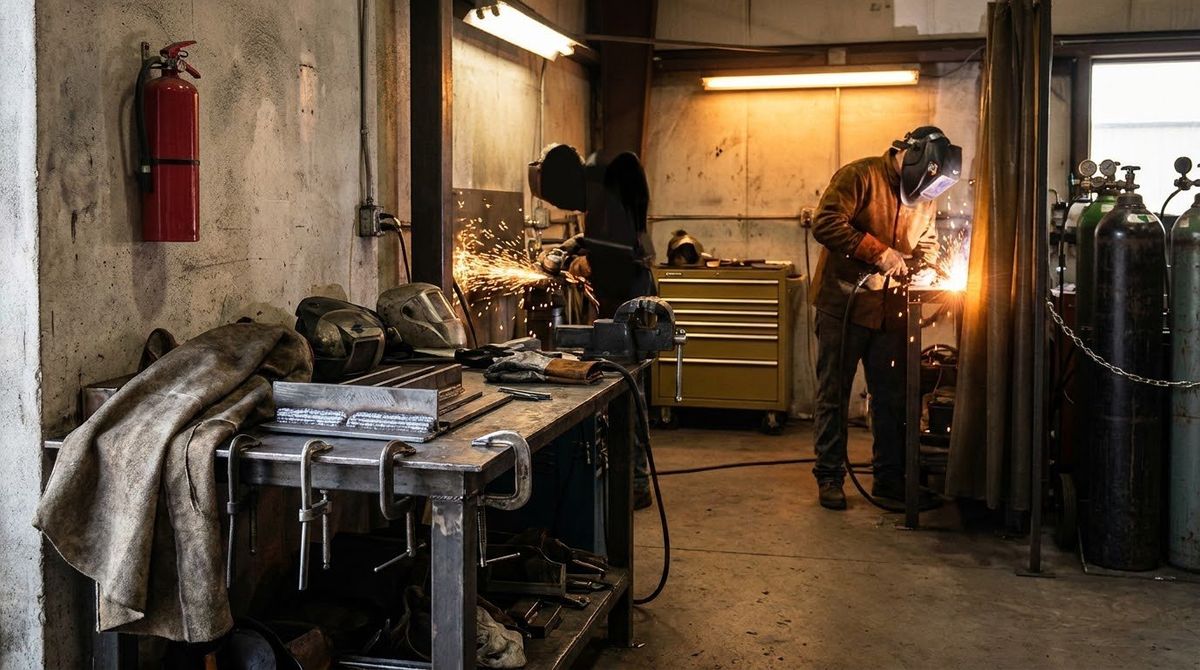
From the guide: Welding Safety and PPE: Fumes, Arc Flash, Shock, Fire and Gas Cylinders
Safety notice: This guide summarizes OSHA 29 CFR 1910.252, NFPA 51B, and AWS fire prevention standards for educational use. It does not replace site-specific hot work permit procedures, local fire codes, or formal safety training.
Most welding-related fires start not while the arc is lit, but minutes or hours later from a stray spark or piece of hot slag smoldering inside sawdust, cardboard, or a wall cavity. Following structured hot work precautions—a core pillar of our welding safety and PPE guide—eliminates those hidden ignition sources before you strike an arc.
Whether you are supervising a commercial job site under a hot work permit or welding a trailer hitch in a home shop, the same core principles from OSHA 29 CFR 1910.252 and NFPA 51B apply.
The Hierarchy of Hot Work Fire Prevention
Under OSHA 29 CFR 1910.252(a) and NFPA 51B, OSHA’s basic precautions and NFPA 51B point to this order of preference before welding or cutting begins:
- Move the work: If the part can be relocated to a designated, fire-safe welding area, move it there.
- Move the hazards: If the work cannot be moved, take all movable fire hazards to a safe place; OSHA says combustibles should, where practicable, be relocated at least 35 feet (10.7 meters) from the work site.
- Guard the hazards: If combustibles cannot be moved, use guards to confine the heat, sparks, and slag, and post a fire watch where the conditions below apply.
If these precautions cannot be met, OSHA states that welding and cutting shall not be performed. It is also prohibited in sprinklered buildings while that protection is impaired and in the presence of explosive atmospheres (mixtures of flammable gases, vapors, liquids, or dusts with air).
Understanding the 35-Foot Rule
The 35-foot rule is not a flat circle drawn on the shop floor; it is a three-dimensional sphere covering everything above, below, and on the far side of wall or floor openings.
Sparks from grinding, stick welding, and oxyfuel cutting bounce across concrete floors and drop through floor grates, pipe chases, and door gaps. Before starting hot work:
- Sweep floors clean of wood shavings, sawdust, paper, and lint within 35 feet.
- Protect combustible floors: OSHA says they must be kept wet, covered with damp sand, or protected by fire-resistant shields. Where floors are wet down, arc welding personnel must be protected from possible shock.
- Seal cracks and openings in walls, floors, and ductwork within 35 feet so sparks cannot fall into concealed spaces or rooms below.
- Move flammable liquids and gases—including gasoline cans, aerosol brake cleaners, paint thinners, and propane tanks—well outside the hazard zone.
Fire Watch Duties and the 30-Minute Rule
A fire watch is required whenever hot work is performed near combustibles that could be ignited by sparks, slag, or radiant heat.
Under OSHA 29 CFR 1910.252(a)(2)(iii), fire watchers are required where more than a minor fire might develop, or where any of these conditions exist:
- Appreciable combustibles are closer than 35 feet to the work.
- Appreciable combustibles are more than 35 feet away but are easily ignited by sparks.
- Wall or floor openings within 35 feet expose combustibles in adjacent rooms or lower levels.
- Combustibles are adjacent to the opposite side of metal partitions, walls, ceilings, or roofs where heat conduction could ignite them.
What a Fire Watch Must Do
A fire watch is not a casual bystander. Under OSHA and NFPA 51B, the person on fire watch must:
- Have fire-extinguishing equipment readily available and be trained in its use.
- Have the authority to stop hot work if unsafe conditions develop.
- Watch for fires in all exposed areas, including floors below or rooms behind metal partitions.
- Try to extinguish a fire only when it is obviously within the capacity of the equipment available, and otherwise sound the alarm.
- Remain on watch after the work ends: OSHA’s minimum is a half hour, and NFPA 51B calls for a longer baseline.
In a home shop where you work alone, treat the half-hour minimum seriously: do your cleanup, put tools away, and stay in the shop for at least that long after your final bead or grind before leaving. Longer is safer.
Hot Work Permits and Prohibited Locations
In commercial and industrial facilities, NFPA 51B uses a Hot Work Permit system in which a Permit Authorizing Individual (PAI), someone designated by management, authorizes hot work outside designated areas. The PAI is responsible for inspecting the work area, ensuring appropriate fire protection and extinguishing equipment is at the site, and ensuring a fire watch is present where required. See also our welding fume safety guide for ventilation.
OSHA 1910.252(a) prohibits welding or cutting in:
- Areas with explosive atmospheres (mixtures of flammable gases, vapors, liquids, or dusts with air).
- Sprinklered buildings while that protection is impaired.
- Used drums, barrels, tanks, or other containers until they have been thoroughly cleaned; hollow spaces and containers must also be vented before heating or cutting. Lincoln Electric warns such containers can explode even if they seem empty.
Fire Extinguishers and Shop PPE for Fire Safety
Keep a fully charged extinguisher, such as an ABC dry chemical unit, where you can reach it quickly and not behind the welding table where a fire could block access.
| Fire Class / Fuel | Recommended Extinguisher | Common Welding Shop Source |
|---|---|---|
| Class A (wood, paper, rags) | ABC Dry Chemical or Water | Cardboard boxes, shop rags, wood framing |
| Class B (oils, fuels, solvents) | ABC Dry Chemical or CO2 | Hydraulic fluid, degreasers, fuel lines |
| Class C (energized electrical) | ABC Dry Chemical or CO2 | Welder power cords, breaker panels |
| Class D (combustible metals) | Class D agent | Magnesium or titanium grindings/shavings |
Clothing and Workpiece Hazards
Your own clothing can catch fire if sparks collect in pockets or cuffs. Follow Miller Electric’s shop safety guidance:
- Wear flame-resistant clothing that covers your skin, plus welding gloves and high-top leather boots. Miller notes that shorts, short sleeves, and open collars leave you vulnerable to burns, cloth shoes can catch a spark and smolder unnoticed, and mechanic-style gloves are not flame resistant.
- Lincoln Electric’s safety instructions call for cuffless trousers, high shoes, and a cap over your hair. Keeping pockets buttoned and cuffs out of the way helps keep spatter from lodging.
- Keep combustibles such as paper, cloth rags, oil, and gasoline away from the work, and leave nothing flammable in your pockets.
- Check your ground (work) clamp connection: a poor work-lead connection can send welding current through unintended paths, so clamp directly to the workpiece.
- Chain compressed gas cylinders securely to a stationary, upright support or cart (Miller), as we cover alongside gas setup in our shielding gas guide.
Pre-Weld Fire Safety Checklist
Run through this quick check before striking an arc in any shop or field location:
- Clear 35 feet where practicable: Remove wood, paper, rags, aerosols, and fuel cans, or guard immovable items with fire-resistant welding blankets or shields.
- Check hidden paths: Seal floor cracks, wall gaps, and drains; check the other side of metal walls.
- Verify extinguishers: Confirm an inspected ABC extinguisher is reachable along your exit route.
- Inspect PPE and ground: Wear FR clothing without cuffs or open pockets, verify your auto-darkening helmet and gloves, and clamp the work lead directly to clean metal on the workpiece.
- Wait: After finishing, inspect the area for hot slag and stay at least 30 minutes (OSHA’s minimum) before leaving the shop unattended.
Welding on Vehicles, Trailers, and Farm Equipment
Vehicle and equipment repairs combine tight spaces, hidden wiring, pressurized lines, and fuel systems, making them one of the highest-risk settings for shop fires. Before welding on any car, truck, trailer, or tractor:
- Follow the vehicle manufacturer’s instructions for welding repairs, including whether and how to disconnect the battery and protect onboard electronics.
- Shield fuel, brake, and hydraulic lines: Inspect the back side of frame rails and floor pans before welding or cutting. Fuel, brake, and hydraulic lines can run directly behind the weld zone. Move or shield them, and never weld near leaking fuel or fluid.
- Watch for sound deadener, undercoating, and carpet: Undercoating, seam sealer, and interior trim are combustible. Remove them from the weld zone and keep a fire watch with extinguishing equipment where heat could reach them (OSHA’s fire-watch conditions include combustibles on the opposite side of metal partitions).
- Tire and rim warning: Never weld or perform other hot work on a rim wheel. The Massachusetts FACE program, in a report on a welder killed in a rim wheel explosion, recommends exactly that.
Preventing Stray-Current and Grounding Fires
A poorly placed work (ground) clamp can send welding current through paths you did not intend. Keep the work lead connection close to the weld, on clean metal of the piece you are welding. Never attach it to conduit or piping: under OSHA 29 CFR 1910.254(c)(2)(ii), conduits containing electrical conductors shall not be used for completing a work-lead circuit, and pipelines shall not be used as a permanent part of a work-lead circuit.
Questions we get
What is the 35-foot rule in welding fire safety?
Under OSHA 29 CFR 1910.252(a)(2)(vii), combustibles should, where practicable, be relocated at least 35 feet (10.7 meters) from the work site. If they cannot be moved, guards must be used to confine heat, sparks, and slag, and a fire watch is required where appreciable combustibles are within 35 feet. If neither is possible, welding and cutting shall not be performed.
How long is a fire watch required after welding?
OSHA 29 CFR 1910.252(a)(2)(iii)(B) requires a fire watch to be maintained for at least a half hour after welding or cutting is completed. NFPA 51B sets a longer baseline fire watch (1 hour in the text NFPA has published for the 2019 cycle; confirm in your adopted edition), so employers, insurers, and local fire authorities often require more than the OSHA minimum. Check the edition your jurisdiction has adopted.
What type of fire extinguisher should you keep near a welding area?
A multi-purpose ABC dry chemical extinguisher is a common choice because it is rated for ordinary combustibles (Class A), flammable liquids and gases (Class B), and energized electrical equipment (Class C). Combustible metals such as magnesium or titanium are Class D fires and need a Class D agent. Fire watchers must have extinguishing equipment readily available and be trained to use it.
Can you weld on a used fuel tank or 55-gallon drum?
Do not weld or cut on used drums, barrels, tanks, or other containers until they have been thoroughly cleaned (OSHA 29 CFR 1910.252(a)(3)), and hollow spaces must be vented before heating. Lincoln Electric's safety instructions warn that such containers can explode even though they appear empty, because of vapors from the substances inside. When in doubt, do not do the job.
Do I need a hot work permit in a home garage?
OSHA's welding standard governs employers, and NFPA 51B permits are workplace and fire-code tools, but the same pre-work checklist is sensible at home: relocate or shield combustibles, sweep sawdust, move gas cans, and stay in the shop for at least 30 minutes after your last bead. Check local fire rules and your insurer's requirements if you weld in a building.
How far can welding sparks and slag travel?
Sparks and slag can travel well beyond the work area, which is why OSHA's fire-watch conditions cover combustibles within 35 feet, wall or floor openings within that radius that expose combustibles in adjacent areas, and combustibles on the opposite side of metal partitions, walls, ceilings, or roofs. Inspect below and behind the work before starting.
Where we got this
- eCFR — 29 CFR 1910.252 Welding, Cutting, and Brazing (Fire Prevention and Protection) (ecfr.gov)
- NFPA 51B — Standard for Fire Prevention During Welding, Cutting, and Other Hot Work (nfpa.org)
- Lincoln Electric — Operator's Manual Safety Precautions (IM6100) (mechanized.lincolnelectric.com)
- OSHA — 29 CFR 1910.254 Arc Welding and Cutting (osha.gov)
- CDC Stacks — Massachusetts FACE report: welder killed in rim wheel explosion (stacks.cdc.gov)
- Miller Electric — Welding Garage Safety Guide (millerwelds.com)
Keep reading
- Welding Safety and PPE: Fumes, Arc Flash, Shock, Fire and Gas Cylinders
Welding safety and PPE guide covering OSHA 1910.252, ANSI Z49.1, fume ventilation, arc-eye protection, electric shock, fire watch, and gas cylinders.
- Best Welding Helmets: Auto-Darkening, Lens Shade and Fit
Compare auto-darkening and passive welding helmets by ANSI Z87.1 rating, lens shade range, optical clarity, and headgear fit for MIG, TIG, and stick.
- Welding Fume Safety and Ventilation: What OSHA and NIOSH Say
Learn OSHA 1910.252 ventilation rules, NIOSH fume hazards like hexavalent chromium and manganese, and how to choose LEV, respirators, and PAPRs.