Shielding Gas for MIG and TIG: Argon, CO2 and Mixes
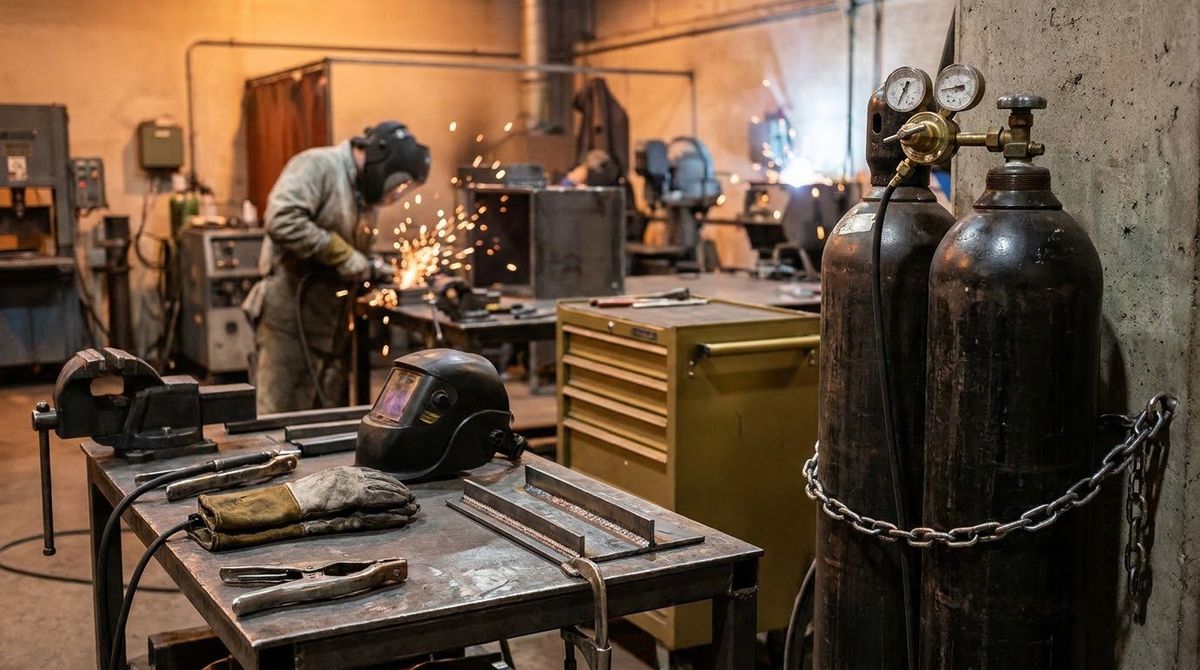
Miller Electric names 75% argon / 25% CO2 (C25) a common mild-steel MIG gas, 100% argon as the most common aluminum MIG gas and the usual TIG gas. Miller suggests 25 to 35 CFH for short-circuit MIG and 15 to 20 CFH for TIG. Keep high-pressure gas cylinders chained to a stationary upright support or cart, with valve caps in place when moving or storing them.
From the guide: Welding Supplies and Consumables: Wire, Rods, Shielding Gas, and Wear Parts
Safety notice: Compressed shielding gas cylinders are stored at high pressure and inert gases can displace oxygen in enclosed spaces. Always follow OSHA cylinder rules (29 CFR 1910.253 and 1926.350), your gas supplier’s safety data sheet (SDS), and your welder’s manual.
Shielding gas forms a protective blanket around the molten weld puddle, blocking atmospheric oxygen, nitrogen, and hydrogen that would otherwise cause brittle welds and porosity. Picking the right gas blend and setting the correct flow rate in cubic feet per hour (CFH) is just as important as choosing the right MIG welding wire or amperage—a core topic in our welding supplies and consumables guide.
This guide covers the standard gas mixes for MIG and TIG welding, recommended CFH flow rates, troubleshooting porosity, and mandatory cylinder safety practices.
Shielding Gas for MIG Welding (GMAW)
MIG welding uses either semi-inert blends or pure CO2 on steel, and 100% inert gas on aluminum, depending on transfer mode and base metal.
Mild Steel: C25 (75% Argon / 25% CO2) vs. 100% CO2
- 75% Argon / 25% CO2 (C25): The standard choice for home shops and light-to-medium fabrication. As Miller Electric explains, C-25 produces minimal spatter and good arc characteristics, making it a common choice for mild steel.
- 100% CO2: Costs less per cylinder and provides deeper joint penetration on thicker steel, which is why heavy industrial shops sometimes use it. The trade-off, per Miller, is a bit more spatter and a slightly erratic arc, though newer machines handle it better than older ones. Cylinder valve outlets differ by gas family, so use the regulator your gas supplier specifies and never force or adapt a mismatched fitting.
- 90% Argon / 10% CO2 (C-10): Miller calls C-10 “a good option” for spray transfer, which is typically used on thicker plate, though it is less common among DIY welders.
Aluminum and Stainless Steel MIG Gas
- Aluminum MIG: Always use 100% Argon Miller calls it the most common aluminum MIG gas; blends with helium are costly, and CO2 should be avoided because it contaminates aluminum welds.
- Stainless Steel MIG: Use a tri-mix (90% Helium / 7.5% Argon / 2.5% CO2) for short-circuit welding, or 98% Argon / 2% CO2, which Miller describes as versatile for spray and pulsed spray transfer. Miller warns that too much CO2 can cause porosity on stainless, so check your wire manufacturer’s gas recommendation.
Shielding Gas for TIG Welding (GTAW)
TIG typically uses 100% argon (or an argon-helium blend for thick aluminum), and Miller warns that argon/CO2 mixes cause immediate contamination.
In TIG welding, the tungsten electrode carries the arc without melting into the joint, and the gas protects the electrode and the weld puddle. For thick aluminum, an argon-helium blend is an option; check your machine and filler manufacturer’s guidance for blend ratios and flow settings.
Setting the Right Flow Rate (CFH, Not PSI)
Your welding regulator’s flow gauge measures volume flow in Cubic Feet per Hour (CFH), not line pressure in PSI. Setting the flow too low gives poor coverage and porosity; setting it too high causes turbulence that pulls in contaminants.
| Process | Miller’s recommended flow | Notes |
|---|---|---|
| MIG (short-circuit) | 25 – 35 CFH | Other transfer modes can run slightly higher |
| TIG | 15 – 20 CFH | Lower end preferred; higher flow does not mean better protection |
How to set flow accurately: On a flowmeter, flow gas (pull the MIG trigger or use the TIG gas-purge function), then adjust until the reading matches your target CFH. Excess flow causes turbulence that pulls in air. Use our welding tools and calculators alongside your machine manual for settings.
Troubleshooting Porosity and Gas Coverage
If your welds suddenly look like a sponge with tiny pinholes, check your gas delivery in this order before changing machine voltage or wire speed:
- Wind or shop fans: Drafts and fans blow shielding gas away. Close bay doors, set up welding screens, or switch to self-shielded flux-core or stick electrodes outdoors. Keep fume extraction hoods positioned to capture rising smoke without pulling the gas blanket off the arc.
- Spatter in the nozzle: Built-up spatter inside a MIG nozzle disrupts laminar flow. Clean the nozzle with nozzle gel or pliers.
- Leaks and O-rings: Spray soapy water (never oil) on regulator threads, hose barbs, and TIG torch back-caps to spot leaks.
- Cylinder contents: Check the high-pressure gauge; an empty cylinder gives no shielding.
Compressed Gas Cylinder Safety Rules (YMYL)
Compressed gas cylinders store a great deal of energy, and OSHA’s cylinder rules exist to keep them from being knocked over or damaged. Follow OSHA 29 CFR 1926.350, OSHA 29 CFR 1910.253, and Miller Electric’s shop safety rules:
- Chain cylinders upright: Secure them to a stationary, upright support or cart (Miller), using a truck, chain, or other steadying device to keep them from being knocked over (OSHA 1926.350(a)(7)).
- Keep the valve cap on: OSHA requires valve protection caps in place and secured, never used to lift a cylinder, and regulators removed before cylinders are moved.
- Keep fittings free of oil and grease: OSHA requires cylinders, valves, regulators, and hose to be free of oily or greasy substances, and says oxygen must never strike an oily surface.
- Never strike an arc on a cylinder: OSHA prohibits tapping an electrode against a cylinder to strike an arc, and says cylinders must stay away from electric circuits and grounding paths.
- Ventilate enclosed spaces: NOAA’s CAMEO database says argon is heavier than air and can asphyxiate by displacement of air, so pits, tanks, and small unventilated rooms are asphyxiation hazards. OSHA also says cylinders shall not be kept in unventilated enclosures such as lockers and cupboards. Review our welding fire safety guide and welding safety and PPE guide before setting up cylinders in any shop.
How to Choose in Practice
Start from your metal and your budget, then confirm against your machine and wire manuals. On mild steel, the trade is cost against arc quality: Miller describes C-25 as the lower-spatter option that costs more, and 100% CO2 as the cheaper gas that may spatter a bit more and run a slightly erratic arc. On aluminum, argon is the common answer, and because the same argon also supports TIG, a shop that does both processes can often run a single cylinder. Blends containing helium are costly, so they make sense mainly where thick aluminum needs the extra heat input.
If you are unsure, ask your gas supplier which blend they recommend for your wire and process, and use the supplier’s labeled, welding-grade product. Whatever you choose, set the flow to the machine manual’s range, check for leaks after every cylinder change, and keep the cylinder secured.
Storage, Confined Spaces, and Back-Purging
Some gas rules go beyond tipping and caps. OSHA 29 CFR 1910.253 requires cylinders stored indoors to be kept in a well-protected, well-ventilated, dry location at least 20 feet from highly combustible materials such as oil or excelsior, and says cylinders shall not be kept in unventilated enclosures such as lockers and cupboards. Oxygen cylinders must be separated from fuel-gas cylinders or combustibles by 20 feet or by a noncombustible barrier at least 5 feet high with a half-hour fire-resistance rating.
When welding is done inside a confined space, OSHA 29 CFR 1910.252(b)(4)(iii) says the gas cylinders and welding machines shall be left on the outside. That keeps leaking gas from collecting around the welder and keeps ignition sources and pressure vessels out of the space. Our fume safety guide covers ventilation requirements for those jobs.
Gas also matters on the back side of a joint. Miller links oxygen exposure to “sugaring” on the backside of stainless welds and says back-purging with argon, or reducing amperage, helps prevent it. If you weld stainless pipe or tube, plan the purge before you start rather than troubleshooting afterward.
Cylinder Capacity, Fittings, and Gas Runtime
Welding gas cylinders are sold by the volume of gas they hold in cubic feet, and capacity varies by gas, supplier, and cylinder size, so read the label or ask your supplier. Dividing the contents by your flow rate gives approximate continuous arc time. For example, a cylinder holding 80 cubic feet at 25 CFH lasts about 3.2 hours of continuous gas flow (80 divided by 25).
Valve connections differ by gas family so the wrong regulator cannot be fitted by accident. Use the regulator your gas supplier specifies, check for leaks after connecting, and never force a mismatched thread.
Pre-Flow, Post-Flow, and Gas Purity
Many TIG machines and some MIG welders offer pre-flow and post-flow timers that purge air before the arc starts and keep gas on the cooling weld and tungsten afterward. Set them according to your machine’s manual, since appropriate times depend on the machine, torch, and job.
Gas purity matters most on aluminum, titanium, and stainless. Buy welding-grade gas from a reputable supplier and ask for the purity grade appropriate to your application.
Choosing Between Owning and Leasing a Cylinder
Before buying your first tank, ask your local welding gas supplier about their cylinder exchange and lease policies, including who is responsible for testing and inspection and what size they offer for your gas. Requirements and fees vary by supplier. Pick a size that you can move safely on a cart and secure upright.
| Gas / Mix | Process | Base Metal | Key Characteristics |
|---|---|---|---|
| 75% Argon / 25% CO2 (C25) | MIG (Short-Circuit) | Mild steel | Minimal spatter, good arc characteristics; costs more than CO2 |
| 100% CO2 | MIG (Short-Circuit / Globular) | Mild steel | Lower gas cost; more spatter and a somewhat erratic arc |
| 90% Argon / 10% CO2 (C-10) | MIG (Spray) | Mild steel (thicker plate) | Recommended by Miller for spray transfer |
| 100% Argon | TIG (GTAW) & MIG (Spray) | Aluminum, steel, stainless, chromoly | Most common aluminum MIG gas; standard TIG gas |
| Tri-Mix (90He / 7.5Ar / 2.5CO2) | MIG (Short-Circuit) | Stainless steel | Listed by Miller for stainless short-circuit work |
Choose C25 (75/25 Argon-CO2) for everyday mild-steel MIG welding, 100% Argon for all TIG welding and aluminum MIG, and 100% CO2 when lower gas cost matters more than extra spatter.
Questions we get
What is the best shielding gas for MIG welding mild steel?
A 75% argon / 25% CO2 blend, commonly called C25, is the best all-around shielding gas for short-circuit MIG welding on mild steel. According to Miller Electric, C-25 produces minimal spatter and good arc characteristics, though it costs more than 100% CO2.
Can you use 75/25 argon-CO2 gas for TIG welding?
No. Miller warns to avoid argon/CO2 mixes used for MIG in TIG welding because they cause immediate contamination. TIG typically uses 100% argon, or an argon-helium blend for thick aluminum. Follow your machine and tungsten manufacturer's gas instructions, and check the gas on the cylinder label before you connect it.
What CFH should I set my MIG or TIG gas regulator to?
Miller gives 25 to 35 cubic feet per hour (CFH) for short-circuit MIG and 15 to 20 CFH for TIG, with the lower end preferred for TIG. Too little flow causes porosity from poor coverage, and too much creates turbulence that pulls in contaminants, so more flow does not mean better protection.
Is 100% CO2 better than C25 for MIG welding?
Miller notes 100% CO2 (C-100) is the cheaper option for mild steel but may produce a bit more spatter and a slightly erratic arc, although newer machines handle it better than older ones. C-25 costs more but produces minimal spatter.
Why does my MIG weld have pinholes (porosity) even with the gas turned on?
Porosity is usually a shielding problem: contaminants reach the molten puddle. Likely causes include an empty cylinder, a leaking fitting, a nozzle clogged with spatter, a draft or fan blowing the gas away, or a flow rate that is too low (poor coverage) or too high (turbulence pulling in air).
How should compressed welding gas cylinders be stored and moved?
Miller advises chaining gas cylinders securely to a stationary, upright support or cart, and fastening the protective cap when moving or storing them. OSHA requires valve protection caps in place and a truck, chain, or other steadying device to keep cylinders from being knocked over, and says cylinders must not be lifted by the cap. Keep cylinders away from electric circuits and grounding paths.
Where we got this
- Miller Electric — What Type of Gas Is Best for MIG Welding in DIY Applications? (millerwelds.com)
- Miller Electric — How to Solve 10 Common TIG Welding Problems (millerwelds.com)
- OSHA — 29 CFR 1926.350 Gas welding and cutting (cylinder handling) (osha.gov)
- NOAA CAMEO Chemicals — Argon (cameochemicals.noaa.gov)
- Miller Electric — Welding Garage Safety Guide (Cylinder Handling) (millerwelds.com)
- OSHA — 29 CFR 1910.253 Oxygen-fuel gas welding and cutting (cylinders) (osha.gov)
Keep reading
- Welding Supplies and Consumables: Wire, Rods, Shielding Gas, and Wear Parts
Complete guide to welding supplies and consumables: MIG wire (ER70S-6), stick electrodes (E7018, E6011), shielding gases, TIG tungsten, and gun parts.
- MIG Welding Wire Guide: Types, Sizes and Choosing the Right Wire
Learn how to choose MIG welding wire by AWS class (ER70S-6, ER70S-2, aluminum, stainless) and wire diameter (.023, .030, .035, .045) for your steel.
- Welding Amperage Chart: Settings by Process and Thickness
Starting welding amps by process, rod size and metal thickness for MIG, stick and TIG, plus gas flow ranges, from published manufacturer charts.
- Welding Rods and Electrodes Guide: 6010, 6011, 6013, 7018 Explained
Understand AWS stick electrode numbers and compare 6010, 6011, 6013, and 7018 welding rods by polarity, amperage range, penetration, and storage.