Welding Rods and Electrodes Guide: 6010, 6011, 6013, 7018 Explained
E6010, E6011, E6013, and E7018 are the four core mild-steel stick electrodes, differing in penetration, current type, and coating. Miller says 6010 and 6011 cut through corroded and unclean metal, 6013 gives a soft arc on clean thinner material, and iron-powder 7018 produces strong welds with high impact properties. Always follow the electrode box for polarity and amperage.
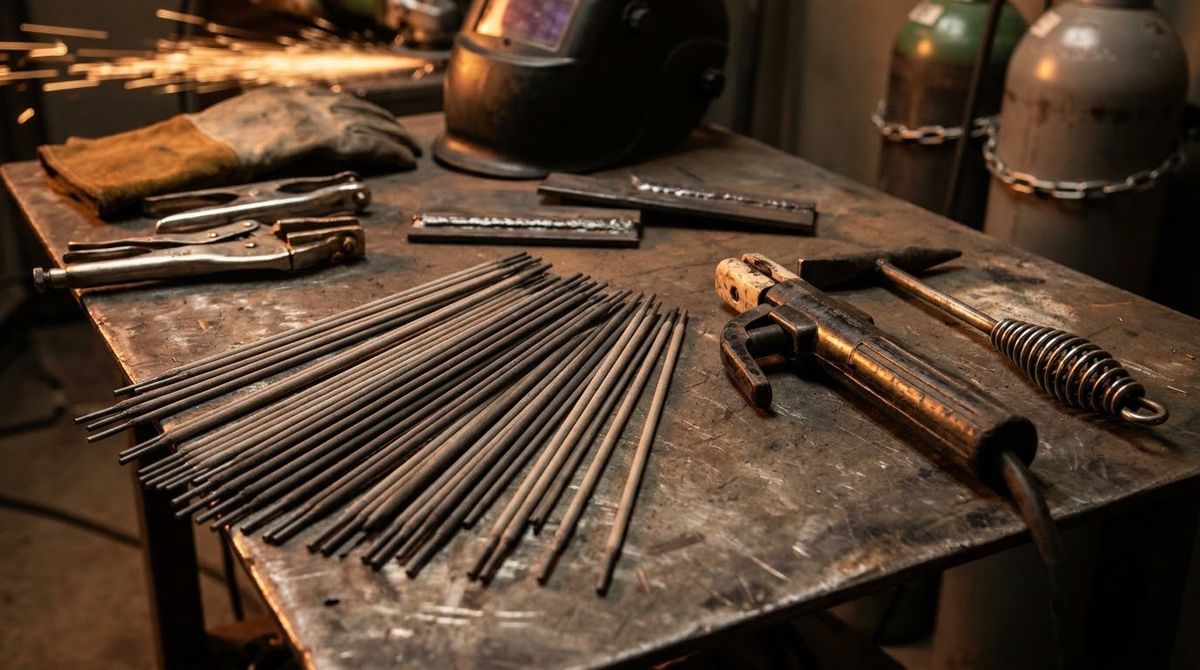
From the guide: Welding Supplies and Consumables: Wire, Rods, Shielding Gas, and Wear Parts
Every stick welding electrode carries an AWS code that tells you its tensile strength, usable positions, and coating and current type. Learning to read those numbers, and knowing when to grab 6010, 6011, 6013, or 7018, solves many arc-starting and penetration problems in Shielded Metal Arc Welding (SMAW), a core part of our welding supplies and consumables guide.
Because stick electrodes are self-shielded, they need no shielding gas cylinder, which Miller notes suits outdoor work where wind interferes with shielding gases.
How to Decode AWS Stick Electrode Numbers
As Miller Electric’s stick welding guide explains, the digits of a code like E7018 carry three pieces of information:
- First two digits (
60or70): The “as welded” minimum tensile strength in thousands of pounds per square inch (60= 60,000 psi;70= 70,000 psi). - Third digit: The acceptable welding positions. For the electrodes in this guide it is
1, meaning all-position. - Fourth digit: The coating type and the type of welding current.
When you have chosen a rod, the amperage and settings calculator shows the manufacturer’s current range for that diameter; the rod amperage ranges by size lists those ranges by rod and size.
E6010 vs. E6011 vs. E6013 vs. E7018 Breakdown
E6010 (Deep Penetration, DC Only)
Miller calls E6010 an all-position electrode only suitable with DC power sources. It penetrates deeply and can dig through rust, oil, paint, and dirt, but its tight arc can be hard for beginners. ESAB’s Sureweld 10P, a cellulosic E6010, is aimed at the pipe welding industry. Check the electrode box for the polarity to use.
E6011 (Deep Penetration, AC or DC)
Miller describes E6011 as an all-position electrode for AC or DC that produces a deep, penetrating arc that cuts through corroded and unclean metals. ESAB lists its Sureweld 6011 as AC-DCEP (electrode positive) and lists applications including buildings, piping, shipbuilding, and tanks. If you own an AC machine, E6011 is the deep-penetration option to look for.
E6013 (Moderate Penetration, Soft Arc)
Miller describes E6013 as an all-position electrode for AC or DC with a soft arc, moderate penetration, and easily removed slag. It works best on clean, thinner materials and wide root openings. ESAB’s Sureweld 6013 is recommended for vehicle bodies, ornamental work, and thin-sheet structures.
E7018 (Low-Hydrogen, Strong Welds)
Miller describes E7018 as an all-position electrode with high iron powder content that is easy to use and “produces strong welds with high impact properties (even in cold weather).” ESAB describes its Atom Arc 7018 as a low-hydrogen electrode for carbon and low-alloy steels. Check the box for the polarity your electrode requires.
Welding Rod Amperage by Diameter
Amperage depends mainly on electrode diameter and type. Miller notes that the side of the electrode box usually indicates operating ranges, and that you should reduce heat by about 15 percent for vertical and overhead work compared with flat welding. The ranges below are published by ESAB for its own products and are examples only; other brands differ, so use the range on your box.
| ESAB product (E-class) | 3/32” (2.4 mm) | 1/8” (3.2 mm) | 5/32” (4.0 mm) |
|---|---|---|---|
| Sureweld 6011 (E6011) | 60 – 80 A | 85 – 120 A | 140 – 175 A |
| Sureweld 6013 (E6013) | 60 – 90 A | 120 – 135 A | 145 – 190 A |
| Atom Arc 7018 (E7018) | 70 – 100 A | 90 – 160 A | 130 – 220 A |
For E6010, Miller gives an example of about 75 to 125 amps for a 1/8-inch electrode. Use our welding tools and calculators alongside the box, and compare stick with MIG welding wire in our types of welding processes guide.
Storage, Moisture Control, and Safety
How you store stick rods affects weld quality, and low-hydrogen rods need the most care:
- E7018 (low-hydrogen): ESAB says unopened containers can be stored safely for an indefinite time under normal dry storage conditions. After opening, it says to protect Atom Arc electrodes from humid air by keeping them at 225 to 300 degrees F (107 to 149 C), or to recondition them by baking for one hour at 700 degrees F (371 C) if the need arises. ESAB also notes that no moisture-resistant electrode eliminates the need for storage and rebake ovens or the need to follow code requirements for exposure times. Other brands have different instructions, so follow the manufacturer.
- Cellulosic rods (E6010 and E6011): Do not assume the low-hydrogen oven routine applies to them. Follow the storage instructions printed on the electrode container.
- Safety and PPE: Stick welding throws slag and sparks and produces fume. Wear a welding helmet, safety glasses for chipping slag, and dry welding gloves, and follow our welding fume safety and welding fire safety precautions. Never weld in wet conditions without special electric shock protection.
Technique Basics
Miller’s technique guidance for stick welding applies across the common electrodes:
- Arc length: Keep it no longer than the electrode core’s diameter. A short arc can freeze the electrode, and a long arc causes spatter and porosity.
- Angle: For flat, horizontal, and overhead welding, hold the electrode perpendicular to the joint and tilt it 5 to 15 degrees in the direction of travel. For vertical-up welding, use a push angle.
- Travel speed: Keep the arc in the leading third of the weld pool. Slow travel makes a wide, convex bead, and fast travel reduces penetration.
Different electrodes handle differently, and Miller notes that 6010’s tight arc can be hard for beginners, so practice on scrap and follow the manufacturer’s guidance for each electrode.
Choosing Electrode Diameter
Amperage depends mainly on electrode diameter, so the diameter you choose limits your amperage range. Pick a diameter whose range suits the thickness of the metal and the output of your machine, and check that range on the box. Miller notes that you should not use filler thicker than the base metal. Thin metal calls for smaller electrodes and lower amperage, while thicker plate calls for larger electrodes and more current. If you are choosing a power source for stick welding, check our machine-buying guide.
Specialty Stick Electrodes Worth Knowing
- E7024: ESAB describes Sureweld 7024 as a high-speed, heavy-coated iron powder electrode for high deposition rates on horizontal and downhand (flat) welding, particularly horizontal fillets and lap welds.
- E308L-16 (stainless steel): ESAB lists E308/E308L-16 for applications such as tank and vessel fabrication and general fabrication. Match stainless electrodes to the base metal, since stainless generally needs a filler that matches the base material.
- Cast iron: Specialty electrodes exist for cast iron repair. Follow the electrode manufacturer’s procedure, since cast iron is sensitive to heat.
Deposition Rate and Efficiency Examples
Amperage is not the only number on a manufacturer’s data sheet. ESAB also publishes deposition rate and efficiency for each diameter, which help you estimate how much electrode a job will use. For 1/8-inch (3.2 mm) electrodes, ESAB lists about 1.1 kg/h (2.4 lb/h) at 70 percent efficiency for Sureweld 6011, about 1 kg/h (2.1 lb/h) at 73 percent for Sureweld 6013, and about 1.2 kg/h (2.6 lb/h) at roughly 72 percent for Atom Arc 7018. These are manufacturer examples under test conditions, so your own results will vary with technique and settings. The practical takeaway is that a good share of each rod ends up as stub and slag rather than weld metal, so buy more than the net weight of weld you need.
Outdoor Work and Wind
Because stick electrodes are self-shielded, they are a natural fit for outdoor jobs. Miller advises that a self-shielded flux-cored wire or a stick electrode is typically a better choice than TIG or MIG outdoors, and that gas-shielded processes are not recommended when wind reaches 5 mph or more. Remember that wind also carries sparks and slag farther, so review the 35-foot and fire watch rules in our welding fire safety guide before you strike an arc outside.
Troubleshooting Common Stick Welding Defects
- Rod sticks on arc start: Confirm amperage is in the range on the box and that your arc length is not too short. Miller notes a short arc can freeze the electrode.
- Porosity (pinholes): Miller notes a long arc causes spatter and porosity. Damp electrodes and contaminated base metal are other causes, so keep rods dry per the manufacturer and clean the joint.
- Slag inclusions: Chip and wire-brush slag from the previous pass before the next pass, and keep the arc in the leading third of the weld pool.
- Arc blow (wandering arc on DC): Magnetic fields can push a DC arc sideways. Common fixes are to move the work clamp or change the direction of travel.
Which Stick Electrodes Should a Home or Farm Shop Stock?
You do not need many boxes of electrodes. A practical start is one all-position deep-penetration rod for unclean or rusty metal, and one low-hydrogen rod for strength:
- E6011 (for AC machines or rusty and painted repairs): Miller says it cuts through corroded and unclean metals and works on AC or DC.
- E7018 (for strong welds): Miller says it produces strong welds with high impact properties, even in cold weather.
Store electrodes dry per the manufacturer’s instructions, and inspect your electrode holder insulation and lead connections before striking an arc. For stainless or cast iron repairs, buy small packs only when the job calls for them. Keep the manufacturer’s amperage ranges handy so you can dial in settings without guessing.
| Electrode | Polarity | Penetration | Best Application |
|---|---|---|---|
| E6010 | DC only (check the box) | Deep | Cuts through rust, oil, paint, and dirt; pipe work |
| E6011 | AC or DC | Deep | Corroded and unclean metal on AC or DC machines |
| E6013 | AC or DC | Moderate | Clean, thinner material; soft arc, easy slag removal |
| E7018 | AC or DC | Moderate | Strong welds with high impact properties; low-hydrogen |
Per Miller, E6011 suits corroded and unclean metal on AC or DC machines, E7018 gives strong welds with high impact properties, E6010 needs a DC machine, and E6013 suits clean, thinner material.
Questions we get
What do the numbers on a 7018 welding rod mean?
Per Miller, the first two digits give the as-welded minimum tensile strength (70 means 70,000 psi), the third digit gives the acceptable welding positions (1 means all positions), and the fourth digit gives the coating type and type of welding current. Miller describes 7018 as an all-position, high-iron-powder electrode that works on AC or DC.
What is the difference between 6010 and 6011 welding rods?
Both are 60,000 psi, all-position electrodes that Miller says penetrate deeply and cut through unclean metal. The key difference is current: Miller says E6010 is only suitable with DC power sources, while E6011 works on AC or DC. Check the electrode box for the exact polarity.
Why does my 7018 welding rod keep sticking?
Sticking usually means amperage is too low for the rod diameter or the arc length is too short. Miller says arc length should be no longer than the electrode core's diameter, since a short arc can freeze the electrode and a long one causes spatter and porosity. Check the amperage range on the electrode box and confirm that your machine's current type suits the rod.
How should 7018 welding rods be stored?
E7018 is a low-hydrogen electrode, so keeping it dry matters. ESAB says unopened containers can be stored indefinitely under normal dry conditions, and that opened Atom Arc electrodes should be kept at 225 to 300 degrees F (107 to 149 C), or reconditioned by baking for one hour at 700 degrees F if needed. Other brands differ, so follow your electrode manufacturer's instructions.
What amperage should I run for a 1/8-inch 7018 rod?
ESAB lists 90 to 160 amps for 1/8-inch Atom Arc 7018 (optimal about 120 to 140 amps). Ranges differ by brand, so use the range printed on your electrode box. Miller advises reducing heat by about 15 percent for vertical and overhead work compared with flat welding.
Can I use stick welding rods outdoors in the wind?
Yes. Miller notes that stick is self-shielded, so it needs no gas cylinder, and wind interferes with shielding gases in outdoor MIG or TIG work. Miller also says a self-shielded flux-cored wire or a stick electrode is typically a better choice than TIG or MIG outdoors. Outdoor fire and fume precautions still apply.
Where we got this
Keep reading
- Welding Supplies and Consumables: Wire, Rods, Shielding Gas, and Wear Parts
Complete guide to welding supplies and consumables: MIG wire (ER70S-6), stick electrodes (E7018, E6011), shielding gases, TIG tungsten, and gun parts.
- MIG Welding Wire Guide: Types, Sizes and Choosing the Right Wire
Learn how to choose MIG welding wire by AWS class (ER70S-6, ER70S-2, aluminum, stainless) and wire diameter (.023, .030, .035, .045) for your steel.
- Shielding Gas for MIG and TIG: Argon, CO2 and Mixes
Compare C25 (75/25 argon-CO2), 100% CO2, and pure argon shielding gases for MIG and TIG welding, plus CFH flow rates and gas cylinder safety rules.
- Welding Amperage Chart: Settings by Process and Thickness
Starting welding amps by process, rod size and metal thickness for MIG, stick and TIG, plus gas flow ranges, from published manufacturer charts.