Welding Fume Safety and Ventilation: What OSHA and NIOSH Say
Welding fumes are classified by IARC as a Group 1 human carcinogen and require source-capture ventilation, proper head positioning, and often respiratory protection under OSHA and NIOSH rules. OSHA 29 CFR 1910.252 mandates mechanical ventilation in small or low-ceiling spaces, while 29 CFR 1910.1026 sets a strict 5 micrograms per cubic meter limit for hexavalent chromium.
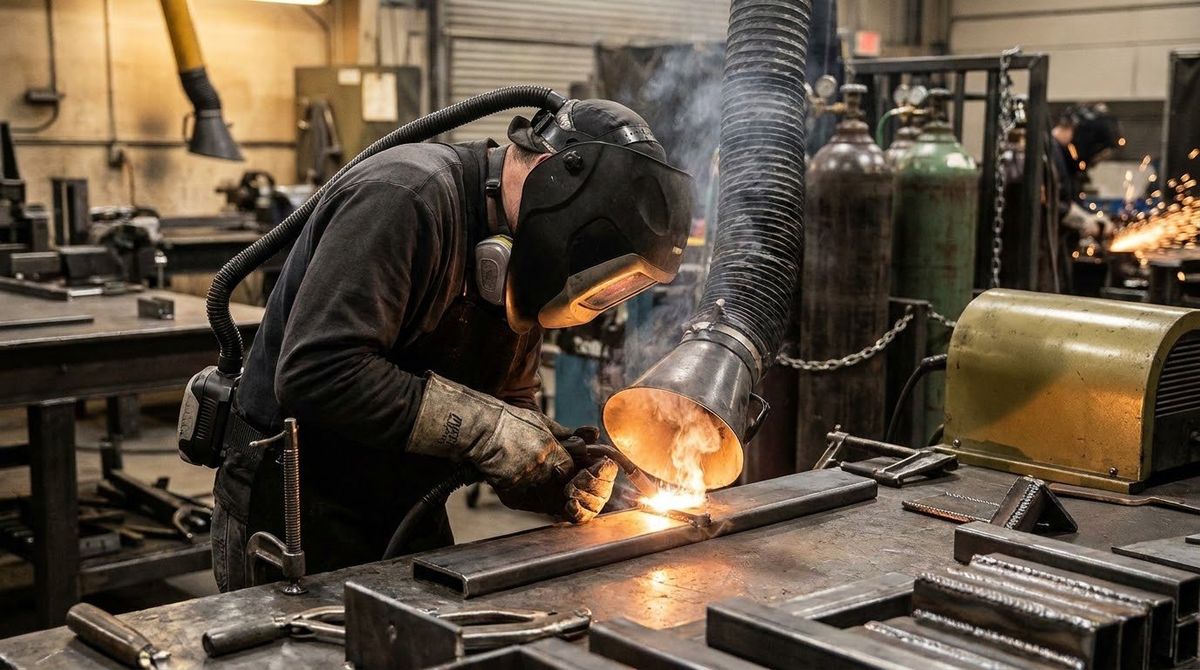
From the guide: Welding Safety and PPE: Fumes, Arc Flash, Shock, Fire and Gas Cylinders
Safety notice: This guide summarizes OSHA, NIOSH, and manufacturer welding fume guidance for educational purposes. It is not a substitute for workplace exposure monitoring by an industrial hygienist, your equipment manuals, or site-specific safety training.
Welding fumes are a complex mixture of vaporized metals, metal oxides, silicates, and toxic gases that pose serious respiratory and neurological risks if inhaled over time. Controlling those fumes requires combining proper work positioning, source-capture ventilation, and—when needed—respiratory protection, as outlined in our welding safety and PPE guide.
Whether you run a production fabrication bay or weld on weekends in a two-car garage, understanding what is in the plume and how OSHA and NIOSH standards apply keeps your lungs safe without ruining your shielding gas coverage.
What Is in Welding Fume and Why Is It Dangerous?
Welding fume consists of sub-micron solid particles formed when vaporized metal condenses in the air, alongside invisible shielding and arc-generated gases such as ozone, nitrogen oxides, and carbon monoxide.
Because the particles are microscopic, they bypass the upper respiratory tract and settle deep in the lungs. According to NIOSH researchers, the International Agency for Research on Cancer (IARC) classified welding fumes as carcinogenic to humans (Group 1) in 2017, an upgrade from the earlier Group 2B rating. Specific base metals, coatings, and filler wires add acute and chronic hazards:
- Hexavalent chromium [Cr(VI)]: Formed when welding stainless steel, high-chrome alloys, or chromate coatings. Regulated under 29 CFR 1910.1026, Cr(VI) is a known human lung carcinogen with an OSHA Permissible Exposure Limit (PEL) of 5 µg/m³ (8-hour time-weighted average) and an Action Level of 2.5 µg/m³.
- Manganese: Present in mild steel and most carbon-steel electrodes and wires. NIOSH states that prolonged exposure to high manganese concentrations (above 1 mg/m³) in air may lead to a Parkinsonian syndrome, and that confined-space welding can significantly increase exposure to manganese fumes.
- Zinc oxide: Released when welding or cutting galvanized (zinc-coated) steel. Breathing zinc oxide fume can cause “metal fume fever,” a short-lived flu-like illness.
- Fluorides, lead, and cadmium: Found in certain flux coatings, old paints, and plated fasteners. Lead and cadmium require strict OSHA substance-specific controls and never belong in an unventilated home shop.
OSHA 29 CFR 1910.252 Ventilation Rules
OSHA’s primary welding standard (29 CFR 1910.252(c)) requires mechanical ventilation whenever natural air movement cannot keep fumes and gases below safe limits, and sets explicit thresholds for enclosed spaces.
Under 1910.252(c)(2), mechanical ventilation is mandatory when welding or cutting in any of these conditions:
- A space with less than 10,000 cubic feet per welder.
- A room with a ceiling height under 16 feet.
- Confined spaces or areas where partitions, balconies, or structural barriers significantly obstruct cross-ventilation.
When general mechanical ventilation is used to meet this rule, OSHA specifies a minimum airflow of 2,000 cubic feet per minute (cfm) per welder—unless you instead use local exhaust hoods/booths or approved airline respirators.
For local exhaust ventilation (LEV)—such as a movable fume-extractor arm placed near the arc—OSHA requires enough airflow to maintain a capture velocity of 100 linear feet per minute (fpm) at the welding zone. A fixed enclosure (a top and at least two sides surrounding the work) must maintain a velocity away from the welder of at least 100 fpm. OSHA’s table sets minimum airflow by hood distance from the arc, for example 150 cfm at 4 to 6 inches and 600 cfm at 10 to 12 inches (based on a 3-inch flanged suction opening).
Confined Spaces and Toxic Metals
Welding inside tanks, boilers, crawlspaces, or enclosed pits is a high-risk confined space operation. Under 1910.252(c)(4), confined-space welding must be adequately ventilated; where ventilation is impossible, NIOSH-approved airline respirators or hose masks are required, and a worker must be stationed outside to ensure the safety of those inside when such equipment is used. Spaces that meet OSHA’s permit-required definition carry additional requirements under 29 CFR 1910.146. OSHA states flatly that oxygen shall never be used for ventilation.
The Hierarchy of Controls for Welding Fumes
Both OSHA and Miller Electric’s fume management guidance follow the Hierarchy of Controls: eliminate or substitute the hazard first, capture fumes at the source second, and rely on respirators only as a supplement or last line of defense.
| Control Level | Welding Example | Effectiveness |
|---|---|---|
| 1. Elimination / Substitution | Grind off galvanizing or paint before welding; change to a lower-fume process or consumable where feasible | Highest |
| 2. Engineering Controls | Source-capture LEV arms, fume-extraction MIG guns, downdraft tables | High |
| 3. Work Practice Controls | Keep your head out of the rising fume plume; clean oil and coatings off steel | Moderate |
| 4. PPE (Respiratory Protection) | Half-mask P100 respirator, PAPR welding helmet, or supplied-air hood | Supplemental / Last resort |
Process Choice Matters
Process type, base metal, and consumable composition all affect how much fume you are exposed to (Miller lists these as exposure factors), and overwelding can increase fume generation. Fume is the main contaminant in most welding, but gas-shielded processes can also generate significant ozone, which AWS notes is produced by arc ultraviolet radiation acting on atmospheric oxygen. You can compare how each process works in our types of welding processes guide.
Choosing Ventilation: Source Capture vs. Shop Air
Source-capture local exhaust ventilation (LEV) is far more effective than general shop exhaust fans because it pulls fumes away before they reach the welder’s breathing zone.
- Portable or wall-mounted fume extractors (LEV arms): Position the hood as near the work as practicable (OSHA’s hood table covers 4 to 12 inches from the arc, and Miller suggests about 1 1/2 duct diameters), angled so it captures the rising plume without pulling shielding gas off the puddle.
- Fume extraction MIG guns: Built-in vacuum nozzles integrated into the MIG gun pull smoke directly at the arc. They work well in heavy production bays where repositioning a hood arm slows the welder down.
- Home-shop and garage ventilation: If you weld occasionally in a garage without a dedicated LEV unit, open the main door and a cross-breeze window, position a gentle fan behind your shoulder (never blasting across the arc) to push the plume away from your face, and wear a P100 respirator.
Welding Respirators: P100 Half-Masks vs. PAPRs
When engineering controls and natural airflow cannot keep exposures below OSHA limits—or when welding stainless steel, galvanized metal, or flux-core in enclosed areas—wear a NIOSH-approved respirator rated at least P100.
- Half-mask elastomeric respirators with P100 filters: The P100 class filters at least 99.97% of airborne particles (an N95 filters at least 95%, per NIOSH). Particulate filters do not remove gases such as ozone or the vapors from solvents and primers; if gases are present, the respirator and cartridges must be selected under a respiratory protection program that follows OSHA 29 CFR 1910.134. Tight-fitting half-masks need a clean-shaven seal, and in workplaces they require medical evaluation and fit testing under that standard. Miller lists a protection factor of 10 for half masks.
- Powered Air-Purifying Respirators (PAPRs): A PAPR draws ambient air through a belt-mounted HEPA/P100 filter pack and blows clean, positive-pressure air inside a sealed welding helmet. Miller notes that a PAPR avoids the fit-check and clean-shaven requirements of half masks and lists a protection factor of 25 or more, though PAPRs are bulkier.
- Supplied-Air Respirators (SAR): Required in oxygen-deficient or immediately dangerous atmospheres where filtering ambient air is unsafe.
Safe Work Practices Every Welder Should Follow
Small habits on the shop floor dramatically cut how much fume reaches your lungs:
- Keep your head out of the plume: Never lean directly over the arc where the hot thermal column rises straight into your helmet. Weld from the side so the plume rises past your shoulder.
- Clean your base metal: Remove oil, grease, paint, and coatings such as zinc from the joint area before welding, and follow the cleaning-product manufacturer’s instructions because cleaners can be toxic or flammable.
- Never weld near chlorinated solvents: Degreasers such as tetrachloroethylene or trichloroethylene are decomposed by the arc’s ultraviolet radiation into toxic gases including phosgene (AWS), and OSHA requires degreasing with chlorinated hydrocarbons to be located so no vapors reach the welding atmosphere. Keep solvent rags and spray cans out of the welding bay.
- Watch for fire and cylinder hazards too: Ventilation fans and open bay doors can blow stray sparks farther than expected—review our welding fire safety and hot work guide before setting up cross-drafts.
Process-Specific Fume Differences and Maintenance
Different welding processes produce very different fume profiles, so your ventilation and respirator setup should match the job:
- Flux-Cored (FCAW) and Stick (SMAW): Fume output depends on the consumable and process. Use source-capture LEV whenever welding indoors with stick electrodes or self-shielded flux-core wire, especially on structural steel or heavy repair.
- MIG (GMAW): Fume is still generated, and Miller notes that fume extraction MIG guns are best suited to flat, in-position welding. AWS also notes significant ozone production in some GMAW operations, highest when welding aluminum with argon.
- TIG (GTAW): TIG can produce little visible smoke, which tempts welders to skip ventilation. However, AWS notes that significant quantities of ozone are produced in some GTAW operations, and nitrogen oxides are among the principal gases from arc welding. Both are invisible and are respiratory hazards.
Respirator and Filter Maintenance
A respirator or fume extractor only protects you if it is maintained properly. Inspect P100 particulate filters before every shift and replace them whenever breathing resistance increases, the filter becomes visibly dirty, or it gets damaged by sparks. Store elastomeric half-masks in a sealed zip bag away from shop dust and welding spatter so the inside of the facepiece stays clean. If you weld stainless steel commercially, remember that OSHA 29 CFR 1910.1026 requires employers to perform exposure assessments whenever materials or processes change, establish regulated areas above the 5 µg/m³ PEL, and offer medical surveillance to employees exposed at or above the 2.5 µg/m³ Action Level for 30 or more days per year.
Questions we get
Are welding fumes carcinogenic?
Yes. According to NIOSH and the International Agency for Research on Cancer (IARC), welding fumes are classified as a Group 1 carcinogen, meaning they are known to cause cancer in humans. Fumes from stainless steel and coated metals can also contain hexavalent chromium and nickel compounds, which further elevate lung cancer risk.
When does OSHA require mechanical ventilation for welding?
Under OSHA 29 CFR 1910.252(c)(2), mechanical ventilation is required when welding in a space with less than 10,000 cubic feet per welder, in a room with a ceiling height under 16 feet, or in confined spaces where partitions or balconies obstruct cross-ventilation. General mechanical systems must provide at least 2,000 cubic feet per minute per welder.
What is the best respirator for welding fumes?
When ventilation alone cannot keep exposures below safe limits, NIOSH-approved respirators with P100 particulate filters are the standard choice for welding fumes because P100 filters capture at least 99.97 percent of airborne particles. For heavy production or stainless steel welding, Powered Air-Purifying Respirators (PAPRs) or supplied-air systems offer higher protection and comfort.
What metals produce the most toxic welding fumes?
Stainless steel and chrome-plated metals produce hexavalent chromium, a potent lung carcinogen regulated under OSHA 29 CFR 1910.1026. Galvanized steel releases zinc oxide fumes that cause metal fume fever, while mild steel and many electrodes contain manganese, which NIOSH links to neurological damage after chronic overexposure.
Does a simple box fan protect you from welding fumes?
No, a household box fan is not a substitute for local exhaust ventilation. A small cross-draft can help move the plume away from your breathing zone in an open garage, but a fan only moves fume around rather than capturing it at the source, and strong air movement can disrupt shielding-gas coverage.
How do I know if my welding shop has a fume overexposure problem?
Professional air monitoring conducted by a qualified industrial hygienist is the only reliable way to measure actual worker exposure against OSHA limits. Visible haze hanging in the shop or throat irritation are warning signs that your current ventilation may be inadequate, but the absence of symptoms does not show exposure is safe.
Where we got this
- eCFR — 29 CFR 1910.252 Welding, Cutting, and Brazing (Ventilation) (ecfr.gov)
- eCFR — 29 CFR 1910.1026 Hexavalent Chromium Standard (ecfr.gov)
- CDC / NIOSH — Welding Fumes and Manganese (cdc.gov)
- CDC / NIOSH — Pocket Guide to Chemical Hazards: Welding Fumes (cdc.gov)
- Miller Electric — Welding Fume FAQs: Exposure, Extraction and Respiratory Protection (millerwelds.com)
- NIOSH (CDC Stacks) — Influence of Welding Fume Metal Composition on Lung Toxicity (stacks.cdc.gov)
- AWS — Effects of Welding on Health (EWH-I) (pubs.aws.org)
- CDC / NIOSH — Filtering Facepiece Respirators (cdc.gov)
- Miller Electric — Reduce Weld Fume Exposure by Choosing the Right Option (millerwelds.com)
Keep reading
- Welding Safety and PPE: Fumes, Arc Flash, Shock, Fire and Gas Cylinders
Welding safety and PPE guide covering OSHA 1910.252, ANSI Z49.1, fume ventilation, arc-eye protection, electric shock, fire watch, and gas cylinders.
- Best Welding Helmets: Auto-Darkening, Lens Shade and Fit
Compare auto-darkening and passive welding helmets by ANSI Z87.1 rating, lens shade range, optical clarity, and headgear fit for MIG, TIG, and stick.
- Welding Fire Safety and Hot Work Precautions
Follow OSHA 1910.252 and NFPA 51B hot work rules, the 35-foot combustible clearance rule, fire watch duties, and shop fire extinguisher selection.