Types of Welding Processes Explained: MIG, TIG, Stick, Flux-Core and More
The four primary arc welding processes are MIG (GMAW), TIG (GTAW), Stick (SMAW), and Flux-Core (FCAW). Each melts and fuses base metals using an electric arc, but differs in how filler metal is delivered and how the molten puddle is shielded from air. MIG is easiest for clean indoor steel, TIG delivers the highest precision, and Stick or self-shielded Flux-Core excel outdoors.
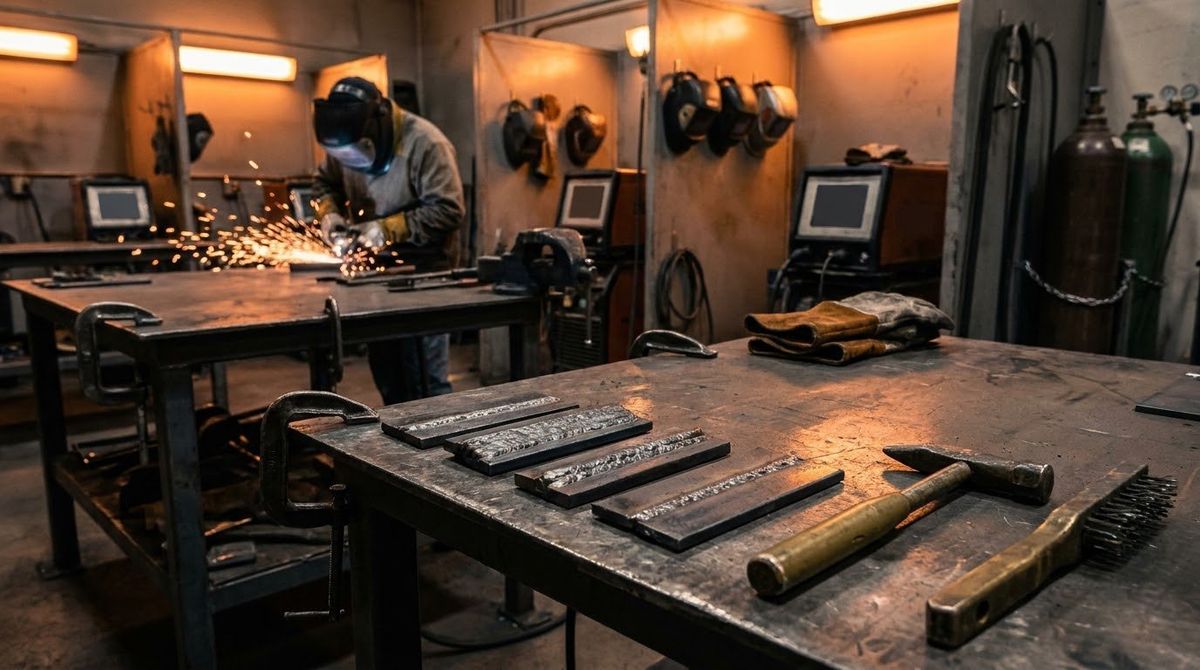
Welding joins metals permanently by using intense localized heat—most commonly an electric arc—to melt the base pieces and fuse them together, usually with a matching filler metal. While dozens of specialized industrial joining methods exist, nearly all shop, automotive, structural, and home-garage work relies on four core arc welding processes: MIG, TIG, Stick, and Flux-Core.
Each process uses a different combination of electrode, power curve, and atmospheric shielding to protect the molten weld puddle from oxygen and nitrogen in the air. Before striking any arc, make sure you follow baseline welding safety and PPE practices to protect your eyes, skin, and lungs.
How Arc Welding Works
In arc welding, a power source completes an electrical circuit between the electrode and the grounded workpiece. When the electrode approaches or touches the metal, current jumps across the small air gap, creating a sustained plasma arc hot enough to liquefy steel, stainless steel, or aluminum in seconds.
Because molten metal reacts rapidly with oxygen and nitrogen—creating brittle welds full of pinholes (porosity)—every arc process must shield the puddle until it solidifies. MIG and TIG flood the weld zone with bottled shielding gas, while Stick and self-shielded Flux-Core burn chemical flux that releases protective gas and forms a removable slag crust.
MIG Welding (GMAW): Fast, Clean, and Beginner-Friendly
Gas Metal Arc Welding (GMAW), universally known as MIG welding, feeds a continuous solid wire electrode through a handheld gun while external shielding gas flows out of the nozzle around the arc. Because the machine handles wire delivery automatically, MIG is the easiest process to pick up and the fastest way to lay long, clean beads on mild steel.
Strengths and Limitations of MIG
- Minimal cleanup: Solid-wire MIG leaves no slag crust to chip away, producing clean welds ready for paint or light grinding.
- High productivity: Continuous wire feeding eliminates frequent stops to swap rods, making MIG ideal for automotive panels, trailers, shop furniture, and production fabrication.
- Clean-metal and indoor requirement: Standard MIG requires bare, oil-free metal and an indoor or wind-sheltered workspace so drafts do not disperse the shielding gas.
To dial in gun angle, wire speed, and travel speed, read our starter MIG tutorial guide. You can also explore wire alloys in our MIG welding wire guide and compare machines in our starter MIG welders compared roundup.
TIG Welding (GTAW): Precision and Cosmetic Control
Gas Tungsten Arc Welding (GTAW), or TIG welding, uses a pointed, non-consumable tungsten electrode to maintain the arc while you manually dab a separate filler rod into the leading edge of the puddle. Most TIG welders use a foot pedal or torch-mounted amperage control, letting you feather heat up and down mid-bead.
Strengths and Limitations of TIG
- Unmatched control and appearance: TIG produces the neatest, spatter-free welds, making it the top choice for thin-wall tubing, stainless steel, chromoly, and aluminum (using an AC/DC machine).
- Zero slag and no wire-feed mess: You control exact filler placement, which prevents cold lap and minimizes post-weld grinding.
- Steeper learning curve and slower pace: Coordinating torch height, filler rod feeding, and pedal pressure takes practice, and travel speeds are slower than wire-feed processes.
Dive into tungsten preparation, gas lenses, and pedal technique in our TIG welding guide, or compare equipment in our TIG welders compared guide.
MIG vs. TIG Welding: Which Should You Learn First?
Shop owners and hobbyists frequently weigh MIG against TIG before buying their first power source. The right choice comes down to material thickness, cosmetic standards, and how much practice time you want to invest before building real projects.
- Pick MIG first if you primarily fabricate mild steel frames, trailers, brackets, or auto body panels and want strong welds within your first weekend of practice.
- Pick TIG first if you work on thin stainless steel, aluminum, bicycles, motorcycles, or custom fabrication where weld appearance and distortion control matter more than speed.
Read our full head-to-head process comparison, learn how drawings specify a weld in welding symbols explained, or test your exact project parameters in our welding process picker.
Stick Welding (SMAW): Rugged, Portable, and Weather-Resistant
Shielded Metal Arc Welding (SMAW), commonly called stick welding, uses a fixed-length metal rod coated in baked chemical flux. As the arc melts both the metal core and the flux, the coating generates its own shielding gas and leaves a hardened slag layer that protects the cooling weld.
Strengths and Limitations of Stick
- Works outdoors and on dirty steel: Because there is no external gas hose, wind cannot disrupt the shield. Stick electrodes like E6010 and E6011 cut through light rust, paint, and mill scale that would ruin a MIG weld.
- Simple, durable equipment: Stick machines have no wire drive rolls, liners, or gas regulators to maintain, making them reliable for field repairs, farm machinery, and heavy structural steel.
- More cleanup and harder thin-metal control: You must chip slag off every pass, replace stubs frequently, and use care to avoid burning through thin sheet metal.
Learn rod codes, arc striking, and slag control in our stick welding guide and welding rods and electrodes guide.
Flux-Core Welding (FCAW): High-Deposition Wire Without Wind Issues
Flux-Cored Arc Welding (FCAW) looks similar to MIG welding because it feeds a continuous wire through a gun, but the wire is a hollow tube packed with flux rather than solid metal. Flux-core comes in two distinct versions:
- Self-shielded Flux-Core (FCAW-S): Uses no external gas cylinder at all. The internal flux creates its own shielding gas and slag, allowing you to weld outdoors on windy job sites with a simple portable wire feeder.
- Dual-shield / Gas-shielded Flux-Core (FCAW-G): Combines flux-cored wire with external shielding gas (such as 75/25 Argon/CO2 or 100% CO2) for very high deposition rates and deep penetration on thick structural steel in fabrication shops.
Flux-core produces more smoke and spatter than solid-wire MIG and leaves a light slag layer to brush or chip off, so always pair it with strong ventilation. Learn setup, polarity (check the wire’s label), and technique in our flux-core welding guide.
Other Welding and Allied Processes You Will Encounter
Beyond the “big four” arc processes, industrial shops and repair technicians use several specialized methods:
- Oxy-Fuel Welding and Cutting: Burns oxygen and acetylene (or another fuel gas) to weld thin steel, braze dissimilar metals, or cut thick carbon steel plate without electricity.
- Submerged Arc Welding (SAW): An automated industrial process that buries the arc under a blanket of granular flux for heavy pressure vessels and structural beams.
- Resistance Spot Welding: Clamps overlapping sheet metal between copper electrodes and passes high current briefly to fuse auto body panels and enclosures.
- Brazing and Soldering: Join metals below the melting point of the base pieces using a lower-melting filler alloy drawn into the joint by capillary action.
Understanding Polarity: DCEP, DCEN, and AC
Every arc welding process depends on electrical polarity—the direction current flows between the electrode and the workpiece. Setting the wrong polarity is one of the fastest ways to ruin a weld bead:
- DCEP (Direct Current Electrode Positive / Reverse Polarity): The electrode lead is connected to the positive (
+) terminal and the work clamp to negative (-). Roughly two-thirds of the arc heat concentrates at the electrode/work interaction for deep penetration and stable transfer. Solid-wire MIG (GMAW) and most structural stick electrodes (such as E7018 and E6010) run on DCEP. - DCEN (Direct Current Electrode Negative / Straight Polarity): The electrode is connected to negative (
-) and the work clamp to positive (+). DC TIG welding is run on DCEN, and many self-shielded flux-core wires are also DCEN, but check the wire manufacturer’s polarity listing and your machine’s process/polarity table. - AC (Alternating Current): Current reverses direction continuously (60 cycles per second on U.S. mains, or at an adjustable frequency on many inverters). AC is essential for TIG welding aluminum, because the positive half-cycle blasts away tough surface aluminum oxide while the negative half-cycle drives penetration into the base metal. AC is also used on basic transformer stick welders with AC-rated rods like E6011 and E6013.
Welding Joint Types and Welding Positions
No matter which process you choose, every fabrication project combines five basic joint geometries and four standardized welding positions:
Five Basic Weld Joints
- Butt joint: Two pieces placed edge-to-edge in the same plane (often beveled into a V-groove on thicker plate for full penetration).
- Tee (T) joint: One piece set perpendicular to the face of another, joined with fillet welds along the inside corner.
- Lap joint: One piece overlapping the surface of another, welded along the exposed edge.
- Corner joint: Two pieces meeting at a right angle along their outer edges, common in sheet-metal boxes and frames.
- Edge joint: Two parallel edges placed side by side and fused along their shared rim.
Four Welding Positions
- Flat (1G/1F): Welding from above on a horizontal surface—the easiest position because gravity helps hold the molten puddle in the joint.
- Horizontal (2G/2F): Welding horizontally across a vertical surface or in the corner of a T-joint.
- Vertical (3G/3F): Welding straight up (vertical-up for maximum structural penetration) or down (vertical-down for thin sheet metal) on a vertical plate.
- Overhead (4G/4F): Welding from underneath a joint, requiring tight arc length, lower heat, and fast-freezing slag or puddle control so molten metal does not drip.
Matching the Process to Common Metals
Different metals conduct heat and react with oxygen differently, which narrows down your process choices:
- Mild Carbon Steel: The most forgiving metal. Welds cleanly with MIG (ER70S-6 + 75/25 Argon/CO2), Flux-Core, Stick (E7018, E6011), and DC TIG.
- Stainless Steel: Holds heat locally and warps easily because of lower thermal conductivity, and loses corrosion resistance if overheated or contaminated with carbon steel. Best welded with DC TIG (100% Argon, often with pulse) for thin/sanitary work, or MIG with stainless wire and tri-mix/Argon-rich gas, or stainless Stick rods.
- Aluminum: Conducts heat much faster than steel and forms a high-melting-point oxide skin. Best welded with AC/DC TIG (100% Argon) for thin or cosmetic parts, or MIG with a spool gun (100% Argon) for thicker plate and faster fabrication. Always clean aluminum oxide with a dedicated stainless-steel wire brush and acetone before striking an arc.
Metal Transfer Modes in MIG (Short-Circuit, Globular, and Spray)
Beginners often assume MIG welding operates the same way at every setting, but changing voltage and wire feed speed shifts how molten metal crosses the arc from the wire tip into the puddle:
- Short-circuit transfer: Used at lower voltages and wire speeds on thin sheet metal and out-of-position welds. The wire physically touches the workpiece, shorts out, pinches off a droplet, and reignites dozens of times per second. It produces the crisp “bacon sizzling” sound and keeps heat input low enough for auto body panels.
- Globular transfer: Occurs in a middle transition zone (especially with 100% CO2) where large, irregular droplets drop across the arc, creating heavy spatter and a rougher bead. Most fabricators dial past this range or stay below it in short-circuit mode.
- Spray transfer: Used at higher voltage and amperage with argon-rich gas mixes. Instead of shorting out, tiny molten droplets spray smoothly across the arc in a steady stream with virtually zero spatter and deep penetration—suited to flat and horizontal welds on thicker plate with machines that have enough output.
Common Weld Defects and What Causes Them
Recognizing visual weld defects helps you diagnose whether the issue is your process choice, machine settings, or hand technique:
- Porosity (pinholes): Gas bubbles trapped in the solidifying weld, usually caused by wind blowing away shielding gas, an empty cylinder, a clogged nozzle, or oil/rust on the base metal.
- Undercut: A groove melted into the base metal along the weld toe that is not filled back in, caused by excessive amperage, too long an arc length, or moving too fast.
- Cold lap (lack of fusion): The weld bead sits on top of the metal without melting into the root or sidewalls, caused by insufficient amperage/voltage or aiming the wire at the puddle instead of the leading edge.
- Slag inclusion: Trapped flux pockets inside Stick or Flux-Core beads caused by failing to chip slag between passes or letting slag run ahead of the arc.
- Burn-through: Melting completely through thin metal, caused by excessive amperage, slow travel speed, or loose joint gaps.
Eye Protection Shade by Process (OSHA 1910.252 Reference)
Every process above produces arc radiation, and the filter lens must be dark enough for the process and electrode size. OSHA’s shade guide in 29 CFR 1910.252(b) lists these minimum starting points:
- Shielded metal-arc (Stick): shade 10 for 1/16-, 3/32-, 1/8-, and 5/32-inch electrodes; shade 12 for 3/16-, 7/32-, and 1/4-inch electrodes; shade 14 for 5/16- and 3/8-inch electrodes.
- Gas-shielded arc welding (MIG-type) with the same smaller electrode sizes: shade 11 for nonferrous metals and shade 12 for ferrous metals.
- Gas welding: shade 4 or 5 (light, up to 1/8 inch), 5 or 6 (medium, 1/8 to 1/2 inch), and 6 or 8 (heavy, 1/2 inch and over).
- Torch brazing: shade 3 or 4. Soldering: shade 2.
OSHA’s table does not give a separate line for TIG, and the lowest-current arc welding can sometimes use a lighter shade than the table suggests, so follow your helmet manufacturer’s shade chart and your employer’s procedure. If you see spots after a weld, or your eyes feel gritty hours later, your shade or coverage was not adequate; stop, protect your eyes from further exposure, and seek medical care if symptoms persist. Bystanders need protection too, which is why screens and curtains matter even for short tack welds. The full checklist is in our welding safety and PPE guide.
How to Choose the Right Welding Process for Your Project
When selecting a process for a specific job, evaluate five practical questions:
- What metal and thickness are you welding? Thin aluminum and stainless favor AC/DC TIG; thin to medium mild steel suits MIG or Flux-Core; heavy structural steel favors Stick or Dual-Shield Flux-Core.
- Are you welding indoors or outdoors? Any outdoor breeze rules out standard MIG and TIG unless you erect windscreens—use Stick or self-shielded Flux-Core instead.
- How clean can you get the joint? Bright, freshly ground steel works with every process; pitted, rusty, or painted farm steel favors Stick or Flux-Core.
- What power outlet do you have? Check whether your garage or job site has 120V or 240V service before choosing a machine—see our 110V vs. 220V welders guide and welding amperage calculator.
- What finish quality is required? Structural hidden brackets prioritize penetration; visible furniture, exhausts, or sanitary welds favor TIG or dialed-in MIG.
Once you pick a process, match your machine in our welder selection guide and stock the right filler metals using our welding supplies and consumables guide.
| Process (AWS Code) | Electrode Type | Shielding Method | Slag Cleanup? | Best Use Case |
|---|---|---|---|---|
| MIG (GMAW) | Consumable solid wire | External gas (75/25 Ar/CO2 or 100% Ar) | No | Beginners, auto body, fast indoor steel fabrication |
| TIG (GTAW) | Non-consumable tungsten + hand rod | External gas (100% Argon) | No | Thin metal, stainless steel, aluminum, precision welds |
| Stick (SMAW) | Consumable flux-coated rod | Flux coating decomposes into gas + slag | Yes (chipping) | Heavy structural steel, rusty metal, outdoor/farm repair |
| Flux-Core (FCAW) | Consumable tubular flux-filled wire | Internal flux (FCAW-S) or flux + gas (FCAW-G) | Yes (light slag) | Thick steel, windy outdoor work, high deposition |
Start with MIG for clean shop fabrication and fast learning, pick Stick or self-shielded Flux-Core for outdoor and rusty-steel repairs, and choose TIG when cosmetic appearance and thin-metal control matter most.
All Welding Processes guides
- Flux-Core Welding (FCAW) Guide: Self-Shielded vs Gas-Shielded
Learn flux-core welding (FCAW): self-shielded FCAW-S vs gas-shielded FCAW-G, DCEN vs DCEP polarity, knurled drive rolls, drag technique, and fume safety.
- MIG vs TIG Welding: Differences, Costs and When to Use Each
Compare MIG vs TIG welding on speed, weld appearance, skill level, gas requirements, and equipment cost to pick the right process for your project.
- MIG Welding for Beginners: Setup, Technique and Common Mistakes
Learn MIG welding (GMAW) step by step: wire sizes, C-25 gas flow rates, DCEP polarity, gun angle, travel speed, and how to fix common weld defects.
- Stick Welding (SMAW) Guide: Rods, Amperage and Technique
Learn stick welding (SMAW): how E6010, E6011, E6013, and E7018 rods work, polarity and amperage ranges, arc striking, drag technique, and safety.
- TIG Welding Guide: How GTAW Works and How to Start
Learn TIG welding (GTAW) step by step: DCEN vs AC polarity, argon flow, tungsten prep, filler technique, and safety rules.
- Welding Joint Types and Positions: Butt, Tee, Lap, Corner, Edge and 1G-6G
Learn the 5 basic weld joint types and the flat, horizontal, vertical, and overhead positions, plus what the 1G-6G and 1F-4F position codes mean.
- Welding Symbols Explained: How to Read AWS Weld Symbols
Learn to read AWS A2.4 welding symbols: the reference line, arrow side vs other side, fillet and groove symbols, field weld flag, and the tail.
Questions we get
What is welding and how does it work?
Welding is a fabrication process that joins two or more pieces of metal by melting their edges together—often with an added filler metal—so they fuse into a single solid piece as the molten puddle cools. In arc welding, an electrical circuit creates an intense arc between an electrode and the workpiece, generating enough heat to melt the base metal.
What are the four main types of welding?
The four main arc welding processes are MIG (Gas Metal Arc Welding, GMAW), TIG (Gas Tungsten Arc Welding, GTAW), Stick (Shielded Metal Arc Welding, SMAW), and Flux-Core (Flux-Cored Arc Welding, FCAW). Together, these four methods handle everything from thin automotive sheet metal to heavy structural steel beams.
Which type of welding is easiest to learn for beginners?
MIG welding is the easiest process for beginners to learn because the machine feeds solid wire automatically at a set speed. You only need to guide the gun along the joint, whereas Stick requires maintaining arc length as the rod burns down and TIG requires coordinating a torch, filler rod, and foot pedal simultaneously.
What is the strongest type of weld?
When performed properly with the correct filler metal and full joint penetration, MIG, TIG, Stick, and Flux-Core welds can all exceed the tensile strength of the surrounding base metal. Stick and Flux-Core are favored on heavy structural steel, while TIG gives the most control on thin or critical joints; welder skill and procedure matter as much as the process.
Can you weld outdoors with MIG or TIG?
Standard MIG and TIG welding perform poorly outdoors because a breeze can blow away the external shielding gas, which causes porosity. For outdoor work, welders switch to Stick (SMAW) or self-shielded Flux-Core (FCAW-S), which protect the weld puddle using internal flux rather than bottled gas.
What safety equipment is required for all welding processes?
Every arc welding process requires an ANSI Z87.1-compliant welding helmet with the proper filter shade, safety glasses underneath, flame-resistant clothing, leather gloves, and adequate ventilation to keep fumes out of your breathing zone. Refer to OSHA 29 CFR 1910.252 and ANSI Z49.1 for full safety requirements.
Where we got this
- Understanding Common Welding Terms — A Guide for Beginners — MillerWelds (millerwelds.com)
- Buying Your First Welder: A Practical, Informative Guide for Do-It-Yourselfers — MillerWelds (millerwelds.com)
- Hobart Brothers — Technical Articles Archive (hobartbrothers.com)
- ESAB University — Welding & Cutting Content (esab.com)
- OSHA 29 CFR 1910.252 — General Requirements (Welding, Cutting, and Brazing) (osha.gov)
Keep reading
- Flux-Core Welding (FCAW) Guide: Self-Shielded vs Gas-Shielded
Learn flux-core welding (FCAW): self-shielded FCAW-S vs gas-shielded FCAW-G, DCEN vs DCEP polarity, knurled drive rolls, drag technique, and fume safety.
- MIG vs TIG Welding: Differences, Costs and When to Use Each
Compare MIG vs TIG welding on speed, weld appearance, skill level, gas requirements, and equipment cost to pick the right process for your project.
- MIG Welding for Beginners: Setup, Technique and Common Mistakes
Learn MIG welding (GMAW) step by step: wire sizes, C-25 gas flow rates, DCEP polarity, gun angle, travel speed, and how to fix common weld defects.
- Stick Welding (SMAW) Guide: Rods, Amperage and Technique
Learn stick welding (SMAW): how E6010, E6011, E6013, and E7018 rods work, polarity and amperage ranges, arc striking, drag technique, and safety.
- TIG Welding Guide: How GTAW Works and How to Start
Learn TIG welding (GTAW) step by step: DCEN vs AC polarity, argon flow, tungsten prep, filler technique, and safety rules.
- Welding Joint Types and Positions: Butt, Tee, Lap, Corner, Edge and 1G-6G
Learn the 5 basic weld joint types and the flat, horizontal, vertical, and overhead positions, plus what the 1G-6G and 1F-4F position codes mean.