Welding Supplies and Consumables: Wire, Rods, Shielding Gas, and Wear Parts
Welding consumables are the filler metals, shielding gases, tungsten electrodes, and front-end wear parts you replace as you weld. Matching your consumable to your process and base metal prevents porosity, weak joints, and feeding jams: mild steel MIG relies on ER70S-6 wire with 75/25 Argon/CO2 gas, structural stick welding uses E7018 or E6011 rods, and TIG uses pure Argon with ground tungsten.
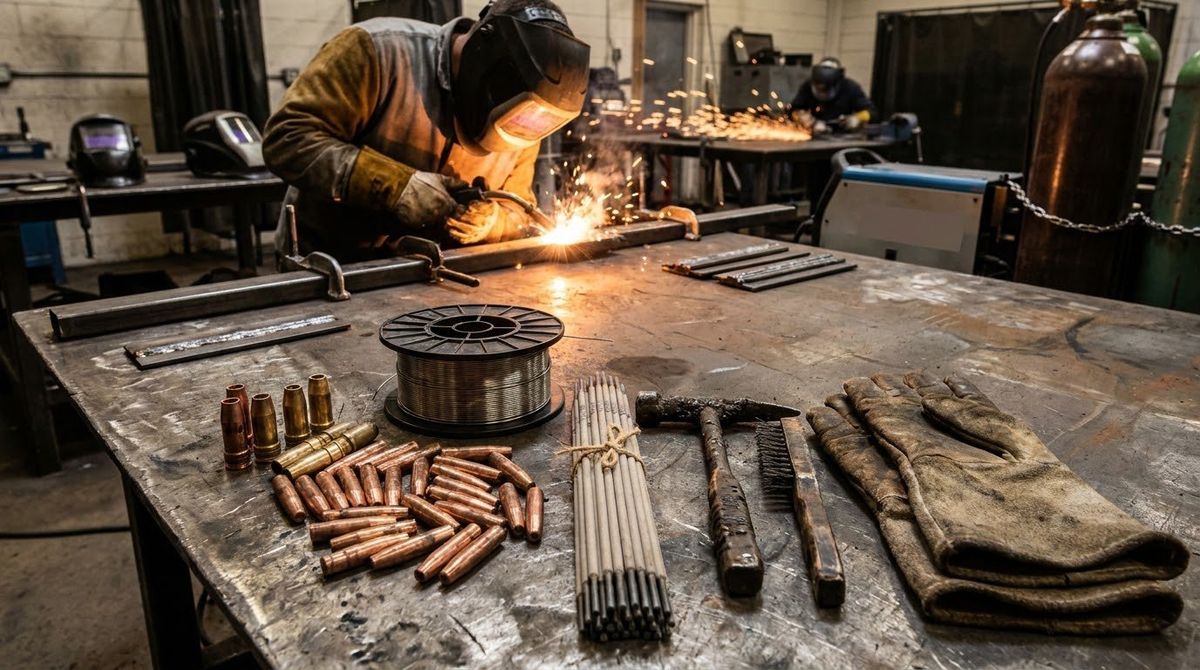
Even the best welding machine produces porous, brittle, or erratic welds if you feed it the wrong wire, damp electrodes, or mismatched shielding gas. Consumables—the filler metals, gases, non-consumable tungsten, and torch wear parts replaced over the life of a project—control bead chemistry, arc stability, and joint strength just as much as the power source itself.
This hub maps out every consumable category across MIG, Flux-Core, Stick, and TIG welding so you can stock your shop without wasting money on incompatible parts. Always pair consumable selection with proper welding safety and PPE—especially fume ventilation and safe gas-cylinder handling.
1. MIG and Flux-Core Welding Wire
Wire-feed processes (GMAW and FCAW) rely on spooled continuous electrodes sized to match your base metal thickness, machine amperage, and shielding method.
Solid MIG Wire (GMAW)
For mild carbon steel, ER70S-6 is the go-to AWS-classified solid wire. The “70” indicates 70,000 psi minimum tensile strength, “S” stands for solid wire, and “-6” denotes higher levels of silicon and manganese deoxidizers that help the puddle wet out smoothly over light mill scale.
- Diameter selection: Thinner wire (such as .023”/.024” or .030”) runs cleanly at lower amperages on automotive sheet metal and 110V machines, while thicker wire (such as .035” or .045”) carries higher current for thicker plate; follow the machine manual’s settings chart.
- Stainless and aluminum wires: Stainless steel requires matching 308L or 309L wires, while aluminum uses softer 4043 or stiffer 5356 alloy wire—usually fed through a spool gun or push-pull gun with U-groove drive rolls and a Teflon/nylon liner.
Flux-Cored Wire (FCAW)
Flux-cored wire is a hollow metal sheath filled with powdered flux and alloying elements:
- Self-shielded (FCAW-S): Requires no gas cylinder and runs outdoors in wind; polarity is typically DCEN (electrode negative). It leaves a light slag layer and produces more smoke and spatter than solid wire.
- Gas-shielded / Dual-Shield (FCAW-G): Uses both internal flux and external shielding gas for high deposition rates on thick structural steel.
Explore spool sizes, wire diameters, and alloy codes in our MIG welding wire guide, and review gun setup in our MIG setup basics and flux-core welding guide.
2. Stick Welding Rods and Electrodes (SMAW)
Stick electrodes use a four- or five-digit AWS classification (such as E7018 or E6011) that tells you tensile strength, usable welding positions, and flux coating chemistry:
- First two (or three) digits: Minimum tensile strength in thousands of psi (e.g.,
60= 60,000 psi;70= 70,000 psi). - Next-to-last digit: Welding positions (
1= all positions including flat, horizontal, vertical, and overhead;2= flat and horizontal fillets only). - Last digit: Flux type and current compatibility (AC, DCEP, or DCEN).
The Four Most Common Mild Steel Rods
- E7018: Low-hydrogen, iron-powder basic electrode for structural steel and heavy fabrication. Produces strong, ductile, low-spatter welds with an easy-peeling slag, but must be kept bone-dry.
- E6011: Fast-freeze cellulosic rod that runs on both AC and DCEP. Cuts through rust, paint, and oil for farm repair, dirty steel, and open-root passes.
- E6010: Deep-penetrating cellulosic rod similar to E6011, used heavily on pipeline root passes, but requires a DC power source with strong open-circuit voltage.
- E6013: Rutile-coated general-purpose rod with a soft arc and light penetration, popular for thin mild steel and hobbyist AC buzz-box machines.
Compare rod diameters, amperage ranges, and dry storage practices in our welding rods and electrodes guide and stick welding guide.
3. Shielding Gases for MIG and TIG
Shielding gas displaces oxygen, nitrogen, and water vapor around the molten weld puddle. Choosing the wrong gas—or running without gas on a gas-required wire—causes immediate porosity (pinholes) and brittle welds.
Standard Gas Blends by Process
- 75% Argon / 25% CO2 (C25): The standard blend for short-circuit MIG welding on mild steel. Argon stabilizes the arc and minimizes spatter, while CO2 adds penetration and flattens the bead.
- 100% CO2: A lower-cost alternative for mild steel MIG that gives deeper penetration but produces a harsher arc and more spatter.
- 100% Pure Argon: Mandatory for TIG welding steel, stainless steel, and aluminum, and also used for MIG welding aluminum (with a spool gun). Never use CO2-containing mixes for TIG—CO2 rapidly contaminates and erodes the tungsten electrode.
- Tri-mix (Helium / Argon / CO2): Used primarily for short-circuit MIG welding stainless steel to control bead profile and corrosion resistance.
Cylinder Safety and Flowmeter Setup
Always verify your regulator matches the cylinder’s CGA valve connection (for example, CGA-580 for inert gases like Argon and Argon/CO2 mixes). Secure cylinders upright to a cart or wall with a chain or strap, open valves slowly, and leak-test fittings with approved leak-detection solution—never an open flame. Check gas selection details in our shielding gas for MIG and TIG guide and cylinder safety rules in our welding safety and PPE guide.
4. TIG Tungsten Electrodes and Cut Filler Rods
Unlike MIG and Stick, the TIG electrode is non-consumable—it carries the arc while you feed a separate cut length of bare filler rod by hand.
- Tungsten types: Modern shops favor rare-earth 2% Lanthanated (blue) or 2% Ceriated (gray) tungsten because they start cleanly on both AC and DC without the low-level radioactivity of traditional 2% Thoriated (red) tungsten. Pure tungsten (green) is sometimes used on older transformer AC machines for aluminum.
- Tungsten grinding: Grind DC tungsten lengthwise (parallel to the electrode, never sideways) to a sharp taper on a dedicated wheel to keep the arc focused and avoid contamination.
- Cut filler rods: Match the filler rod to the base alloy—such as ER70S-2 or ER70S-6 for mild steel, ER308L for 304 stainless steel, and ER4043 or ER5356 for aluminum—and wipe rods clean with acetone or a lint-free cloth before welding.
Read full TIG setup details in our TIG welding guide.
5. Torch, Gun, and Front-End Wear Parts
Many wire-feed problems trace back to worn or mismatched front-end consumables rather than the machine itself:
- MIG contact tips: Match the contact tip to your wire diameter (a tip sized for .030” wire with .030” wire). Worn, egg-shaped tips cause erratic arc voltage and burnbacks.
- MIG gas nozzles and diffusers: Keep nozzles clean of spatter buildup with anti-spatter dip or gel so shielding gas flows in a smooth laminar column.
- Gun liners and drive rolls: Use V-groove drive rolls for solid steel wire, knurled V-groove rolls for flux-core wire (with light tension so you don’t crush the hollow tube), and U-groove rolls for soft aluminum wire.
- TIG collets, collet bodies, and gas lenses: Match the collet and collet body to your tungsten diameter (such as 1/16” or 3/32”). Upgrading to a gas lens replaces the standard collet body with a fine mesh screen that improves shielding coverage and lets you extend the tungsten farther into tight corners.
6. Shop Supplies, Abrasives, and Storage
Beyond filler metals and gas, keep these essential prep and cleanup consumables stocked:
- Abrasives: Flap discs, grinding wheels, and dedicated stainless-steel wire brushes (never use a carbon-steel brush on stainless or aluminum, as embedded iron particles cause rust).
- Surface prep: Acetone for degreasing aluminum and stainless joints (flammable, so let it evaporate completely and keep it away from the arc). Never use chlorinated brake cleaners; OSHA warns that ultraviolet light from the arc decomposes chlorinated solvents into toxic gases.
- Clamps and layout tools: Locking C-clamps, V-pads, welding magnets, soapstone/silver pencils, and a chipping hammer with safety glasses for slag removal.
7. How to Decode AWS Filler Metal Classifications
Understanding AWS filler metal codes prevents costly buying mistakes at the welding supply counter. Every standardized wire or rod name packs strength, alloy, and usability into a short alphanumeric label:
Decoding Solid MIG Wire (Example: ER70S-6)
ER: Electrode or Rod—meaning the wire can be used as a continuous MIG electrode (E) or cut into lengths as a TIG filler rod (R).70: Minimum weld deposit tensile strength in thousands of pounds per square inch (70,000 psi).S: Solid bare wire (as opposed toTfor tubular flux-cored wire).-6: Chemical composition suffix.-6contains higher silicon and manganese deoxidizers than-2or-3, helping the weld puddle flow smoothly and resist porosity over light mill scale.
Decoding Flux-Cored Wire (Example: E71T-11)
E: Electrode.7: Minimum tensile strength in tens of thousands of psi (70,000 psi).1: Welding positions (1= all positions including vertical and overhead;0= flat and horizontal only).T: Tubular flux-cored construction.-11: Usability and shielding designator.-11is a self-shielded (no external gas) wire designed for general-purpose single- and multi-pass mild steel on DCEN polarity, whereas-1denotes a gas-shielded dual-shield wire.
8. Consumable Storage, Shelf Life, and Moisture Control
Filler metals degrade quickly when left exposed to shop humidity, grinding dust, or oil mist:
- Preventing rust on MIG spools: Copper-coated or bare ER70S-6 wire rusts if stored in a damp garage. Rust flakes clog gun liners, wear out contact tips prematurely, and introduce hydrogen porosity into the weld. Remove unused spools from the machine if you won’t weld for weeks, and store them in sealed plastic bags with a desiccant pack.
- Protecting low-hydrogen stick rods: Keep unopened E7018 cans sealed until needed. Once opened, store E7018 electrodes in a heated cabinet or rod oven (Lincoln Electric specifies 120-150 C / 250-300 F), and follow the electrode maker’s exposure limits, because moisture pick-up can cause porosity and hydrogen cracking.
- Keeping TIG filler clean: Store aluminum and stainless TIG rods in labeled PVC tubes with end caps. Even invisible shop oil or aluminum oxide on filler rod creates black soot and porosity in a TIG puddle.
9. Common Consumable Troubleshooting Checklist
When a weld suddenly goes bad, inspect your consumables before blaming the machine:
- Bird-nesting wire at the drive rolls: Check for a clogged liner, wrong drive-roll groove (U-groove vs. V-groove), overtightened spool hub brake, or a worn/undersized contact tip causing burnback.
- Porosity in MIG or TIG welds: Verify cylinder pressure, inspect hose fittings for leaks, check that the nozzle/cup is free of spatter, and ensure shop fans or open garage doors are not blowing shielding gas off the puddle.
- Wandering or splitting TIG arc: Re-grind the tungsten lengthwise on a clean wheel, check for a cracked ceramic cup or loose collet, and verify that post-flow gas time is long enough to keep the hot tungsten shiny silver rather than blue or black.
See the published starting amps by process for published starting amps, and use our welding amperage calculator to pair your wire or rod diameter with starting machine settings, and browse our welding machine selection tips if you are outfitting a new shop.
| Process | Common Mild Steel Filler | Shielding Gas | Key Wear Parts | Storage Care |
|---|---|---|---|---|
| MIG (GMAW) | ER70S-6 solid wire | 75% Argon / 25% CO2 (or 100% CO2) | Contact tips, gas nozzle, diffuser, liner | Keep wire dry and sealed to prevent rust |
| Flux-Core (FCAW-S) | Self-shielded tubular wire (e.g., E71T-11) | None required (internal flux) | Flux-core nozzle/tip, knurled drive roll | Store in dry cabinet or sealed bag |
| Stick (SMAW) | E7018, E6011, E6010, E6013 rods | None required (flux coating) | Stinger jaws, ground clamp | Keep E7018 in rod oven or sealed tube |
| TIG (GTAW) | ER70S-2 or ER70S-6 cut filler rods | 100% Argon | Tungsten electrode, collet, collet body, ceramic cup | Keep filler rods clean and free of oil |
Stock ER70S-6 wire and 75/25 gas for indoor MIG, E7018 and E6011 rods for stick repair, and 100% Argon with clean cut rods for TIG.
All Welding Supplies guides
- MIG Welding Wire Guide: Types, Sizes and Choosing the Right Wire
Learn how to choose MIG welding wire by AWS class (ER70S-6, ER70S-2, aluminum, stainless) and wire diameter (.023, .030, .035, .045) for your steel.
- Shielding Gas for MIG and TIG: Argon, CO2 and Mixes
Compare C25 (75/25 argon-CO2), 100% CO2, and pure argon shielding gases for MIG and TIG welding, plus CFH flow rates and gas cylinder safety rules.
- Welding Amperage Chart: Settings by Process and Thickness
Starting welding amps by process, rod size and metal thickness for MIG, stick and TIG, plus gas flow ranges, from published manufacturer charts.
- Welding Rods and Electrodes Guide: 6010, 6011, 6013, 7018 Explained
Understand AWS stick electrode numbers and compare 6010, 6011, 6013, and 7018 welding rods by polarity, amperage range, penetration, and storage.
Questions we get
What is the difference between welding supplies and welding consumables?
Welding consumables are items that melt, burn, or wear down during welding—such as filler wire, stick electrodes, shielding gas, tungsten, contact tips, and grinding discs. Welding supplies is the broader category that includes consumables plus durable shop gear like helmets, clamps, chipping hammers, regulators, and welding carts.
What MIG wire and gas should I use for mild steel?
For general mild steel MIG welding, ER70S-6 solid wire paired with a 75% Argon / 25% CO2 (C25) shielding gas blend is a common choice, and Lincoln Electric lists 75/25 as the usual gas for ER70S-6, with 90/10 or 100% CO2 as alternatives.
Why do E7018 stick welding rods need dry storage?
E7018 is a low-hydrogen stick electrode whose flux coating readily absorbs moisture from humid shop air. Moisture introduces hydrogen into the molten weld puddle, which can cause underbead cracking in structural steel; Lincoln Electric advises storing opened cans or loose electrodes in a heated cabinet at 120-150 C (250-300 F), and specific codes may set exposure limits.
Can I use the same shielding gas for MIG and TIG welding?
No. Steel MIG welding typically uses an Argon/CO2 blend (such as 75/25 C25) because carbon dioxide stabilizes the arc and improves penetration on steel. TIG welding requires 100% pure Argon (or Argon/Helium mixes) because any CO2 or oxygen rapidly oxidizes and ruins the hot tungsten electrode.
How often should you replace MIG contact tips and liners?
Replace a MIG contact tip as soon as the bore wears oval, spatter welds the wire inside, or the arc begins stuttering. Replace the gun liner when wire feeding feels jerky or inconsistent after checking drive-roll tension—or whenever the liner is clogged or worn; follow the gun manufacturer's guidance.
What safety rules apply to welding consumables and gas cylinders?
Always secure compressed shielding gas cylinders upright with a chain or strap (OSHA 1926.350 requires cylinders to be secured upright), keep valve caps on when cylinders are not in use, never use oil or grease on gas fittings, and wear proper fume protection because flux coatings and filler alloys generate manganese and other hazardous fumes. See OSHA 29 CFR 1910.252 and 1910.253 for full rules.
Where we got this
- Lincoln Electric (Weldmark) — ER70S-6 MIG Wire Flyer (weldmark.com)
- Lincoln Electric — Welding Consumables Packaging, Storage and Handling (media.distributordatasolutions.com)
- OSHA 29 CFR 1926.350 — Gas Welding and Cutting (osha.gov)
- Understanding Common Welding Terms — A Guide for Beginners — MillerWelds (millerwelds.com)
- Buying Your First Welder: A Practical, Informative Guide for Do-It-Yourselfers — MillerWelds (millerwelds.com)
- ESAB University — Welding & Cutting Technical Content (esab.com)
- OSHA 29 CFR 1910.253 — Oxygen-Fuel Gas Welding and Cutting (Cylinders) (osha.gov)
Keep reading
- MIG Welding Wire Guide: Types, Sizes and Choosing the Right Wire
Learn how to choose MIG welding wire by AWS class (ER70S-6, ER70S-2, aluminum, stainless) and wire diameter (.023, .030, .035, .045) for your steel.
- Shielding Gas for MIG and TIG: Argon, CO2 and Mixes
Compare C25 (75/25 argon-CO2), 100% CO2, and pure argon shielding gases for MIG and TIG welding, plus CFH flow rates and gas cylinder safety rules.
- Welding Amperage Chart: Settings by Process and Thickness
Starting welding amps by process, rod size and metal thickness for MIG, stick and TIG, plus gas flow ranges, from published manufacturer charts.
- Welding Rods and Electrodes Guide: 6010, 6011, 6013, 7018 Explained
Understand AWS stick electrode numbers and compare 6010, 6011, 6013, and 7018 welding rods by polarity, amperage range, penetration, and storage.