Flux-Core Welding (FCAW) Guide: Self-Shielded vs Gas-Shielded
Flux-core arc welding (FCAW) feeds a tubular wire filled with flux through a MIG-style gun. Miller says self-shielded flux-cored welding is typically DCEN and needs no gas cylinder, and that FCAW suits dirty or rusted material and windy conditions. Gas-shielded wires such as E71T-1 run on DCEP with CO2 or argon-CO2 gas, so always check the wire label and data sheet.
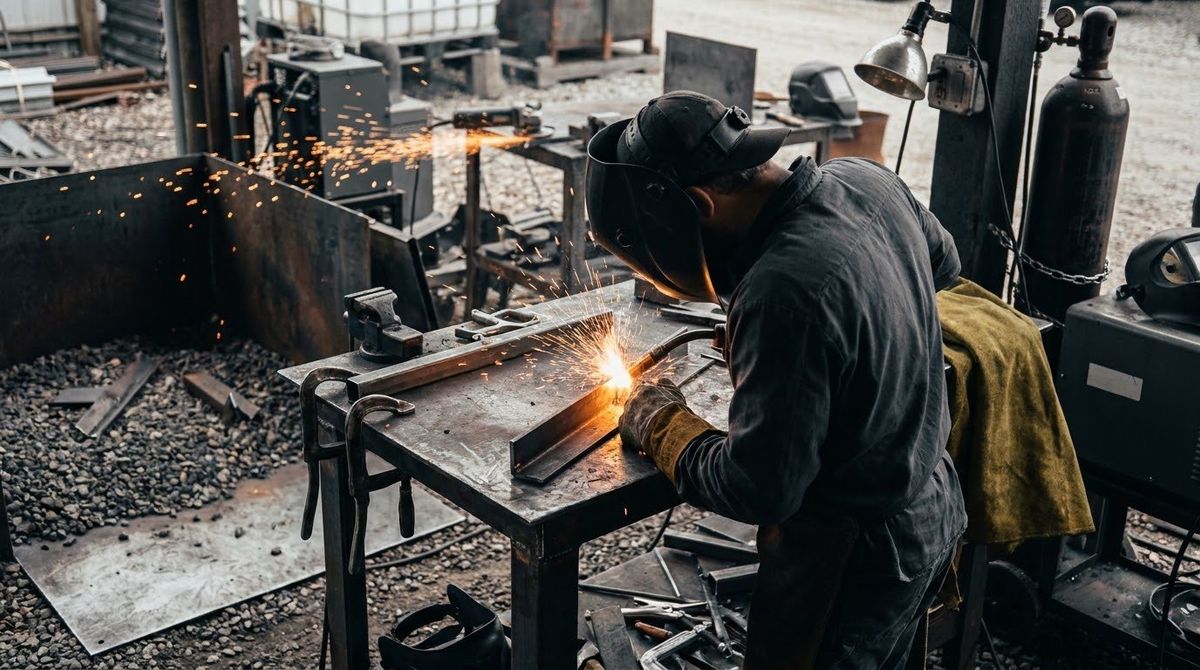
From the guide: Types of Welding Processes Explained: MIG, TIG, Stick, Flux-Core and More
Flux-Cored Arc Welding (FCAW) combines the continuous wire feed of MIG with the outdoor suitability of stick welding (Miller says FCAW and stick are equally suited to windy conditions), making it a cornerstone of our types of welding processes guide. Instead of a solid metal wire, FCAW feeds a hollow steel tube packed with powdered flux that shields the molten puddle and forms a protective slag layer.
For hobbyists and farm fabricators running machines from our beginner-friendly MIG machines guide, self-shielded flux-core lets you weld outdoors in the wind without buying a gas cylinder. Here is how self-shielded and gas-shielded flux-core differ, how to set up your machine, and how to manage FCAW fumes safely.
Self-Shielded (FCAW-S) vs. Gas-Shielded (FCAW-G)
Although both processes use tubular flux-cored wire, they are set up differently:
- Self-Shielded Flux-Core (FCAW-S): Uses wires such as E71T-GS (GS classes are single-pass only in the AWS table) or E71T-11 (single- or multi-pass). Miller says self-shielded flux-cored wire does not require shielding gas, and that it is typically DCEN (electrode negative); the AWS table lists E71T-11 as DCEN and GS wires with no polarity specified.
- Gas-Shielded / Dual-Shield Flux-Core (FCAW-G): Uses wires such as E71T-1 paired with the external gas its classification specifies (CO2 or 75-80% argon with balance CO2 in the AWS table). E71T-1 and E71T-9 run on DCEP (electrode positive). Do not use a different shielding gas than the wire is classified for without consulting the manufacturer, as the AWS table notes.
The amperage and settings calculator can give a starting point for your wire and thickness, though you should check it against the wire maker’s chart.
How to Set Up a MIG Welder for Self-Shielded Flux-Core
If you are switching a standard wire-feed machine from our beginner MIG tutorial to gasless FCAW-S, follow these four steps:
1. Set Polarity Per the Wire Label
Open the wire-feed compartment and follow your manual’s polarity instructions. For a DCEN wire, the gun is negative (-) and the work clamp is positive (+), but always confirm against your wire spool label or data sheet. Running a wire on the wrong polarity can cause an unstable arc and poor results.
2. Install a Knurled Drive Roll
Tubular flux-core wire is hollow and softer than solid wire. Smooth V-groove rolls can slip unless over-tightened, which crushes the tube flat. Install a knurled drive roll matched to your wire diameter (typically 0.030 inch or 0.035 inch) and set just enough tension to feed smoothly.
3. Swap to a Flux-Core Nozzle (or Gasless Tip Shield)
Because you are not flowing shielding gas, you can replace the brass MIG gas nozzle with a compact flux-core insulator tip. This improves visibility of the joint and keeps spatter from bridging inside the nozzle.
4. Set Longer Stick-Out
Follow the wire maker’s recommended stick-out (contact tip to work distance). Hobart’s catalog, for example, lists 1/2 inch for its E71T-11 in 0.030 to 0.045-inch diameters and 3/4 inch for 1/16-inch diameter. Check your machine’s door chart or our free welding tools for starting voltage and wire speed.
Flux-Core Welding Technique
- Follow the wire data sheet for gun angle: Because FCAW creates slag on top of the puddle, a drag (pull) angle, with the gun pointing back toward the finished weld, is the usual practice so slag trails behind the arc. Check your wire’s data sheet for the recommended technique.
- Clean slag between passes: Just like stick welding, chip and wire-brush every bit of slag off the bead before laying a second pass with multi-pass wire like E71T-11. (Note: single-pass E71T-GS wire is intended for single-pass welds only.)
- Watch thin sheet metal: Miller notes that thin metal is prone to burn-through and distortion, and recommends skip (stitch) welding to spread heat evenly.
- Control travel speed and puddle width: Keep the arc positioned on the leading edge of the molten pool. Moving too slowly can let slag run ahead of the arc, while moving too fast leaves a narrow bead with poor tie-in at the weld toes.
Flux-Core vs. Stick Welding for Outdoor Work
Both self-shielded flux-core and stick welding eliminate the need for an external shielding gas bottle in windy outdoor environments, so choosing between them depends on metal thickness and equipment portability:
- Choose self-shielded flux-core (FCAW-S) for outdoor repairs with a wire-feed machine you already own. Continuous wire feeding reduces start-and-stop tie-ins on long seams and avoids the need to change electrodes.
- Choose stick welding (SMAW) for heavier material or field positions away from a wire feeder. Miller notes stick welders can handle thicker metal, with multiple passes and slag removal, but can easily burn through metal that is 18 gauge or thinner.
If you already own a dual-voltage wire-feed machine from our 110V vs 220V welders guide, keeping a spool of self-shielded flux-core wire sized for your machine can turn an indoor MIG setup into an outdoor repair tool, if your manual lists flux-core capability.
Choosing the Right Flux-Core Wire (E71T-GS vs. E71T-11 vs. E71T-1)
Selecting the right wire classification prevents cracking and lack-of-fusion defects:
- E71T-GS (Self-Shielded, Single-Pass): The AWS table lists GS classes as single-pass only, with polarity not specified, so follow the manufacturer’s data sheet. Do not stack multiple passes with a single-pass wire.
- E71T-11 (Self-Shielded, Multi-Pass): The AWS table lists E71T-11 as no external gas, DCEN, single- or multiple-pass, for flat, horizontal, vertical-down and overhead positions. Hobart describes its E71T-11 as providing quality welds on dirty, rusty or coated materials. Chip and brush slag completely between passes.
- E71T-1 / E71T-9 (Gas-Shielded): The AWS table lists them as DCEP with CO2 or 75-80% argon / balance CO2 shielding and all-position welding capability (E71T-1 and E71T-9 are flat, horizontal, vertical-up and overhead). Check the wire’s data sheet and your machine’s rating.
Troubleshooting Common Flux-Core Defects
- Surface porosity or worm-tracking: Check voltage and stick-out against the wire maker’s recommendations and your machine’s chart, and make sure the wire is dry.
- Excessive spatter and erratic arc: Double-check that polarity matches the wire label (typically DCEN for self-shielded wires, per Miller). Applying anti-spatter spray or gel to the tip shield and surrounding workpiece also eases cleanup.
- Crushed wire at the feeder: Loosen drive-roll tension and verify you are using a knurled drive roll rather than a smooth V-groove roll.
- Moisture contamination: Store spare flux-core spools as the wire manufacturer recommends, away from moisture, because damp wire can cause porosity.
Flux-Core Welding Safety Rules (YMYL)
Because welding fumes vary with the wire and base metal, OSHA 29 CFR 1910.252 and ANSI Z49.1 precautions are critical—see our welding safety and PPE guide:
- Heavy fumes and ventilation: NIOSH notes that welding fumes are composed of metals and most contain some manganese, with long-term high exposure linked to neurological effects, and that exposure varies with the manganese in the wire, rods, flux and base metal. Never run flux-core in an unventilated space; use local exhaust or strong mechanical ventilation and appropriate respiratory protection.
- Spatter, fire, and hot work: Hot spatter and slag are fire hazards. Relocate combustibles at least 35 feet from the work site where practicable, shield what cannot be moved, wear leather gloves and flame-resistant clothing, and maintain a fire watch for at least a half hour afterward (OSHA 1910.252(a)).
- Slag-chipping eye protection: Wear safety glasses with side shields underneath your welding helmet at all times, especially while chipping hot slag, and use the filter lens shade OSHA 1910.252(b)(2) and your helmet’s chart specify for your process.
- Cylinder safety (FCAW-G): If running gas-shielded wire, OSHA 1926.350 requires cylinders to be secured upright with valve protection caps in place when moving them and valves closed when work is finished.
Disclaimer: Always follow your welder’s owner’s manual, wire manufacturer data sheets, and OSHA/ANSI Z49.1 safety rules.
Next Steps
Stock up on drive rolls, tips, and wire in our welding supplies and consumables guide, or compare outdoor processes in our stick welding guide.
| Feature | Self-Shielded (FCAW-S) | Gas-Shielded / Dual-Shield (FCAW-G) |
|---|---|---|
| Typical Polarity | Typically DCEN (check the wire label) | DCEP for E71T-1 and E71T-9 (check the wire label) |
| External Gas Cylinder | None required | CO2 or 75-80% argon / balance CO2, as the wire classification specifies |
| Outdoor / Wind Use | Miller: suited to windy conditions | Wind can disrupt the gas shield (Hobart Brothers lists turbulent gas flow as a porosity cause) |
| Common Wire Examples | E71T-11, E71T-GS | E71T-1, E71T-9 |
| Passes (AWS table) | E71T-11 single- or multi-pass; GS classes single-pass only | E71T-1 and E71T-9 single- or multi-pass |
Use self-shielded FCAW-S for outdoor work and portable repairs without a gas bottle. Use gas-shielded FCAW-G in a draft-free shop when your wire data sheet and machine support it.
Questions we get
What polarity is used for flux-core welding?
It depends on the wire. Miller says self-shielded flux-cored welding is typically DCEN. In the AWS A5.20 table in Hobart's catalog, E71T-11 is DCEN and gas-shielded E71T-1 and E71T-9 are DCEP, while GS-class wires have no polarity specified. Always verify polarity on the wire spool label or data sheet before connecting your machine.
Can I use a regular MIG welder for flux-core welding?
Many wire-feed machines can run flux-cored wire if the manual says so. Check the manual for polarity and drive-roll requirements, since flux-cored wire is tubular and often uses a knurled drive roll, and confirm the machine's wire size range. Turn off shielding gas for self-shielded wire, and follow the wire maker's recommended settings.
Do you push or pull flux-core welding?
Follow the wire manufacturer's data sheet and your machine manual. Because flux-cored wire forms slag, the usual practice is a drag (pull) technique so the slag trails behind the arc, but some wires and positions call for different techniques. Miller says FCAW requires slag chipping, so remove slag fully before each additional pass.
Is flux-core welding stronger than MIG welding?
Strength depends on the wire classification, procedure, joint design and freedom from defects rather than on the process name alone. Check the mechanical properties on your wire's data sheet, for example the tensile strength values Hobart publishes for each wire, and follow the applicable code for structural work.
Why does flux-core welding produce so much smoke and spatter?
The wire core contains flux ingredients that vaporize in the arc to shield the puddle. NIOSH notes that welding fumes are composed of metals and that exposure varies with the amount of manganese in the wire, rods, flux and base metal. Use local exhaust or strong mechanical ventilation, and never run flux-core in an unventilated space.
Can flux-core weld rusty or painted steel?
Miller says flux-cored welding is suited to dirty or rusted material, and Hobart describes its E71T-11 as providing quality welds on dirty, rusty or coated materials. Still remove heavy rust, flaking paint and oil. OSHA 1910.252(c) requires special ventilation controls for zinc-bearing, lead-bearing and cadmium-coated metals, so strip those coatings first.
Where we got this
- Hobart Brothers 2021 Filler Metals Catalog (AWS A5.20 flux-cored classification table) (codinter.com)
- Miller Electric: Welding Polarity Switches Made Easy (millerwelds.com)
- Miller Electric: MIG and Flux-Cored Welding on the Farm (millerwelds.com)
- Hobart Brothers: GMAW Troubleshooting Guide (hobartbrothers.com)
- Miller Electric: Buying Your First Welder — A Practical Guide for Do-It-Yourselfers (millerwelds.com)
- OSHA 29 CFR 1926.350 — Gas welding and cutting (cylinder handling) (osha.gov)
- OSHA 29 CFR 1910.252 — Welding, Cutting, and Brazing General Requirements (osha.gov)
- AWS / ANSI Z49.1:2021 Safety in Welding, Cutting, and Allied Processes (pubs.aws.org)
- CDC / NIOSH Welding Fumes and Manganese (cdc.gov)
Keep reading
- Types of Welding Processes Explained: MIG, TIG, Stick, Flux-Core and More
Learn the 4 main types of welding—MIG, TIG, Stick, and Flux-Core—how each works, compatible metals, and how to pick the right process.
- MIG vs TIG Welding: Differences, Costs and When to Use Each
Compare MIG vs TIG welding on speed, weld appearance, skill level, gas requirements, and equipment cost to pick the right process for your project.
- MIG Welding for Beginners: Setup, Technique and Common Mistakes
Learn MIG welding (GMAW) step by step: wire sizes, C-25 gas flow rates, DCEP polarity, gun angle, travel speed, and how to fix common weld defects.
- Stick Welding (SMAW) Guide: Rods, Amperage and Technique
Learn stick welding (SMAW): how E6010, E6011, E6013, and E7018 rods work, polarity and amperage ranges, arc striking, drag technique, and safety.
- TIG Welding Guide: How GTAW Works and How to Start
Learn TIG welding (GTAW) step by step: DCEN vs AC polarity, argon flow, tungsten prep, filler technique, and safety rules.
- Welding Joint Types and Positions: Butt, Tee, Lap, Corner, Edge and 1G-6G
Learn the 5 basic weld joint types and the flat, horizontal, vertical, and overhead positions, plus what the 1G-6G and 1F-4F position codes mean.