MIG Welding Wire Guide: Types, Sizes and Choosing the Right Wire
ER70S-6 solid wire is the most common mild-steel MIG wire, and Miller suggests 0.030-inch as a starting diameter for MIG steel, with .023-inch for thinner stock and .035-inch for thicker metal. Match the wire alloy to the base metal, such as an ER308L-type wire for 304 stainless and a 4043 or 5356 filler for aluminum, and match diameter to thickness and machine output.
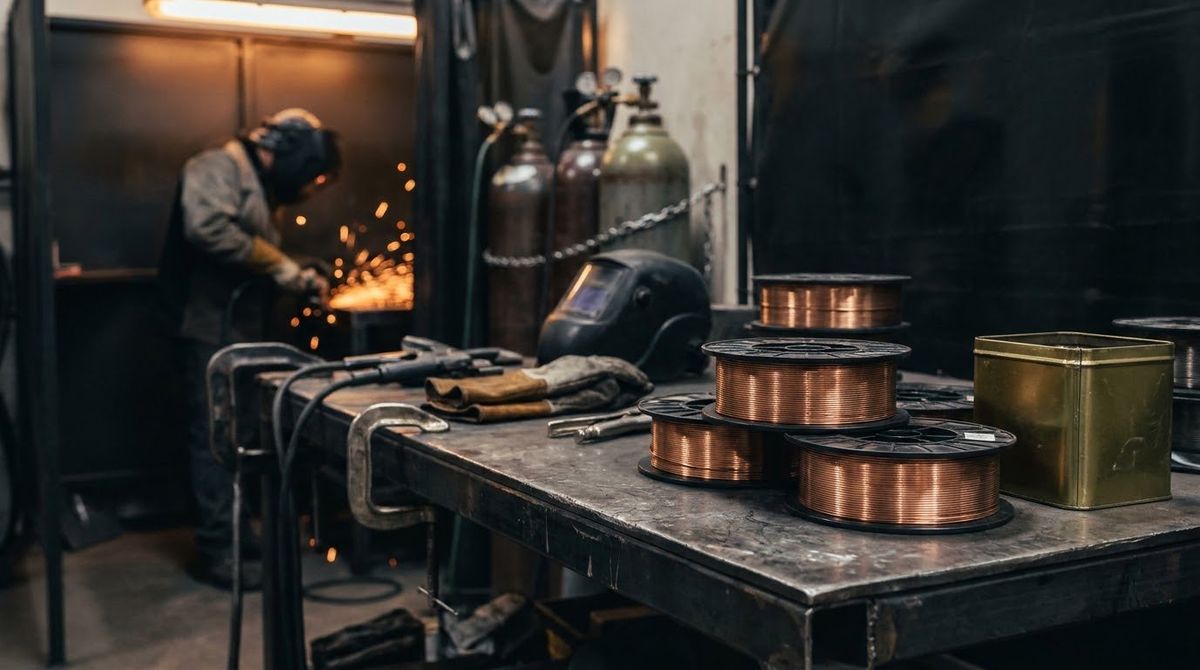
From the guide: Welding Supplies and Consumables: Wire, Rods, Shielding Gas, and Wear Parts
Choosing the right MIG welding wire comes down to two decisions: matching the wire alloy to your base metal, and matching the wire diameter to your metal thickness and machine amperage. Selecting the wrong wire leads to excessive spatter, cold lap, burn-through, or cracked welds—core fundamentals covered across our welding supplies and consumables guide.
This guide explains how AWS MIG wire classifications work, when to pick .023, .030, .035, or .045 wire, and how to set up your drive rolls, polarity, and shielding gas for clean, reliable beads.
How to Read AWS MIG Wire Classifications
AWS classification codes tell you the filler’s form, strength, and chemistry. Taking ER70S-6 as the common example (explained by Hobart Brothers):
- ER = the filler metal is an electrode or rod, so it can be used for MIG or as a TIG rod.
- 70 = 70,000 psi tensile strength.
- S = solid wire.
- -6 = chemical composition and shielding gas requirements.
Once you have picked a wire diameter, the amperage and settings calculator shows the published amp range for it, and the wire speed and gas flow reference adds wire speed and gas flow.
The higher silicon and manganese in ER70S-6, sold for example as Miller Quantum Arc 6, act as deoxidizers that make the wire useful for welding through light rust or mill scale, though Hobart Brothers adds that it is not the best choice for contaminated metal in general and can leave silicon islands that must be removed before painting. Miller lists ER70S-2 as a TIG filler for steel.
Solid MIG Wire vs. Flux-Cored Wire
Solid MIG wire requires an external cylinder of shielding gas and works best indoors, while self-shielded flux-cored wire generates its own gas shield and handles outdoor wind.
- Solid wire (GMAW / ER70S-6): Runs on DC electrode positive (reverse polarity) per Miller, with 75% Argon / 25% CO2 (C25) or 100% CO2 per Hobart Brothers. Solid wire deposits very little slag, though ER70S-6 can leave silicon islands to remove before painting.
- Self-shielded flux-core (FCAW-S / E71T-11 or E71T-GS): Needs no gas bottle, and many self-shielded flux-cored wires run electrode negative, the opposite of solid wire, so always set polarity as the wire label and your machine manual direct. As Miller Electric notes, a self-shielded flux-cored wire or stick electrode is typically a better choice than MIG or TIG outdoors, where gas-shielded processes are not recommended when wind reaches 5 mph or more. Flux-cored welding makes smoke that calls for proper welding fume ventilation.
MIG Wire Diameter Chart: .023 vs. .030 vs. .035 vs. .045
Wire diameter works like a nozzle size for heat: smaller wire suits thinner metal, and larger wire suits thicker metal and machines that can supply the current. Miller notes MIG welding covers material from 24-gauge up to 1/2-inch thick.
| Wire Diameter | Metric | Miller’s guidance |
|---|---|---|
| .023” / .024” | 0.6 mm | Thinner material, to reduce heat input; too hot on 1/4” steel |
| .030” | 0.8 mm | A good all-around size for many thicknesses; Miller suggests it for MIG steel |
| .035” | 0.9 mm | Thicker metal; Miller’s pick for 1/4” steel |
| .045” | 1.1 mm | Thicker metal, if your welder’s output can handle it |
For amperage, voltage, and wire speed, start from the chart inside your wire feeder door or your machine’s auto-set feature. Miller says settings depend on metal thickness, metal type, joint, position, gas, and wire diameter.
Why Wire Size Matters on Thin vs. Thick Steel
Miller says 0.024-inch wire runs too hot on 1/4-inch steel and becomes harsh and high-spatter, and that 0.035-inch wire would not weld light-gauge body panels well. Match the wire to the metal, and do not use filler thicker than the base metal.
If you only want to stock one spool, Miller’s suggestion of .030-inch ER70S-6 for MIG steel is a sensible starting point for a home shop. For starting settings, consult the chart inside your machine’s door or our welding tools and calculators.
Matching MIG Wire to Stainless Steel and Aluminum
Switching from mild steel to stainless or aluminum requires changing the filler alloy, shielding gas, and often the gun liner and drive rolls.
Stainless Steel MIG Wire (ER308L / ER308LSi / ER309L)
- ER308L or ER308LSi: Matches 18% Cr, 8% Ni austenitic stainless such as 304. ESAB says the low carbon content is recommended where there is a risk of intergranular corrosion, and the higher silicon improves wetting. Miller advises that stainless generally needs a filler that matches the base material.
- Dissimilar joints: Ask your filler manufacturer which wire suits joining mild steel to stainless rather than guessing.
- Gas: Miller describes 98% Argon / 2% CO2 as versatile for spray and pulsed spray transfer, and lists a 90% Helium / 7.5% Argon / 2.5% CO2 tri-mix for short-circuit work. Miller warns that too much CO2 can cause porosity, so follow the wire manufacturer’s gas recommendation.
Aluminum MIG Wire (ER4043 vs. ER5356)
- ER4043: ESAB calls it a general-purpose filler whose silicon additions improve fluidity, with no sensitivity to weld cracking and bright, almost smut-free welds. ESAB does not recommend it for anodizing.
- ER5356: ESAB describes it as a widely used general-purpose alloy chosen for its relatively high shear strength; it cautions that 5XXX base metal welded with 5356 and exposed to service temperatures above 65 degrees C (with more than 3% Mg) is susceptible to stress corrosion cracking. Miller mentions 5356 as a strong, tough option for heavy-duty projects.
- Feeding: Miller recommends a spool gun for MIG welding aluminum with 4043 or 4943. Follow your machine manual for liner and drive-roll choices.
- Gas: Always use 100% Argon for aluminum MIG welding.
Spool Sizes, Drive Rolls, and Wire Storage
Before buying a spool, verify which spool sizes your machine accepts, and match your consumables to the wire:
- Contact tip and liner: Match the contact tip bore and gun liner size to your wire diameter (e.g.,
.030tip for.030wire). - Drive roller profile: Use the roll type your machine manual specifies for the wire type and diameter, and set tension per the manual.
- Rust prevention: Hobart Brothers notes copper plating normally prevents corrosion, but any steel spool left in a damp shop can still rust. Keep spools dry and covered.
- Safety reminders: Always wear a welding helmet, welding gloves, and flame-resistant clothing, and verify your welding machine buying advice requirements if upgrading to spray transfer or spool-gun setups.
How Wire Size Interacts with Metal Transfer Modes
Your wire diameter and shielding gas determine which MIG transfer mode your machine runs:
- Short-Circuit Transfer: The wire touches the puddle and short-circuits repeatedly. Hobart Brothers calls 75% argon / 25% CO2 the preferred gas for it, which gives good arc transfer, lower spatter, and good bead appearance.
- Axial Spray Transfer: Hobart Brothers says spray transfer requires a minimum of 85 percent argon in the shielding gas, which reduces undercutting and gives a more fluid, controllable puddle. Miller suggests the 90/10 argon/CO2 blend for spray transfer on thicker plate.
Troubleshooting Common MIG Wire Feeding Problems
Even the right wire alloy will weld poorly if the wire delivery path is misadjusted. Check these four areas whenever your arc sputters or stutters:
- Birdnesting at the drive rolls: Occurs when wire tangles inside the feeder, usually from excessive drive-roll tension, a kinked gun liner, or a plugged contact tip. Set drive-roll tension per your owner’s manual, since Miller notes too much or too little tension causes poor feeding.
- Burnback into the contact tip: Can happen when the wire feed speed is too slow for the voltage setting or the stick-out is too short. Miller advises generally maintaining a stickout of about 3/8 inch and listening for a sizzling-bacon sound; too long a stickout can make the arc irregular.
- Erratic arc or poor electrical contact: Worn contact tips oval out over time and lose consistent current transfer to the wire. Swap in a fresh tip matched to your exact wire diameter whenever the bore looks oblong or copper-fouled.
- Dirty or kinked gun liner: Clean or replace the gun liner as the manufacturer directs (wear eye protection if you use compressed air), and replace liners that are kinked or damaged. Keep the MIG gun cable as straight as possible while welding so the wire feeds with minimal friction.
Reading a MIG Wire Spool Label
Before loading a new spool, check four details printed on the side label:
- AWS Classification: Confirms the exact filler alloy (
ER70S-6,E71T-11,ER4043,ER308LSi). - Diameter: Listed in inches and millimeters (e.g.,
.030"/0.8 mm). - Lot or Heat Number: Traceability code used in structural or code welding to match mill test reports.
- Spool Weight and Polarity Notes: Confirms the polarity the wire needs; solid MIG wire uses electrode positive per Miller, and some self-shielded flux-cored wires differ, so always check the polarity chart inside your welder’s wire-drive compartment before welding.
Quick Selection Summary by Project Type
If you are stocking consumables for a general fabrication or repair shop, three spools cover nearly every common job:
- Everyday mild steel fabrication: Keep .030-inch ER70S-6 with C25 shielding gas as your starting setup, moving to .035-inch for thicker metal.
- Thin sheet metal: Miller recommends .023-inch wire for thinner material to reduce heat input; use matching
.023contact tips. - Outdoor fence, gate, or trailer repair: Miller suggests 0.035-inch E71T-11 self-shielded flux-cored wire for outdoor work, and remember to set machine polarity as the wire’s label and your manual direct before striking an arc.
| AWS Class | Base Metal | Shielding Gas | Best Use Case |
|---|---|---|---|
| ER70S-6 | Mild / carbon steel | 75/25 Ar-CO2 (C25) or 100% CO2 | Most common mild-steel wire; tolerates light rust or mill scale |
| ER70S-2 | Mild / carbon steel | 100% Argon (TIG) | Common TIG filler for steel (Miller lists it in 1/16 and 3/32 in.) |
| ER308LSi | 304 / 304L stainless steel | Per wire maker; Miller lists 98/2 Ar-CO2 or tri-mix | Chemical and food processing, pipes, tubes (ESAB) |
| ER4043 | Aluminum | 100% Argon | General-purpose; not sensitive to weld cracking; not recommended for anodizing (ESAB) |
| ER5356 | Aluminum | 100% Argon | General-purpose; relatively high shear strength (ESAB) |
| E71T-11 (Flux-Core) | Mild steel (self-shielded) | None (flux core) | Outdoor work and wind; Miller suggests 0.035 in. |
Use ER70S-6 for most gas-shielded mild-steel MIG welding, choose self-shielded flux-core for outdoor work in wind, and match the filler to the base metal for stainless or aluminum.
Questions we get
What does ER70S-6 mean on MIG welding wire?
Per Hobart Brothers, ER means the filler can be used as an electrode or rod, 70 signifies 70,000 psi tensile strength, S means solid wire, and the 6 reflects chemical composition and shielding gas requirements. ER70S-6 has higher silicon and manganese, which act as excellent deoxidizers and help it weld through light rust or mill scale.
What size MIG wire should I use for 1/8-inch steel?
Miller calls .030-inch a good all-around diameter for many thicknesses and suggests .035-inch for thicker metal. Settings depend on metal thickness, joint, position, gas, and wire diameter, so start from the chart inside your wire feeder door or your machine's auto-set feature rather than a fixed number.
Can you use .023 or .024 MIG wire on thick steel?
No. Miller recommends the smallest wire, .023-inch, for thinner material to reduce heat input, and notes that 0.024-inch wire on 1/4-inch steel runs too hot and becomes harsh and high-spatter. For that thickness Miller recommends 0.035-inch wire instead, so match the wire diameter to the metal you are welding and confirm it against your machine's settings chart.
What is the difference between ER70S-6 and ER70S-2?
ER70S-6 has higher silicon and manganese, which Hobart Brothers says act as excellent deoxidizers for welding through light rust or mill scale, and it is the most common MIG choice for mild steel. Miller lists ER70S-2 as a TIG filler for steel, in 1/16 and 3/32-inch sizes, while recommending ER70S-6 (Quantum Arc 6) for MIG on relatively clean mild steel.
Do I need different drive rollers for different MIG wire sizes?
Yes, check the drive rolls whenever you change wire diameter or type, and follow your machine manual for the correct roll profile for solid, aluminum, and flux-cored wire. Miller notes that too much or too little tension on the drive rolls or spool hub can cause poor feeding, so set tension per the owner's manual.
Does MIG welding wire expire or go bad in storage?
Steel wire can rust in humid conditions, and Hobart Brothers notes that copper plating normally prevents corrosion while copper-free wire may rust during long storage. Rust and dirt on the wire can hurt feeding and weld quality, so keep spools dry, ideally covered or bagged, and replace wire that is visibly rusty.
Where we got this
- Miller Electric — Choosing What Filler Metal To Use for DIY Welding Projects (millerwelds.com)
- Hobart Brothers — Tips for Choosing a Solid Wire for Welding Applications (hobartbrothers.com)
- ESAB — Filler Metals Catalog (OK Autrod 4043, 5356, 308LSi) (assets.esab.com)
- Miller Electric — MIG Welding Basics for Mild Steel (millerwelds.com)
Keep reading
- Welding Supplies and Consumables: Wire, Rods, Shielding Gas, and Wear Parts
Complete guide to welding supplies and consumables: MIG wire (ER70S-6), stick electrodes (E7018, E6011), shielding gases, TIG tungsten, and gun parts.
- Shielding Gas for MIG and TIG: Argon, CO2 and Mixes
Compare C25 (75/25 argon-CO2), 100% CO2, and pure argon shielding gases for MIG and TIG welding, plus CFH flow rates and gas cylinder safety rules.
- Welding Amperage Chart: Settings by Process and Thickness
Starting welding amps by process, rod size and metal thickness for MIG, stick and TIG, plus gas flow ranges, from published manufacturer charts.
- Welding Rods and Electrodes Guide: 6010, 6011, 6013, 7018 Explained
Understand AWS stick electrode numbers and compare 6010, 6011, 6013, and 7018 welding rods by polarity, amperage range, penetration, and storage.