Welding Certifications Explained: AWS and Beyond
Welding certifications verify that a welder can produce sound welds meeting a specific code or procedure, most commonly through the American Welding Society (AWS) Certified Welder program. Unlike an employer-specific qualification, an AWS Certified Welder credential is earned at an Accredited Test Facility and transfers across employers as long as you maintain process continuity.
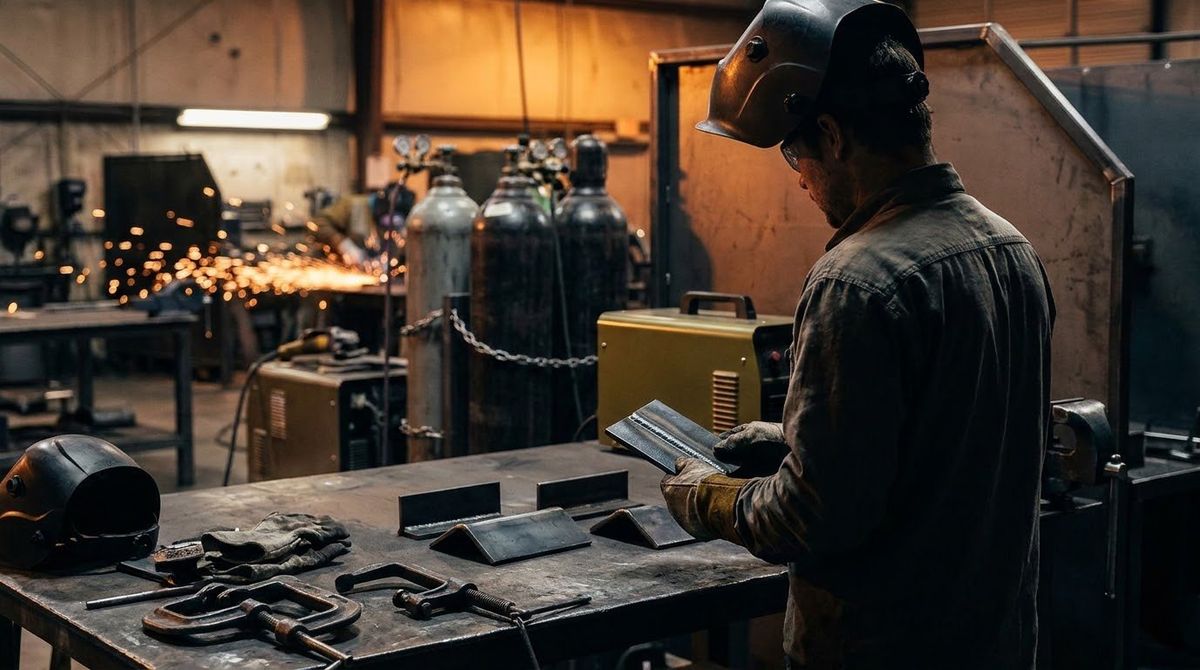
From the guide: How to Become a Welder: Training, Certification and First Jobs
Welding certifications verify that a welder can produce sound welds meeting a specific code or procedure, most commonly through the American Welding Society (AWS) Certified Welder program. If you are planning for a welding career, knowing which credentials employers actually look for—and which ones are only valid at a single shop—saves you time and money on testing.
Many beginners assume there is one universal “welding license.” In reality, welding credentials are tied to specific processes, joint positions, base metals, and industry codes. Understanding how those pieces fit together helps you pick the right test for the jobs you want.
Qualified vs. Certified: What Is the Difference?
In the welding industry, qualified and certified are not interchangeable terms, as the American Welding Society explains in its Welding Digest article on becoming a certified welder:
- Welder Qualification: When a shop or contractor gives you a pre-hire weld test on their own procedure and records your results, you become qualified to weld for that specific employer. If you leave that company, your qualification stays behind.
- Welder Certification: When you pass a performance test at an AWS Accredited Test Facility (ATF) under the AWS QC47 specification, you earn a Certified Welder (CW) credential. That record is maintained by AWS and is not tied to a specific employer, according to AWS.
Even with an AWS Certified Welder card, an employer may still require its own qualification test for a specific job or procedure. A CW credential is tested at an ATF and, per AWS, is not tied to a specific employer, project, or location.
How the AWS Certified Welder (CW) Program Works
The AWS Certified Welder program is designed to test practical ability rather than classroom seat time. There are no prerequisite courses or prior certifications required to schedule a CW test. If you can lay down a weld that passes inspection, you are eligible to earn the credential.
The program tests welders on procedures used across four major sectors:
- Structural steel
- Petroleum pipelines
- Sheet metal
- Chemical refineries
Step-by-Step Path to Earning Your CW
- Choose your process, code, and position: Decide which credential aligns with your target jobs—for example, stick welding or flux-core welding on structural steel plate, or TIG welding on pipe or sheet metal.
- Review the Welding Procedure Specification (WPS): Request the WPS from your chosen testing center so you know the exact base metal, filler metal, polarity, joint preparation, and position required.
- Schedule a test at an AWS Accredited Test Facility (ATF): CW exams must be taken in person at an accredited facility operating under QC47 standards.
- Complete the weld test under supervision: You perform the test weld while a qualified observer monitors compliance with the WPS and welding safety and PPE rules.
- Pass inspection and receive your credential: Once your test coupon passes visual and mechanical (bend) or radiographic testing, the ATF forwards your application and qualification test record to AWS.
- Maintain continuity: To keep your CW active, you must show you continue to use the certified welding process. AWS describes both a six-month maintenance form and an annual WeldCert Pro subscription, so confirm the current schedule with AWS.
Major Welding Codes and Standards You Will Encounter
Because different industries face different structural loads, temperatures, and pressures, no single test covers everything. Most commercial welding jobs fall under one of these primary codes:
| Code / Standard | Governing Body | Primary Applications |
|---|---|---|
| AWS D1.1 | American Welding Society | Structural steel buildings, bridges, and heavy fabrication |
| AWS D1.2 / D1.5 | American Welding Society | Structural aluminum (D1.2) and highway bridges (D1.5) |
| AWS D17.1 | American Welding Society | Aerospace fusion welding |
| ASME BPVC Section IX | ASME | Boilers, pressure vessels, and power or process piping |
| API 1104 | American Petroleum Institute | Cross-country oil, gas, and petroleum pipelines |
When you read job postings, notice which code is listed. Structural shops commonly ask for AWS D1.1 plate certifications, while refinery, power plant, and pipe shops look for ASME Section IX or API 1104 qualifications.
Common Weld Test Positions Explained
Every welder certification specifies the exact positions you are qualified to weld. Positions are designated by a number (1 through 6) and a letter (F for fillet welds or G for groove welds):
- 1F / 1G (Flat): Welding from the upper side of the joint with the weld face roughly horizontal.
- 2F / 2G (Horizontal): Welding along a horizontal axis on a vertical surface (groove) or inside a horizontal corner (fillet).
- 3F / 3G (Vertical): Welding vertically up or down on a vertical plate.
- 4F / 4G (Overhead): Welding from the underside of a joint.
- 5G / 6G (Pipe): Fixed horizontal pipe (5G) or pipe fixed at a 45-degree angle (6G), which requires welding flat, vertical, and overhead around the circumference without rotating the pipe.
Which positions a test qualifies you for depends on the code’s qualification tables, so confirm the range with the testing facility before you test. Practicing vertical (3G) and overhead (4G) plate positions is common preparation after welding school.
How Weld Test Coupons Are Inspected and Evaluated
Finishing a test plate or pipe is only half of the exam. Once your coupon cools, an inspector evaluates it in two stages:
- Visual Inspection (VT): Before any cutting or bending happens, the test administrator checks the finished weld against the code’s visual acceptance criteria. Excessive undercut, surface porosity, cracks, incomplete fusion, wrong weld size, or poor bead profile will fail a coupon immediately before it ever reaches the saw.
- Destructive Guided-Bend Testing: For most structural plate qualifications, strips are cut from the weld coupon, ground flush, and bent around a plunger in a guided-bend jig—testing the face, root, or side of the weld under extreme tension. Any open discontinuity or crack exceeding the code’s maximum allowable size causes the test to fail.
- Radiographic (X-Ray) or Ultrasonic Testing: On many pipe and pressure-vessel tests, non-destructive radiographic testing (RT) or ultrasonic testing (UT) is used to inspect internal soundness for slag inclusions, lack of penetration, or subsurface porosity.
Keeping Your AWS Certified Welder Credential Active
Unlike a driver’s license that simply renews on a calendar cycle, welding qualifications depend on continuity—proof that you are actively using the process you tested on. Under the AWS Certified Welder program, your credential remains valid as long as continuity is maintained. AWS’s program page describes submitting maintenance (continuity) documentation every six months and also an annual AWS WeldCert Pro subscription; confirm the current schedule with AWS.
Continuity requires documentation that you have kept welding with the process you were tested on. If continuity lapses, the certification may become inactive and you may need to requalify through testing, so keep copies of your work logs and continuity forms in one place.
Beyond CW: AWS Certified Welding Inspector (CWI) and Other Credentials
Once you gain years of shop or field experience, AWS offers advanced credentials that move you into quality assurance, supervision, or instruction—roles beyond production welding. See the welder salary data for what BLS reports for welders themselves.
The Certified Welding Inspector (CWI) is one of the most widely recognized credentials in the trade. Unlike a CW who makes the weld, a CWI inspects welds, reviews procedures, and verifies compliance against codes such as AWS D1.1, ASME Section IX, or API 1104.
Because CWI carries major safety responsibility, AWS enforces strict experience and education prerequisites:
| Education Level | Minimum Welding-Based Work Experience |
|---|---|
| Bachelor’s or higher in welding engineering or welding technology (max 4-year substitution) | 1 year |
| Associate or higher in welding, engineering technology, engineering, or a physical science (max 3-year substitution) | 2 years |
| Engineering/technical courses applicable to a welding bachelor’s degree (max 2-year substitution) | 3 years |
| Trade/Vocational courses (max 1-year substitution) | 4 years |
| High school diploma or equivalency | 5 years |
| 8th-grade schooling | 9 years |
| Less than 8th-grade schooling | 12 years |
Source: American Welding Society Certified Welding Inspector (CWI) application requirements.
Applicants must also submit an Employment Verification Form and a Visual Acuity Exam Form. The CWI exam has three parts (fundamentals, practical, and open-book code book), each requiring a minimum score of 72%. AWS also lists related credentials including Certified Associate Welding Inspector (CAWI), Certified Welding Supervisor (CWS), and Certified Welding Educator (CWE).
How to Prepare for Your First Certification Test
Passing an ATF test on the first try comes down to preparation and discipline:
- Practice on the exact joint and thickness: Do not practice only on thin scrap if your test uses thicker beveled plate with backing strips.
- Master your heat input and interpass cleaning: Slag inclusions and lack of fusion are weld defects that can cause a bend test to fail. Clean every pass thoroughly with a wire wheel or chipper before laying the next bead.
- Follow the WPS strictly: A good-looking weld still fails if you use the wrong filler metal, incorrect polarity, or amperes outside the procedure range.
- Stay sharp on safety: Every testing booth expects strict compliance with eye protection, fume extraction, and hot-work fire safety.
Sources
Questions we get
What is the difference between a qualified welder and a certified welder?
A qualified welder has passed a performance test administered by a specific employer or contractor, which is only valid for that employer's work. An AWS Certified Welder has passed a standardized performance test at an Accredited Test Facility (ATF), earning a portable credential recognized across employers and industries.
Do you need to go to welding school to get AWS certified?
No. The AWS Certified Welder program has no prerequisite education or training course requirements. Anyone who can safely operate the equipment and produce a weld that passes the required visual and destructive or radiographic tests at an Accredited Test Facility can earn the credential.
How long does an AWS Certified Welder certification last?
An AWS Certified Welder credential stays valid as long as you maintain continuity, meaning you keep using the welding process you tested on. AWS's program page describes submitting maintenance documentation every six months and also an annual WeldCert Pro subscription, so confirm the current schedule with AWS. If continuity lapses, the certification may become inactive and you may need to requalify by testing.
What is the most common AWS welding certification for beginners?
There is no single beginner certification. Structural steel plate tests under AWS D1.1 are a common choice for welders aiming at fabrication work, using processes such as stick (SMAW) or flux-core (FCAW). The positions and ranges a test qualifies depend on the code's qualification tables, so check the code and the testing facility before you pick a test.
What is the difference between AWS D1.1, ASME Section IX, and API 1104?
AWS D1.1 governs structural steel fabrication and erection such as buildings and bridges. ASME Boiler and Pressure Vessel Code (BPVC) Section IX covers pressurized vessels, boilers, and power or process piping. API 1104 is the standard for welding cross-country petroleum and natural gas pipelines.
How do you become a Certified Welding Inspector (CWI)?
To become an AWS Certified Welding Inspector, you must meet combined education and work-experience minimums—such as five years of welding-based experience with a high school diploma, or as little as one year with a bachelor's degree in welding engineering or technology—submit employment verification and visual acuity forms, and pass the three-part CWI exam (fundamentals, practical, and code book).
Where we got this
Keep reading
- How to Become a Welder: Training, Certification and First Jobs
Step-by-step guide to becoming a welder: trade school vs apprenticeships, AWS certifications, BLS median pay ($53,750/yr), and landing your first shop job.
- Welder Salary: How Much Do Welders Make?
U.S. welders earn a median wage of $53,750 per year ($25.84/hour), with the top 10% earning $77,530 or more based on BLS 2025 data.
- Welding School and Training Programs: What to Expect and How to Choose
Learn what welding schools teach, how long programs take, what AWS SENSE accreditation means, and how to compare trade schools and community colleges.