How to Become a Welder: Training, Certification and First Jobs
To become a welder, start with a high school diploma or equivalent, learn core processes (MIG, Stick, TIG, and Flux-Core) through a trade school, community college, or union apprenticeship, and earn an American Welding Society (AWS) certification. According to the U.S. Bureau of Labor Statistics, welders earn a median annual wage of $53,750 with roughly 40,300 annual job openings.
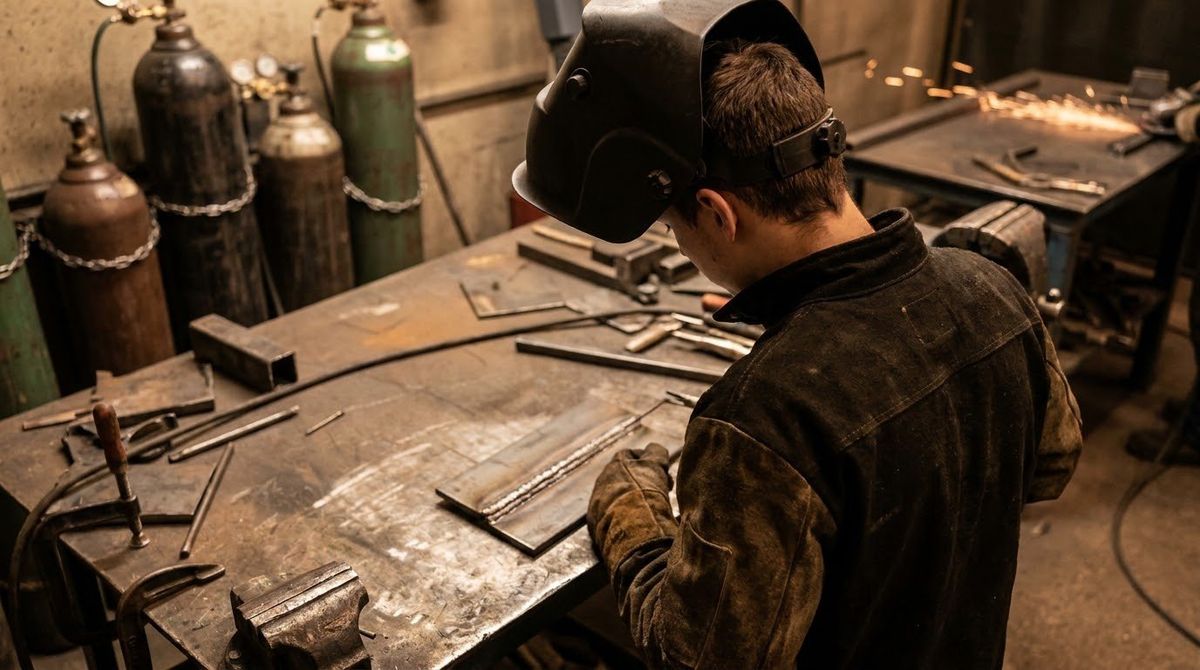
Becoming a welder is one of the fastest paths into a high-demand skilled trade without taking on four-year college debt. Whether you want to work in a clean manufacturing shop fabricating stainless steel, build structural bridges and buildings, or travel on industrial pipeline and plant turnarounds, the career path follows a clear sequence: learn safety and core arc processes, log supervised hood time, pass code-based qualification tests, and apply to entry-level shop or apprentice roles.
This guide walks through each step—from choosing a training route and earning AWS certifications to understanding realistic pay and landing your first welding job.
1. Understand What Welders Do and What the Job Pays
Welders, cutters, solderers, and brazers read engineering blueprints, fit and clamp metal parts, select the right filler metals and machine settings, and join components using processes like MIG, TIG, Stick, and Flux-Core. Beyond running beads, day-to-day work involves grinding, oxy-fuel or plasma cutting, inspecting welds for defects, and maintaining strict shop safety.
Salary and Job Outlook (BLS Data)
According to the U.S. Bureau of Labor Statistics (BLS) Occupational Outlook Handbook:
- Median annual wage: $53,750 per year (about $25.84 per hour), as of May 2025 data.
- Annual job openings: Roughly 40,300 openings each year are projected over the 2025–2035 decade (BLS attributes most openings to workers changing occupations or leaving the labor force) alongside a projected 2 percent employment growth.
- Pay progression: Entry-level production MIG welders typically start near the lower end of the scale, while welders who add out-of-position Stick, Flux-Core, TIG, or pipe qualifications—or work overtime on industrial shutdowns—can move well past the median.
Explore pay ranges by industry, specialty, and experience level in our welder salary guide.
What the BLS Says About Entry Requirements, Licensing, and Training
The Bureau of Labor Statistics Occupational Outlook Handbook is the most reliable single source on how people enter this trade, and it is worth reading directly before you commit to a school or a program:
- Education and training: The typical entry-level education is a high school diploma or equivalent, combined with technical school training or moderate-term on-the-job training. Employer-based apprenticeship programs are another way in, and BLS notes some apprenticeships accept workers with no prior experience.
- Licensing: Welders must be licensed in some states and localities, and requirements vary, so check with your state or city before assuming no license is needed.
- Certification: Professional organizations offer courses leading to general certification, and some employers require general or specific certification for certain jobs. A certification is not a legal requirement everywhere, but it can open doors with employers that ask for one.
- Safety training: BLS notes that OSHA requires welders to complete training on electrical safety, while other OSHA training is generally not required by the agency, although individual employers may require it.
- Growth and openings: Employment is projected to grow 2 percent from 2025 to 2035, slower than average, with about 40,300 openings each year on average, mostly from workers who change occupations or leave the labor force. That means steady hiring to replace workers, rather than rapid growth in the number of jobs.
Treat the pay figure as a national median for the whole occupation group, not a promise for your first job. Wages differ by region, industry, employer, and the processes and certifications you hold, and a median means half of workers earn less. Ask any school you are considering for its published completion and job-placement information, and ask local employers which processes and qualifications they hire for. If a program promises a specific salary or guaranteed job, ask to see the data behind that promise and compare it with the BLS figures above.
2. Build a Foundation in Shop Math, Blueprints, and Safety
Before you ever strike an arc in a job interview, employers expect you to know how to work safely and read basic fabrication drawings:
- Welding safety: Employers are required to follow OSHA rules, and many follow ANSI Z49.1, for arc-eye protection, fume ventilation, fire watch, and gas cylinder handling. Study our welding safety and PPE guide early—some schools include OSHA 10 training; ask the program.
- Blueprints and weld symbols: Fabrication shops hand you a print, not verbal instructions. Practice reading fillet, groove, and all-around symbols using our interactive weld symbols chart, and learn the joint and position names a print assumes in welding joint types and positions.
- Basic shop math: Comfort with fractions, decimals, tape-measure reading, and angle layout is essential for cutting and fitting parts accurately.
3. Choose Your Training Path: Trade School, Apprenticeship, or On-the-Job
There is no single national license to become a welder; BLS notes welders must be licensed in some states and localities, so check local requirements, and employers generally hire based on hands-on skill. Most welders enter the trade through one of three routes:
Technical Schools and Community Colleges
Vocational schools and community college welding certificates offer booth time in programs ranging from short certificates to two-year associate degrees. Good programs cover MIG welding, Stick welding, TIG welding, Flux-Core welding, blueprint reading, and thermal cutting, and often prepare you to sit for AWS qualification tests before graduation. Compare program types, costs, and questions to ask admissions teams in our welding school and training programs guide.
Union and Employer Apprenticeships
Unions and employers offer structured apprenticeships where you earn a paycheck on the job while attending classroom training; BLS notes that some apprenticeships accept workers with no prior experience. Entry requirements and program length vary by program.
Entry-Level Shop Helper / On-the-Job Training
Some manufacturing plants and fabrication shops hire motivated helpers to grind, clean, saw-cut, and tack-weld parts while training them on production MIG setups. This path avoids tuition entirely, though advancing beyond basic flat-position MIG often requires practicing out-of-position welds or taking evening classes on your own.
4. Master the Core Welding Processes in Order
If you are planning your training hours, prioritize processes in the order employers hire for them:
- MIG (GMAW) and Flux-Core (FCAW): The fastest processes to learn and the backbone of manufacturing, trailer building, and structural fabrication shops.
- Stick (SMAW): Essential for outdoor construction, structural steel, farm/heavy equipment repair, and qualification tests that may use E7018 in vertical and overhead positions.
- TIG (GTAW): Slower and harder to master, but opens doors to sanitary stainless steel, aerospace, motorsport, and root passes on critical pipework.
5. Earn Your Welding Certifications (AWS Explained)
A school diploma proves you attended class; a welding certification proves you can lay a code-quality weld under inspection. Under the American Welding Society (AWS) Certified Welder program, you weld a test at an AWS Accredited Test Facility, following a welding procedure specification, and a Certified Welding Inspector evaluates the weld against the applicable code or standard. Test positions and materials depend on the procedure you qualify to.
Important reality check: AWS states its certification is not tied to a specific employer, project, or location, but some employers still ask applicants to pass their own weld test. Learn how test positions, codes, and renewals work in our certification paths from AWS guide.
6. Pass Your First Weld Test and Land the Job
When applying for your first welding position, preparation on test day matters as much as your resume:
- Bring your own PPE: Show up to every shop interview with a clean ANSI-rated helmet, safety glasses, leather gloves, FR jacket or long-sleeve cotton shirt, and steel-toe boots.
- Ask what process and position the test uses: Confirm whether the shop test is short-circuit MIG, flux-core, or E7018 stick, and check plate thickness so you can set starting parameters cleanly (practice using our welding amperage calculator).
- Inspect and clean your metal: Grind mill scale bright if allowed, maintain steady travel speed, and clean slag thoroughly between passes; cold lap, undercut, and trapped slag are common visible defects.
7. Major Welding Career Paths and Work Environments
Not every welding job looks the same. Once you have baseline skills in MIG, Stick, TIG, and Flux-Core, you can steer your career toward very different environments, schedules, and pay ceilings:
- Manufacturing and Production Shops: Indoor, climate-controlled or semi-conditioned plants building trailers, agricultural equipment, industrial machinery, or consumer metal products. Work is typically indoors, with heavy reliance on MIG and dual-shield Flux-Core.
- Custom Job Shops and Architectural Fabrication: High-variety work reading new blueprints every week—building stairs, railings, food-grade stainless counters, and custom brackets. Requires strong math, layout, fitting, and both MIG and TIG versatility.
- Structural Steel and Ironwork: Outdoor construction erecting buildings, bridges, and industrial frameworks using Stick (SMAW) and self-shielded Flux-Core (FCAW-S). Demands comfort working at heights and in weather, and employers may require structural welder qualification.
- Pipe Welding, Refineries, and Power Plants: High-precision root and fill passes on pressure piping using Stick and TIG (including 6G inclined pipe tests). Often involves union dispatch or traveling contractor work during seasonal plant turnarounds, with pay that varies by contract and region.
- Aerospace, Motorsport, and Defense TIG: Clean-room or precision-bench environments welding thin titanium, Inconel, chromoly, and aluminum alloys to strict inspection standards.
- Advancement Beyond the Hood: Experienced welders frequently move into Certified Welding Inspector (CWI) roles, welding supervision, robotic weld-cell programming, or independent mobile repair businesses.
8. Basic Tool Kit for Your First Welding Job
While employers supply the welding machines, shielding gas, and filler metals, most fabrication shops expect entry-level welders to show up with their own personal PPE and basic hand/layout tools:
- Personal PPE: Auto-darkening or passive welding helmet (ANSI Z87.1), clear safety glasses with side shields, spare cover lenses, leather TIG and MIG/Stick gloves, FR welding jacket or sleeves, welding cap, and steel-toe leather boots.
- Layout and measurement: 25-foot tape measure, 6-inch combination square, soapstone holder or silver streak pencil, torpedo level, and a center punch.
- Prep and cleanup: Chipping hammer, stainless-steel and carbon-steel wire brushes, locking C-clamps or pliers (MIG pliers/Welpers for trimming wire and clearing nozzles), and a 4-1/2-inch angle grinder if the shop requires personal hand tools.
Your Next Step
- Exploring pay and specialties? Read How Much Do Welders Make?
- Comparing training options? Check Welding School and Training Programs
- Ready for credentials? Review AWS credential options
Questions we get
How long does it take to become a welder?
Program length varies by school: certificate programs at technical schools and community colleges are shorter than associate degrees, and apprenticeships combine paid on-the-job training with classroom instruction over a multi-year term set by the program. BLS lists a high school diploma plus technical school or moderate-term on-the-job training as the typical path. Check each program's published length.
Do you need a college degree to become a welder?
No. According to the U.S. Bureau of Labor Statistics, the typical entry-level education for a welder is a high school diploma or equivalent. Employers value hands-on arc time, blueprint reading, OSHA safety training, and the ability to pass a practical weld qualification test far more than a four-year degree.
How much do welders make starting out and at the median?
The U.S. Bureau of Labor Statistics reports a median annual wage of $53,750 ($25.84 per hour) for welders, cutters, solderers, and brazers. Half of welders earn less than the median and half earn more; pay varies with region, industry, and experience.
What is the difference between a welding certificate and an AWS welding certification?
A welding certificate is a graduation credential from a school showing you completed coursework and lab hours. An AWS welding certification (such as AWS Certified Welder) is a performance credential earned by completing a weld test under a specified procedure at an AWS Accredited Test Facility, where the weld is inspected against the applicable code or standard.
Which welding process should I learn first for a career?
Start by mastering MIG (GMAW) and Stick (SMAW) on mild steel, because they are widely used in fabrication, manufacturing, and structural shops. Adding Flux-Core (FCAW) and TIG (GTAW) broadens the jobs you can qualify for in heavy steel, stainless, and pipe; check local job postings to see what employers want.
What safety training do employers expect new welders to have?
Many employers expect new hires to know welding safety fundamentals such as PPE, fume ventilation, fire watch rules, and compressed-gas cylinder handling (see OSHA 29 CFR 1910 Subpart Q). BLS notes that OSHA requires welders to complete training on electrical safety; employers may also ask for OSHA 10 or 30 cards.
Where we got this
- U.S. Bureau of Labor Statistics — Occupational Outlook Handbook: Welders, Cutters, Solderers, and Brazers (bls.gov)
- American Welding Society — Certified Welder Program (aws.org)
- American Welding Society — Free Welding Resources & Safety Guides (aws.org)
- OSHA — Welding, Cutting, and Brazing Overview (osha.gov)
Keep reading
- Welder Salary: How Much Do Welders Make?
U.S. welders earn a median wage of $53,750 per year ($25.84/hour), with the top 10% earning $77,530 or more based on BLS 2025 data.
- Welding Certifications Explained: AWS and Beyond
Understand how AWS Certified Welder (CW), CWI, D1.1, ASME Section IX, and API 1104 certifications work, and how to test at an Accredited Test Facility.
- Welding School and Training Programs: What to Expect and How to Choose
Learn what welding schools teach, how long programs take, what AWS SENSE accreditation means, and how to compare trade schools and community colleges.