Welding School and Training Programs: What to Expect and How to Choose
Welding school and training programs teach hands-on arc welding processes, blueprint reading, metallurgy, and shop safety to prepare students for entry-level fabrication and construction jobs. Program length varies by school and credential, and BLS says employers often want technical training on top of a high school diploma. Choosing a program aligned with AWS SENSE standards gives you a published benchmark to compare curricula.
From the guide: How to Become a Welder: Training, Certification and First Jobs
Welding school and training programs teach hands-on arc welding processes, blueprint reading, metallurgy, and shop safety to prepare students for entry-level fabrication and construction jobs. If you are planning your path into welding, choosing between a short-term certificate, a community college degree, or a union apprenticeship shapes both your upfront costs and the types of jobs you qualify for on day one.
Not all welding programs deliver the same amount of booth time. Before you enroll or sign a tuition agreement, you need to know what a strong curriculum covers, how AWS SENSE standards work, and how to evaluate a school’s lab and job-placement track record.
Types of Welding Training Programs
Students entering the trade generally choose from four main training paths, each suited to different schedules, budgets, and career goals.
| Program Type | Typical Focus | Best For |
|---|---|---|
| Technical / Trade School Certificate | Intensive booth hours across core arc processes and cutting | Career-changers seeking fast entry into shop or field work |
| Community College Diploma or Associate Degree | Core welding processes plus metallurgy, blueprint reading, CAD, and general education | Students wanting broader fabrication, supervisory, or inspection pathways |
| High School CTE / Vocational Program | Introductory safety, oxy-fuel cutting, and basic MIG/stick skills | Students starting early before graduation |
| Union Apprenticeship | Paid on-the-job hours paired with classroom and lab instruction | Workers pursuing pipefitting, ironworking, or boilermaking careers |
Certificate and diploma programs focus almost entirely on getting you ready to pass an employer’s weld test. Associate degree programs take longer, but the extra coursework in metallurgy, testing, and layout can help if you later aim for welding engineering technology or inspection credentials.
What You Learn in Welding School
A well-rounded welding curriculum balances classroom theory with heavy hands-on practice under the hood. According to the American Welding Society (AWS) SENSE framework and standard occupational tasks tracked by O*NET OnLine, expect training across five core areas:
1. Welding Safety and Hazard Control
Safety comes before striking your first arc. Under OSHA 29 CFR 1910.252(a)(2)(xiii)(C), employers must ensure welders and supervisors are suitably trained in the safe operation of their equipment and the safe use of the process. Good schools drill these habits from week one:
- Proper selection and use of helmets, lenses, leather protection, and respiratory gear covered in our welding safety and PPE guide.
- Local exhaust ventilation and welding fume safety around mild steel, stainless steel, and galvanized coatings.
- Fire prevention, hot-work permits, and welding fire safety rules, including the OSHA 29 CFR 1910.252 requirements for a fire watch when combustibles are within 35 feet of the work and for a fire watch of at least 30 minutes after welding or cutting ends.
- Safe handling and securing of compressed shielding-gas and oxy-fuel cylinders.
2. Core Arc Welding Processes
Programs train students on the four primary industrial processes—MIG welding (GMAW), TIG welding (GTAW), stick welding (SMAW), and flux-core welding (FCAW)—along with oxy-fuel and plasma cutting. You start in the flat (1F/1G) and horizontal (2F/2G) positions on mild steel plate before progressing to vertical-up (3F/3G) and overhead (4F/4G) joints.
3. Blueprint Reading and Weld Symbols
Shops expect entry-level welders to read engineering drawings without constant supervision. Training covers orthographic views, tolerances, joint geometry, and interpreting weld symbols (our guide to welding symbols explained is a good primer) so you know the exact weld type, size, length, and finish required.
4. Machine Setup, Consumables, and Metallurgy
Knowing how to pull a trigger is not enough if you cannot troubleshoot porosity, undercut, or lack of fusion. Schools teach polarity selection, voltage and wire-feed speed tuning, electrode classification (such as E7018 and ER70S-6), and how base metals like carbon steel, stainless steel, and aluminum respond to heat input.
5. Destructive and Visual Inspection
In advanced modules, students cut and bend their own test coupons in a guided-bend jig to see firsthand how slag inclusions, incomplete fusion, or poor root penetration behave under stress.
Typical Progression Inside a Welding Program
Whether you enroll in a short certificate or a longer community college degree, many structured welding programs follow a similar step-by-step sequence so your skills build safely:
- Orientation, Safety, and Cutting: You start with welding safety and PPE, shop orientation, oxy-fuel torch setup, and plasma cutting before striking an arc. Learning to make clean, square cuts is essential because poor fit-up ruins weld quality.
- Flat and Horizontal Fillet Welds: Next, you spend weeks running stringer and weave beads on mild steel plate in the flat (1F) and horizontal (2F) positions, learning to read the puddle, control arc length, and maintain consistent travel speed.
- Out-of-Position Plate Welds: Once your flat beads are uniform, you move to vertical-up (3F/3G) and overhead (4F/4G) joints using stick welding and flux-core welding, fighting gravity and managing heat input.
- Wire-Feed and Precision Processes: Programs then expand into short-circuit and spray-transfer MIG welding on thinner sheet and structural plate, followed by TIG welding on carbon steel, stainless steel, and aluminum.
- Capstone Qualification Prep: Final terms focus on open-root groove welds, blueprint projects, and mock bend tests patterned after AWS certification standards.
Funding, Grants, and Financial Aid Options
Because welding programs range from short bootcamps to degree tracks, funding eligibility depends on the institution you choose:
- Accredited Community Colleges and Technical Institutes: Eligibility for federal student aid (FAFSA) depends on whether the institution and program are approved, so ask each school’s financial aid office what applies, along with any state workforce scholarships.
- AWS SENSE and Perkins Funding: AWS says SENSE’s built-in adherence to government regulatory and safety guidelines can strengthen a school’s applications for federal funding such as Perkins grants. That is about school funding, so it does not guarantee lower tuition for you.
- Workforce Boards and Employer Sponsorship: Local workforce development boards, veterans’ education benefits, and employer tuition programs may help with training costs; BLS notes some employers pay for training and testing. Eligibility varies.
- Union Apprenticeships: BLS says workers may enter the occupation through employer-based apprenticeship programs; some are open to people with no experience, while others require completing a vocational-technical welding program. Terms vary by program.
What AWS SENSE Accreditation Means
When researching schools, you will frequently see the acronym SENSE (AWS: “School for Excellence in Welding Education”). Launched by the American Welding Society in 1993 with a U.S. Department of Education grant, SENSE is not a single certification test; it is a national set of standards and guidelines for welding education (AWS titles it “School for Excellence in Welding Education”).
Programs aligned with AWS SENSE cover structured Entry Welder and Advanced Welder benchmarks across SMAW, GMAW, FCAW, and GTAW. Students who complete a SENSE-participating program receive an AWS SENSE Certificate of Completion and are listed in the AWS SENSE Training Database. AWS says SENSE’s adherence to federal regulatory and safety guidelines can strengthen school applications for federal funding such as Perkins grants.
School Certificate vs. AWS Certified Welder
A common misconception among prospective students is that graduating from welding school automatically makes you a “certified welder.” In reality, a school diploma proves you completed coursework; it does not replace code qualification.
As outlined in our guide to welder certification options, the AWS Certified Welder (CW) credential is strictly performance-based. You must weld a test plate or pipe in person at an AWS Accredited Test Facility (ATF) according to a specific Welding Procedure Specification (WPS), and your test coupon must pass visual and destructive or radiographic inspection.
Some trade schools and community colleges operate an ATF on campus or partner with a local testing center so students can sit for their first CW qualification test before graduation. Always ask whether certification testing is included in tuition or billed separately.
How to Evaluate and Choose a Welding School
Before committing to a program, schedule an in-person tour of the welding lab and ask direct questions:
- How many booth hours are guaranteed? Look for a program where the majority of instructional time is spent welding in an individual booth rather than watching demonstrations or sharing a machine with two other students.
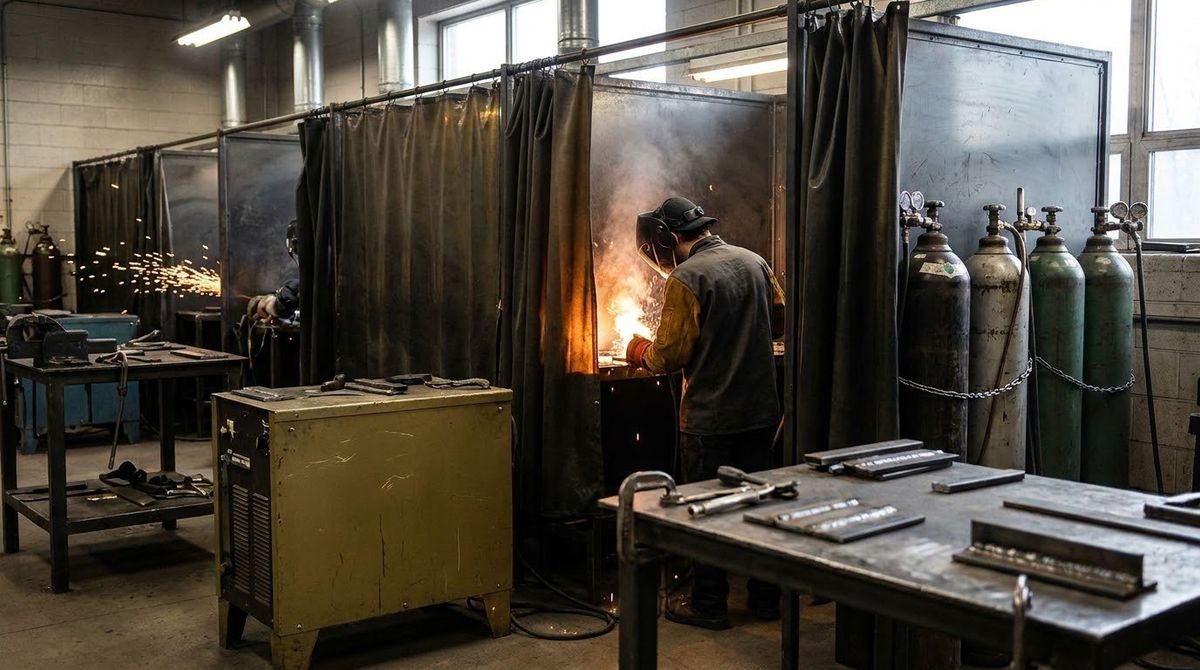
- Are ventilation and PPE standards enforced? Check that every booth has working fume extraction, welding curtains, and clean air circulation. If a school cuts corners on fume ventilation or eye protection, treat it as a red flag.
- What equipment is in the shop? You should train on industrial-grade constant-voltage (CV) and constant-current (CC) machines—not just light hobbyist units—so you are comfortable on real job-site power sources.
- Does the school follow AWS SENSE or offer ATF testing? Structured benchmarks and access to an Accredited Test Facility give your resume measurable weight when applying for jobs.
- What is the total out-of-pocket cost? Tuition, lab fees, personal PPE kits, and certification test fees vary widely between public community colleges and private technical institutes. Compare total costs against local starting wages in our welder salary guide so you avoid taking on unnecessary debt.
- Who hires their graduates? Ask for a list of local fabrication shops, shipyards, or contractors on the school’s advisory board and whether employers host on-campus weld tests.
Preparing Before Day One
You do not need prior shop experience to succeed in welding school, but showing up prepared accelerates your progress. Review the basics of types of welding processes so the terminology is familiar, buy properly fitting flame-resistant clothing and leather boots, and prioritize hand-eye steadiness and patience. Welding is a physical skill built through repetition—the more deliberate arc time you log, the faster you will be ready for your first shop test.
Sources
- American Welding Society: SENSE Program Overview
- American Welding Society: Certified Welder Program
- OSHA 29 CFR 1910.252: Welding, Cutting, and Brazing General Requirements
- BLS Occupational Outlook Handbook: Welders, Cutters, Solderers, and Brazers
- O*NET OnLine: 51-4121.00 - Welders, Cutters, Solderers, and Brazers
Questions we get
How long does welding school take to complete?
Program length varies by school and credential, and none of our sources gives a standard duration. BLS notes that technical training is offered through high school classes, vocational-technical institutes, community colleges, and private welding schools, and that even trained entry-level workers still receive several months of on-the-job training. Ask each school for its total program hours, credential type, and cost before enrolling.
What is an AWS SENSE welding program?
SENSE is the American Welding Society's school program, which AWS titles School for Excellence in Welding Education. Schools that participate structure training around Level I Entry Level Welder and Level II Advanced Welder benchmarks covering SMAW, GTAW, GMAW, and FCAW, and graduates receive an AWS SENSE Certificate of Completion and are listed in the SENSE Training Database.
Do you need welding school to get a welding job?
BLS says workers can enter the trade through employer-based apprenticeships as well as technical training, and that welders must be licensed in some states and localities, so check local requirements. A structured program gives you supervised practice across multiple processes, which can help with an employer's pre-hire weld test.
What processes do welding schools teach?
Most career-focused welding programs cover the four core arc welding processes: Shielded Metal Arc Welding (stick), Gas Metal Arc Welding (MIG), Flux-Cored Arc Welding (FCAW), and Gas Tungsten Arc Welding (TIG), the four processes AWS SENSE covers. Programs also commonly teach oxy-fuel cutting, plasma cutting, blueprint reading, weld symbols, and shop safety.
Does welding school make you a certified welder?
Graduating from welding school earns you a diploma, certificate, or degree, not an AWS Certified Welder credential. To become an AWS Certified Welder, you must pass a performance qualification test at an AWS Accredited Test Facility (ATF). Some schools operate an ATF on campus or schedule ATF testing before graduation.
What should you look for when touring a welding school?
Inspect the welding lab to verify each student gets an individual welding booth, functional ventilation and fume extraction, and modern multi-process power sources. Ask what percentage of total program hours are spent under the hood versus in the classroom, and whether the school aligns with AWS SENSE standards.
Where we got this
- American Welding Society: SENSE Program Overview (aws.org)
- American Welding Society: Certified Welder Program (aws.org)
- OSHA 29 CFR 1910.252: Welding, Cutting, and Brazing General Requirements (osha.gov)
- BLS Occupational Outlook Handbook: Welders, Cutters, Solderers, and Brazers (bls.gov)
- O*NET OnLine: 51-4121.00 - Welders, Cutters, Solderers, and Brazers (onetonline.org)
Keep reading
- How to Become a Welder: Training, Certification and First Jobs
Step-by-step guide to becoming a welder: trade school vs apprenticeships, AWS certifications, BLS median pay ($53,750/yr), and landing your first shop job.
- Welder Salary: How Much Do Welders Make?
U.S. welders earn a median wage of $53,750 per year ($25.84/hour), with the top 10% earning $77,530 or more based on BLS 2025 data.
- Welding Certifications Explained: AWS and Beyond
Understand how AWS Certified Welder (CW), CWI, D1.1, ASME Section IX, and API 1104 certifications work, and how to test at an Accredited Test Facility.