TIG Welding Guide: How GTAW Works and How to Start
TIG welding (Gas Tungsten Arc Welding, or GTAW) uses a non-consumable tungsten electrode and an inert shielding gas, typically argon, to melt base metal while you feed filler rod by hand. Miller says to set DCEN for steel and AC for aluminum, set argon flow to 15-20 cfh, keep the metal and filler rod clean, and keep gas flowing after you stop the arc.
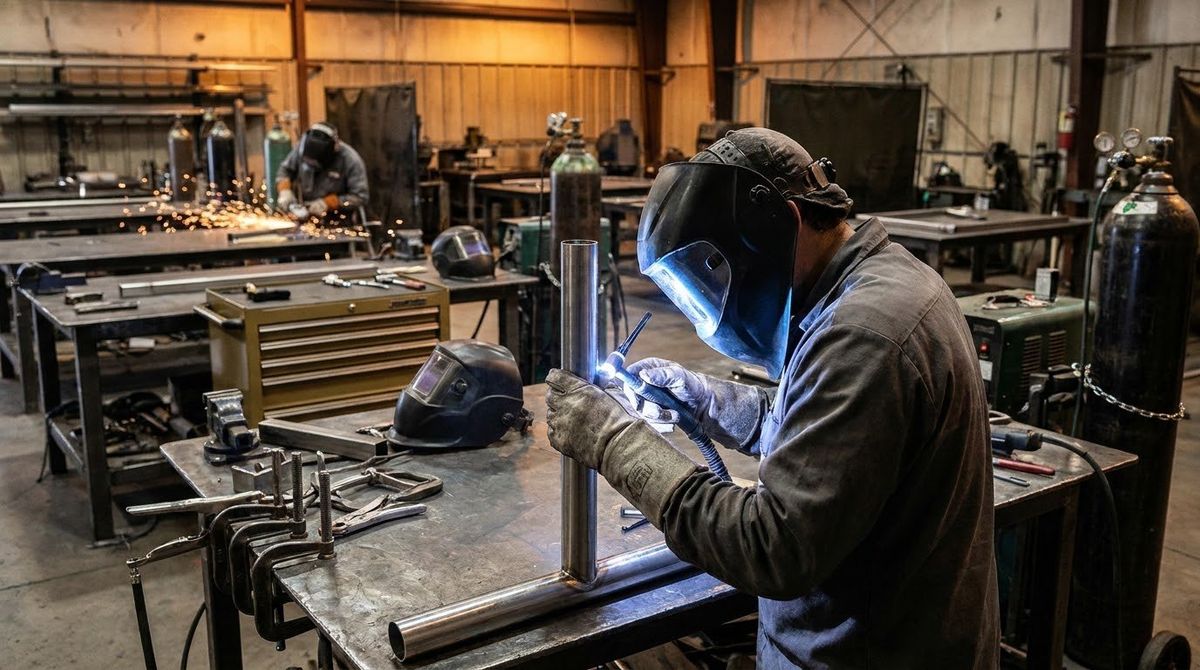
From the guide: Types of Welding Processes Explained: MIG, TIG, Stick, Flux-Core and More
Gas Tungsten Arc Welding (GTAW)—commonly known as TIG welding—gives you the highest level of precision, cleanliness, and heat control of any manual arc process in our types of welding processes guide. Because the tungsten electrode does not melt into the joint, you control heat input with a foot pedal in real time while dabbing filler metal independently with your free hand.
If you are weighing speed against precision, read MIG versus TIG differences, and if you are shopping for a machine, check our top TIG machines comparison. Below is how GTAW works, how to set up your torch and gas, and how to build clean muscle memory from your first arc.
How TIG Welding (GTAW) Works
In TIG welding, a constant-current (CC) power source sends current through a tungsten electrode held inside a hand torch. Shielding gas, typically argon, flows out of a ceramic cup around the tungsten, shielding both the red-hot electrode tip and the molten weld pool from oxygen and nitrogen.
A rough starting amperage for your metal thickness is available in the welding amperage calculator, which marks anything it could not source as unconfirmed.
When you press the foot pedal, the arc melts the base metal to form a small liquid puddle. You advance the torch slightly, dip the tip of a matching filler rod into the leading edge of the puddle, withdraw the rod, and repeat—creating the signature clean ripples TIG is known for.
TIG Polarity, Gas, and Tungsten Setup
Getting the machine settings right before you strike an arc prevents many beginner problems.
1. Select the Right Polarity
- DCEN (Direct Current Electrode Negative): Torch connected to negative (
-), work clamp to positive (+). Miller says to use DC TIG, or DCEN, for steel and steel alloys. Miller warns that the tungsten would melt if the polarity is wrong, because the heat would be in the tungsten instead of the workpiece. - AC (Alternating Current): Miller says to set the amperage to AC for aluminum. Miller adds that the balance control sets the cleaning versus penetration levels on aluminum, with typical balance settings of 70 to 80 percent.
2. Set Argon Shielding Gas
Connect an argon cylinder—Miller warns not to use the same gas you would use with a MIG welder. Miller’s TIG guide says to set shielding gas flow to 15–20 CFH and confirm the hose, valve and torch are not restricted. Also set post-flow: Miller says to keep gas flowing 10–15 seconds after stopping the arc, or about 1 second per 10 amps of weld current, to protect the hot tungsten and finished weld.
3. Choose and Prep Your Tungsten Electrode
Miller’s TIG guide describes 2% ceriated (gray) tungsten as versatile for AC and DC on steel, stainless and aluminum, and 2% lanthanated (blue) as suited to DC TIG. Match electrode diameter to your amperage using your machine manual or the electrode maker’s chart. Miller says tungsten should stick out of the cup by about 1/8 inch.
Everlast advises grinding the tungsten lengthwise, not radially across the tip, and using a clean, dedicated wheel so the tip is not contaminated.
4. Set Starting Amperage
Set maximum amperage using your machine manual or filler metal data for the metal and thickness you are welding. Miller says to practice controlling heat with the foot pedal and describes a target puddle of about 1/4 inch wide. You can look up starting ranges in our free welding tools.
Step-by-Step TIG Welding Technique
Clean Everything Spotlessly
TIG welding is unforgiving of contamination. Miller says to make sure the base metal is dry and free of condensation, and to eliminate grease, oil and moisture from both the base material and the filler rod. Grind off mill scale. Keep chlorinated degreasers away from the welding area (see the safety section), and use a dedicated brush on aluminum.
Practice Arc Length Without Filler First
Before adding filler rod, practice running dry “autogenous” passes on scrap steel:
- Hold the torch leaning slightly back in the direction of travel.
- Keep a short, consistent arc length and never let the tungsten touch the workpiece or puddle, as Miller says.
- Press the pedal until a shiny, circular puddle forms, then move smoothly forward at a steady pace.
Add Filler Rod Smoothly
Hold the filler rod at a shallow angle to the workpiece. Miller says selecting the correct filler rod is critical for weld quality, and for aluminum 4043 is commonly used. Keep the hot tip of the filler rod inside the shielding gas at all times so it does not oxidize between dabs, and dab the rod into the front edge of the molten puddle.
Taper Off at the End
Do not snap your foot off the pedal at the end of a bead. Ease off the amperage gradually while adding a final small dab of filler to fill the crater, then hold the torch still until post-flow gas stops.
Control Heat with Pulse and Foot Pedal
On bench-top jobs, a foot pedal lets you ramp amperage up quickly to establish the weld puddle on cold metal, then taper amperage down as heat builds toward the end of a joint. If your inverter includes pulsed TIG (GTAW-P), setting a peak current and lower background current can help control heat on thin material (Miller lists pulsed TIG among the best options for controlling heat on thin metal).
Common TIG Mistakes and Fixes
- Dipped tungsten: If the tungsten touches the puddle or filler rod, stop immediately, turn off the arc, and re-grind a clean tip. Welding with a contaminated tungsten causes an erratic, wandering arc.
- Black soot on aluminum or dull gray stainless welds: Miller says to maintain a steady 15-20 cfh flow and keep gas flowing after the arc stops, and to check that the hose, valve and torch are not restricted.
- Undercut or sunken weld: Either amperage is too high, travel speed is too fast, or you are not feeding enough filler rod.
TIG Welding Safety Rules (YMYL)
TIG welding carries the same hazards as other arc processes, and OSHA 29 CFR 1910.252 and ANSI Z49.1 safety rules apply in full—see our welding safety and PPE guide:
- Severe UV and arc-eye protection: TIG arcs produce intense ultraviolet radiation. Wear a helmet with the filter lens shade that OSHA 1910.252(b)(2) and your helmet’s chart specify for your amperage, side-shield safety glasses, TIG gloves, and flame-resistant sleeves that cover bare skin.
- Fumes and hexavalent chromium: NIOSH lists stainless steel welding as a source of hexavalent chromium exposure and says exhaust ventilation is often the best control, and notes that most welding fumes contain some manganese. Use local exhaust ventilation and, where needed, appropriate respiratory protection.
- Tungsten grinding safety: Thoriated tungsten contains thorium, which is radioactive. Studies summarized by AWS estimated welding and grinding exposures well below regulatory limits, but you can avoid the question with non-thoriated tungsten, and should grind with local exhaust and follow the electrode maker’s guidance.
- Keep chlorinated solvents away from the arc: OSHA 1910.252(c)(11) requires degreasing with chlorinated hydrocarbons to be located so vapors do not reach a welding operation, and says trichloroethylene and perchlorethylene should be kept out of atmospheres penetrated by gas-shielded arc ultraviolet radiation.
- High-frequency and cylinder safety: If you have a pacemaker or other heart device, talk to your doctor before welding; Medtronic advises limiting welding to currents under 160 amps and keeping the arc at least 24 inches from the device. OSHA 1926.350 requires gas cylinders to be secured upright.
Disclaimer: This guide is educational; always follow your welder’s owner’s manual, OSHA regulations, and ANSI Z49.1 safety standards.
Next Steps
Stock up on tungsten, cups, and filler rods in our welding supplies and consumables guide, or compare machine options in our TIG welder picks guide.
Questions we get
What does TIG stand for in welding?
TIG stands for Tungsten Inert Gas, and the process is also called Gas Tungsten Arc Welding (GTAW). The process creates an arc between a non-consumable tungsten electrode and the workpiece, with an inert shielding gas, typically argon, protecting the tungsten and weld puddle.
What polarity is used for TIG welding?
Miller's TIG guide says to set the machine to DC TIG, or DCEN, for steel and steel alloys, and to AC for aluminum. Miller also notes that on aluminum the balance control sets cleaning versus penetration. Check your machine manual and filler metal data for other alloys.
What shielding gas is used for TIG welding?
Miller says an inert gas, typically argon, protects and cools the tungsten and puddle, and its TIG guide says to set flow to 15-20 cfh. Miller also warns not to use the same gas you would use with a MIG welder. Check your machine and filler metal data for gas requirements for your specific alloy.
Why does my tungsten keep balling up or turning black?
Inadequate shielding gas coverage is a common cause. Miller advises keeping gas flowing 10-15 seconds after you stop the arc, or about 1 second per 10 amps of weld current, and notes that drafts can disrupt shielding gas. Miller also says to confirm you are on DCEN, not DCEP, because the tungsten can melt if the polarity is wrong.
How sharp should I grind my TIG tungsten?
Everlast, a TIG machine maker, says to grind tungsten along its length and not radially, with a taper at least 2.5 times longer than the electrode is wide at lower amps, and a very slightly truncated tip. Miller recommends a pointed ceriated tungsten over a balled pure tungsten for better arc control on thin aluminum. Follow your electrode maker's guidance.
Is TIG welding harder than MIG welding?
Generally yes. Miller says TIG welding requires significantly finer precision and control, because you hold the torch in one hand, feed filler rod with the other, and control amperage with a foot pedal, all while keeping the tungsten from touching the workpiece.
Where we got this
- Miller Electric: How a TIG Welder Works and When to TIG Weld (millerwelds.com)
- Miller Electric: Guide to TIG Welding Basics (millerwelds.com)
- Miller Electric: Successfully Welding Sheet Metal with MIG and TIG (millerwelds.com)
- Miller Electric Syncrowave 212 Air-Cooled Package Product Page (millerwelds.com)
- Everlast: Grinding Tungsten (everlastgenerators.com)
- AWS: The Effects of Welding on Health XIV (thoriated electrodes) (pubs.aws.org)
- NIOSH Engineering Controls: Hexavalent Chromium (cdc.gov)
- Medtronic: Can someone with a heart device weld? (medtronic.com)
- OSHA 29 CFR 1926.350 — Gas welding and cutting (cylinder handling) (osha.gov)
- OSHA 29 CFR 1910.252 — Welding, Cutting, and Brazing General Requirements (osha.gov)
- AWS / ANSI Z49.1:2021 Safety in Welding, Cutting, and Allied Processes (pubs.aws.org)
- CDC / NIOSH Welding Fumes and Manganese (cdc.gov)
Keep reading
- Types of Welding Processes Explained: MIG, TIG, Stick, Flux-Core and More
Learn the 4 main types of welding—MIG, TIG, Stick, and Flux-Core—how each works, compatible metals, and how to pick the right process.
- Flux-Core Welding (FCAW) Guide: Self-Shielded vs Gas-Shielded
Learn flux-core welding (FCAW): self-shielded FCAW-S vs gas-shielded FCAW-G, DCEN vs DCEP polarity, knurled drive rolls, drag technique, and fume safety.
- MIG vs TIG Welding: Differences, Costs and When to Use Each
Compare MIG vs TIG welding on speed, weld appearance, skill level, gas requirements, and equipment cost to pick the right process for your project.
- MIG Welding for Beginners: Setup, Technique and Common Mistakes
Learn MIG welding (GMAW) step by step: wire sizes, C-25 gas flow rates, DCEP polarity, gun angle, travel speed, and how to fix common weld defects.
- Stick Welding (SMAW) Guide: Rods, Amperage and Technique
Learn stick welding (SMAW): how E6010, E6011, E6013, and E7018 rods work, polarity and amperage ranges, arc striking, drag technique, and safety.
- Welding Joint Types and Positions: Butt, Tee, Lap, Corner, Edge and 1G-6G
Learn the 5 basic weld joint types and the flat, horizontal, vertical, and overhead positions, plus what the 1G-6G and 1F-4F position codes mean.